
Warby Parker (WRBY) Jumps On Google Smart Glasses Deal But Is The Upside Priced In
Warby Parker (WRBY) drew fresh attention after announcing a collaboration with Google to develop AI-powered smart glasses. This event coincided with a 10.4% single-day move in the share price.
The Google partnership comes on top of a share price that is already up 21.53% year to date, with a 30‑day share price return of 13.64%, suggesting momentum has been building. However, the 90‑day share price return declined 6.05%, and the 1‑year total shareholder return is 3.97% compared with a very large 3‑year total shareholder return near 7x, which highlights how volatile Warby Parker has been for longer term holders.
Spot emerging eyewear and AI momentum beyond Warby Parker by scanning our hand picked list of 38 AI small caps.For Warby Parker, a 10.4% jump on AI smart glasses can either mirror real shifts in the eyewear business or just hotter sentiment around the story. Which force are investors actually paying for at today’s price?
Most Popular Narrative: 8% Undervalued
Warby Parker's most widely followed narrative puts fair value at about $29.92 per share versus the last close of $27.49. This frames the recent AI smart glasses move against an already supportive valuation story built on growth, margins, and optionality.
The partnership with Google to develop AI-powered intelligent eyewear positions Warby Parker to enter a substantially larger market, leveraging advancements in wearable technology and artificial intelligence to drive new, higher-margin revenue streams in the future.
See why 10 investors see Warby Parker as 8% undervalued.
Result: Fair Value of $29.92 (UNDERVALUED)
Still, if retail expansion drags on margins or the Google AI eyewear project stumbles on execution, the Warby Parker undervaluation story could unravel quickly.
Find out about the key risks to this Warby Parker narrative.
Another View: Warby Parker Looks Expensive On Sales
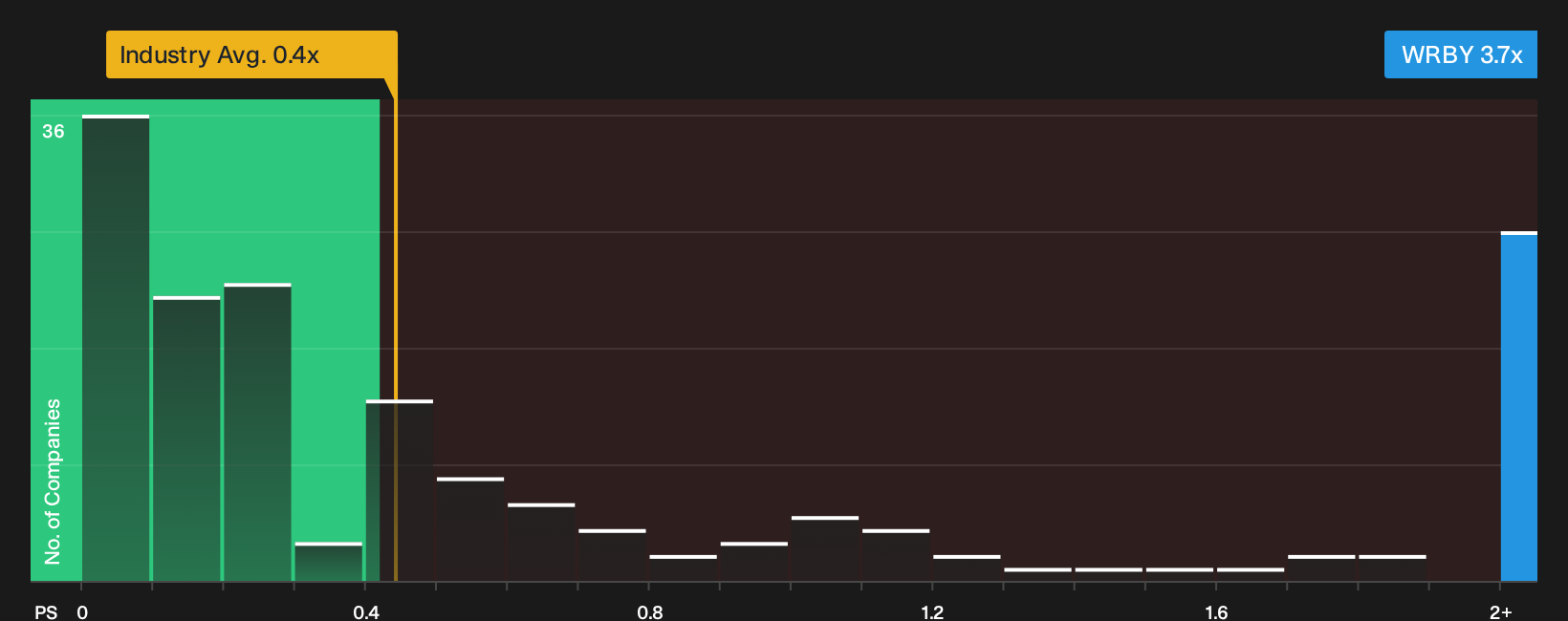
Analysts see Warby Parker as about 8% undervalued at a fair value of $29.92, yet the share price tells a different story when you look at sales multiples.
The stock trades on a P/S ratio of 3.7x. That is far higher than both the US Specialty Retail industry at 0.4x and an estimated fair ratio of 1.5x that the market could move towards over time.
Those gaps point to clear valuation risk if revenue growth or margins fall short of expectations, since investors are already paying a rich price for each dollar of Warby Parker sales. Which lens do you trust more: the analyst fair value or the current sales multiple?
See what the numbers say about this price — find out in our valuation breakdown.
Next Steps
Mixed on Warby Parker so far, or starting to form a clear view? Pull up the data, weigh both the optimism and the concern, then pressure test your own thesis with the 2 key rewards and 1 important warning sign
Looking for more investment ideas beyond Warby Parker?
If Warby Parker has you thinking more broadly about where your money works hardest, use the same lens across sectors and uncover fresh opportunities before everyone else catches on.
- Target resilient income potential by scanning companies that appear in the 7 dividend fortresses and focus on businesses where cash returns to shareholders play a central role.
- Hunt for mispriced quality by reviewing the 28 high quality undervalued stocks and see which stocks combine supportable fundamentals with what looks like a discounted entry point.
- Prioritize capital protection first by filtering for the 31 resilient stocks with low risk scores and highlight businesses with more robust balance sheets and gentler risk profiles.
This article by Simply Wall St is general in nature. We provide commentary based on historical data and analyst forecasts only using an unbiased methodology and our articles are not intended to be financial advice. It does not constitute a recommendation to buy or sell any stock, and does not take account of your objectives, or your financial situation. We aim to bring you long-term focused analysis driven by fundamental data. Note that our analysis may not factor in the latest price-sensitive company announcements or qualitative material. Simply Wall St has no position in any stocks mentioned.
Have feedback on this article? Concerned about the content? Get in touch with us directly. Alternatively, email editorial-team@simplywallst.com