
Nvidia hit a new high, and AI computing power and technology themes staged a major counterattack! Non-agricultural agriculture only increased by 29,000+ oil prices declined, and the Fed's interest rate hike is betting on a major cooling
The Zhitong Finance App learned that after the release of the latest non-agricultural data, the market bet on the Federal Reserve's October interest rate hike, combined with a series of actively catalyzed falls in international oil prices to break 100 US dollars, jointly driving the US stock market and technology stocks in the European market to stage a major counterattack. In particular, recently facing heavy upward pressure on US bond yields of 10 years or more and a sharp rise in interest rate hike expectations, which together continue to suppress the DCF valuation system, the rise in US stocks at the beginning of Friday was the most aggressive. The stock price of Nvidia, the “supremacy of AI computing power,” directly hit a record high stock price point after opening.
The number of new jobs added in the US in September fell short of expectations, and wage growth slowed, indicating that at a time when costs are rising, employers are showing a certain degree of caution in recruitment. Richard Moody, chief economist at Regions Financial Corp. said, “I'm surprised that this has been going on for over a year. The situation of low recruitment and low layoffs still exists.”
Overall, non-agricultural cooling and falling oil prices are opening a “valuation decompression window” for AI computing power stocks and a wider range of global technology stocks that rely on the DCF denominator side cooling valuation system. Non-farm payrolls in the US increased by only 29,000 people in September, and wage growth slowed at the same time, driving the market to further reduce the Fed's interest rate hike bets. At the same time, expectations of the recovery of crude oil supply in the Middle East and the coordinated release of strategic inventories in Europe drove Brent crude oil below $100 per barrel. Employment and energy prices both cooled down, and US bond yields fell, adding further macro-catalysts to the rebound in European and American technology stocks. The rise in Nasdaq 100 futures extended to about 1.2%.
The J.P. Morgan strategist team recently released a research report saying that the agency is particularly optimistic about rearrangement opportunities created by easing position congestion, falling valuations, and profit resilience, focusing on AI semiconductors. According to the latest research report released by the agency, since June, semiconductor's earnings forecast per share for the next 12 months has been raised by about 30%, and software profit forecasts have not improved accordingly; the capital expenditure forecasts for hyperscale cloud vendors quoted are: about US$950 billion in 2026, US$1.4 trillion in 2027, and about US$3 trillion in 2030.
According to data released by the US Bureau of Labor Statistics on Friday, the number of non-farm payrolls increased by 29,000 last month, and the data for the previous two months was significantly revised at the same time. This increase is lower than all of the agency's benchmark forecasts in the survey reports covering hundreds of economists before the official release of the non-agricultural data. The unemployment rate rose to 4.2%, partly reflecting a significant increase in the size of the workforce.
Strong consumer spending and strong corporate investment have supported recruitment, yet many employers that focus on cost control are reluctant to expand their workforce. However, layoffs are still at a low level.
“The non-farm payrolls data for September shows that after the impressive data for August, the employment growth rate has slowed. Coupled with rising unemployment, this report does not support the Federal Reserve's interest rate hike in October. We expect the Federal Reserve to keep interest rates unchanged for the rest of the year.” Bloomberg Intelligence economists Anna Wang, Andrew Sahel, and Eliza Winger said.
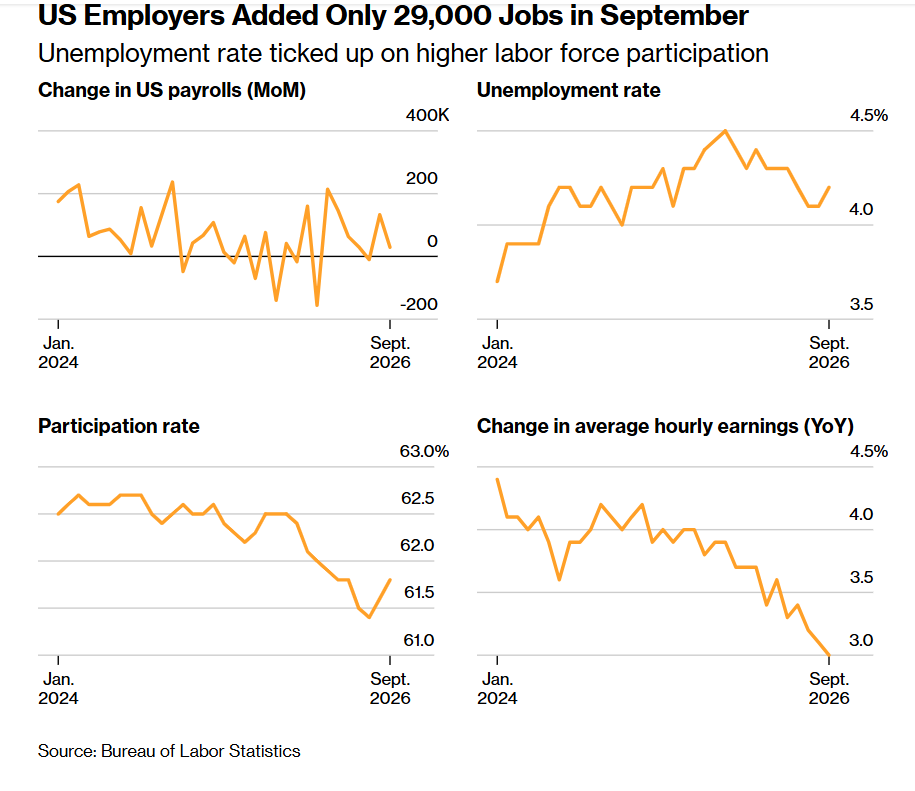
Since the unemployment rate is still at a historically low level, Federal Reserve officials can still focus their attention on inflation when considering when to raise interest rates again. After the data was released, traders in the interest rate futures market drastically lowered their bets on the Federal Reserve's interest rate hike in October. After the non-agricultural data was released, the probability that the interest rate futures market expected an interest rate hike in October was only less than 10%, but at one point it soared to a probability mark close to 80% before the non-agricultural products were announced.
“For the Federal Reserve, this data should be enough to completely eliminate the possibility of an October rate hike,” Thomas Simmons, chief US economist from Wall Street financial giant Jefferies, said in a report. “Now it seems that policymakers who stress that there is still some time before they need to raise interest rates again are more likely to remain patient.”
After the data was released, S&P 500 futures rose, and long-term US Treasury yields and the US dollar index fell significantly.
This is the last employment report before the November midterm elections. It is expected that economic conditions will be an important factor affecting the voting of American voters. The labor market is part of it, but while consumers continue to spend, concerns about the lingering cost of living remain the focus of attention.
According to information, non-agricultural segmented statistics show that the number of people employed in local governments in the US has declined, and the number of employed people has also declined in some of the industries most vulnerable to artificial intelligence, including the information industry, professional and commercial services, and finance. Investments in data centers and other artificial intelligence-related infrastructure have supported the expansion of recruitment in the construction and manufacturing industries.
There has also been an increase in employment in the healthcare industry and the leisure and hospitality industry. Meanwhile, the average hourly wage increased slightly by 0.1% from August, lower than expected; the year-on-year increase was 3%, the slowest annual wage growth rate since 2021.
The employment report consists of two surveys: one for businesses to compile data on non-farm payrolls; the other for households, which provides a basis for statistics such as unemployment rate and labor participation rate. Household surveys also have independent indicators of the number of employed people, which rose sharply during the month.
The labor participation rate — the share of the population working or actively seeking workers — rose to 61.8% in September, a four-month high.
However, the stability of the labor market also has its drawbacks. In some cases, insufficient staff mobility makes workers feel trapped in jobs they don't like. It also makes it harder for the unemployed to find another job. This may explain why many Americans are pessimistic about the job market: fewer people think jobs are plentiful, while more people think jobs are hard to find.
29,000 non-agricultural investors repulsed interest rate hike bets, and technology stocks ushered in a “valuation decompression window”
The semiconductor and AI computing power sector, which was previously doubly suppressed by rising long-term interest rates and rising expectations of interest rate hikes, is becoming an important main line in this round of counterattacks. The European technology sector had already risen about 2.1% before the announcement of the non-agricultural industry, led by semiconductor equipment leaders; in the US early trading market, AI computing power leader Nvidia strengthened the most. At 21:30 Beijing time, the US stock market directly rose more than 2% to a record high of 236.420 US dollars, and the total market value was an astonishing 5.7 trillion US dollars. For AI infrastructure companies whose profit expectations are still improving, the easing of interest rate pressure means that valuation offsets profit growth is being reduced, and as a result, the market has ushered in a positive window to shift from “killing valuation” to “taking over profits.”
Non-farm payrolls are cooling at the same time, compounded by a recovery in crude oil supply and a fall in international oil prices, easing the two forces suppressing technology stocks — policy pressure on further interest rate hikes, and high interest rates are squeezing the valuation of forward profits. Non-farm payrolls in the US increased by only 29,000 in September, which is significantly lower than the market's expectations of about 90,000 people; the total number of employed people in July and August was lowered by 60,000. At the same time, the average hourly wage increased by only 0.1% month-on-month and 3.0% year-on-year, the unemployment rate rose to 4.2%, and the labor participation rate increased to 61.8%. This set of data can be described as significantly weakening the basis for “employment and wages continue to overheat, forcing the Federal Reserve to quickly raise interest rates again”; the rise in the participation rate also shows that part of the rise in the unemployment rate is due to more people entering the labor market, and it cannot all be explained as worsening layoffs.
The global interest rate futures market immediately lowered its austerity bets. The latest US stock market prices after the opening of the US stock market at 21:30 on October 2, Beijing time, showed that the probability of interest rate hikes in October fell to less than 10%; US two-year, ten-year, and 30-year Treasury yields fell by about 7, 6, and 4 basis points, respectively, to 4.716%, 5.176%, and 5.569%, while the US dollar index fell by about 0.2%. Short-term yields are most sensitive to policy expectations, and the decline is even greater; the simultaneous decline in the long term provides a direct buffer for stock valuations and additional corporate financing costs.
The fall in oil prices added another layer of support to this “big wave of decompression of valuations,” and this change occurred before the non-agricultural industry was announced. As of 20:00 Beijing time, Brent crude oil was reported at $99.78 per barrel, down 2.47%; WTI reported $89.55, down 3.57%. However, in a simple comparison of the pre-war closing price on February 27, the two still rose by about 37.7% and 33.6%, respectively: the energy shock is easing, and their cumulative increase has not disappeared.
The supply-side improvements are substantial: According to statistics quoted by people familiar with the matter, the east-west pipeline transportation volume is close to 6 million barrels per day, accounting for about 86% of the design capacity of 7 million barrels; after deducting usage from West Coast refineries, the crude oil that can be exported is about 4.5 million barrels per day. Meanwhile, France is promoting the coordinated release of strategic stocks. The latest plans under discussion include Europe's release of about 50 million barrels of diesel, and the release of about 50 million barrels of crude oil by members of the International Energy Agency. It is worth noting that this corresponds to the pipeline transportation restoration and reserve release plan, which cannot be directly equivalent to the fact that G7 has increased production or completed release.
However, it should be noted that the military risk between the US and Iran still exists: the US continues to send additional military forces to the Middle East, while Iran is preparing to expand its counterattack in the event of an attack. The current oil price correction reflects the suppression of risk premiums due to improved supply, which is not enough to indicate that the geopolitical conflict has been reduced.
From “killing valuations” to “taking over profits”: J.P. Morgan sees a new round of upward momentum in the technology sector! Can the AI computing power theme and broader technology stocks break into the “profit takeover zone”?
These changes do constitute an important positive catalyst for global technology stocks, particularly semiconductors and AI computing power topics. The core is that valuation resistance to profit growth is being reduced. However, the reaction of global long-term bonds needs to be distinguished according to the trading period: US bonds have clearly declined after non-agricultural production; the yield on British ten-year treasury bonds had previously fallen to about 5.33% in early European trading as oil prices fell. The main trading period for Japanese cash came to an end earlier than the US non-farm payrolls announcement. The local 10-year yield is still around 3.1% high, affected by Tokyo inflation and the Bank of Japan's policy expectations. Therefore, it can now be confirmed that the pressure on the European and American bond markets will ease, and the probability that the pressure on the Japanese bond market will ease is also heating up sharply.
For popular stocks related to the AI computing power theme, the drastic decline in interest rates/US bond yields was the first improvement in the present value of future cash flow. AI infrastructure construction requires first investing in chips, servers, networks, and power facilities, and then gradually cashing out cloud service revenue; the later the revenue is realized, the more sensitive it is to the discount rate. Previously, even if orders and profit expectations continued to rise, this could be offset by shrinking price-earnings ratios. Today, if long-term interest rates fall steadily and profit forecasts continue to rise, stock prices will have a chance to enter the “profit takeover zone” — the rise can rely more on profit growth, and at the same time receive support from reduced valuation pressure.
A bullish position research report recently released by J.P. Morgan Chase provides an industry and valuation basis for this judgment: J.P. Morgan's estimated data shows that the ratio of the Big Seven's expected price-earnings ratio for the next 12 months to the market is ten years low, while the earnings forecast for semiconductors per share for the next 12 months has increased by about 30% since June. The former means that the relative valuation premium has shrunk significantly, while the latter means that profit expectations are still expanding. The fall in the combined ratio of the two helps the market to refocus on “whether profit improvement can continue”. This is also the reason why semiconductors may benefit more than the technology sector, which lacks profit improvement.
From the perspective of actual AI inference engineering, the intelligent applications represented by Muse and Astra advance computational requirements from “generating an answer once” to “continuously completing a task.” A task often involves planning, retrieval, tool calls, code execution, and result verification, and may involve retrying and collaborating with multiple agents. This will simultaneously increase the need for accelerator computing, CPU task orchestration, memory and context caching, persistent storage, and network data exchange, extending the benefits of AI infrastructure investments from GPUs to server CPUs, HBM and DRAM, enterprise SSDs, and high-speed interconnections. Multi-step execution and tool cycles are important characteristics that differentiate agent workloads from simple question-and-answer.
Falling interest rates may also improve the investment economy of data center projects: in the case where credit spreads remain stable, falling risk-free interest rates can help reduce the cost of additional financing, increase the net present value of the project, and make it easier to advance some expansion plans near the return threshold. As a result, a positive chain worth paying attention to has been formed: the expansion of the use of smart devices brings about demand for computing power, easing financing pressure to improve construction feasibility, and improving delivery and utilization rates into revenue and profit.
According to a research report released by J.P. Morgan Chase, the overall valuation adjustments of the seven major US tech giants (i.e. Magnificent Seven, Mag 7), which account for the high weight of US stocks, may have been largely completed, and profit growth is expected to once again become the main force supporting stock prices; J.P. Morgan said that the ratio of the Big Seven's expected price-earnings ratio over the next 12 months to the market has dropped to about one standard deviation below the historical median, which is at a ten-year low.
Apple, Microsoft, and Google parent companies Alphabet, Amazon, Meta, Nvidia, and Tesla are not only an important part of the US stock market capitalization weighted index, but also influence global AI investment expectations through AI chips/AI semiconductors, cloud computing, AI applications, and a wide range of terminal layouts. Previously, up to the end of 2025, the market value of the S&P 500 super bull market expanded by about 30 trillion US dollars over a three-year period. The seven major tech giants and the broader AI computing power infrastructure supply chain were important driving forces. Therefore, changes in the profits and valuations of the Big Seven can simultaneously affect the performance of the benchmark index, risk appetite in the global stock market, and the growth prospects of the AI computing power industry chain.
The J.P. Morgan strategist team believes that as the technology sector in the US stock market decreases in bullish position congestion, strong profit performance, and more realistic valuations, technology stocks will regain some of the momentum lost since the end of the first half of the year, so investors are advised to re-enter this sector when the market recovers.
Technology stocks are still leading the S&P 500 index by a large margin this year, but gains have cooled down in recent months, and the market is worried that huge investment in AI may not bring the returns that optimists assume. Within the technology sector, the valuation of the “Big Seven” of US stocks is at its lowest level in 10 years, while semiconductor stocks are coming out of a difficult phase — Anthropic's Dario Amodei and OpenAI's Sam Altman have previously called for coordination to slow down the development of advanced AI, making the sector's plight worse.
“We doubt there will be any significant slowdown in the end, as this race is still a game about survival and winner-take-all,” wrote the J.P. Morgan Stock Strategy team led by Mislav Matejka. J.P. Morgan said that although the increase in the first half of the year is unlikely to be repeated, significant opportunities still exist.
The “Big Seven” valuation is not an isolated judgment of J.P. Morgan Chase. According to data from the Morgan Stanley Wealth Management Global Investment Committee, the valuation premium of the “Big Seven US stocks” compared to 493 other stocks in the S&P 500 index is currently only 10%, the lowest level in more than 10 years, and the seven giants as a whole still have an annual profit growth advantage of about 45%.
Lisa Shalett, chief investment officer at Morgan Stanley Wealth Management, wrote in the report: “By contrast, we think these hyperscale cloud giants simply look too cheap right now.”