
Unusual Options Activity Is Flashing in This Beaten-Down Stock. 2 Ways to Play It Here.
Markets ended in positive territory on Thursday, barely, with the S&P 500 up 0.19%, the Dow and Nasdaq Composite both up 0.04%, and the Russell 2000 up 0.35%.
As I write this, minutes before the markets open Friday, S&P 500 futures are up nicely on lower oil prices. However, the federal government reports the U.S. nonfarm payrolls report for September this morning. Economists expect the unemployment rate to remain unchanged at 4.1%. Any deviation could move markets on the week’s final trading day.
In yesterday’s options trading, volume was 64.87 million, up 1.79 million from the 90-day average. Calls outnumbered puts 54% to 46%. DTEs (days to expiration) of six days or more accounted for 41% of the contracts traded. That’s where I focus for unusual options activity.
There were 36 options with Vol/OI (volume-to-open-interest) ratios of 20.0 or more on the day. One of those was Weyerhaeuser’s (WY) April 16/2027 $20 call. Today’s commentary focuses on it.
Have an excellent weekend.
The WY Option in Question

The call’s last trade was 8% OTM (out-of-the-money), while the last trade price of $1.09 leaned bearish. Total volume was 2,632 contracts, 23.29 times the open interest, and 19% of the day’s volume, which was 5.7 times the 30-day average and the second-highest in the past year. Options investors confirmed the bearish bias yesterday with a P/C volume ratio of 1.49.
Options flow also tells us more about investor sentiment for Weyerhaeuser.
Of the eight trades of 100 contracts or more (DTEs of six days or longer), six were for puts, with put volume outnumbering call volume 7,400 to 2,899. Nothing changes if you include all expiration dates. Interestingly, the put trade prices are all over the place. I count two at the midpoint, none at the bid or ask, three leaning to the bid, and one to the ask. So, at least from an institutional investor perspective, investor sentiment is mixed.
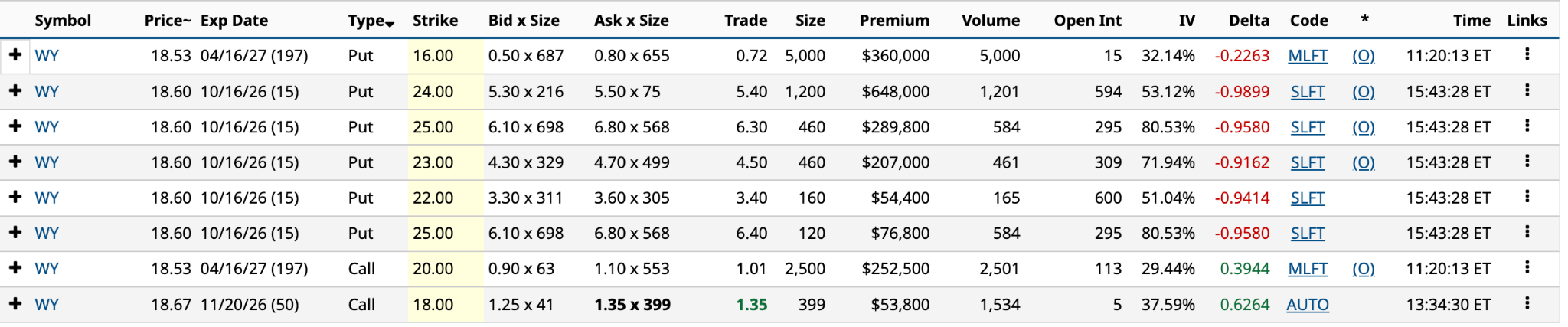
I want to focus on two options trades: the unusually active April 16/2027 $20 call for 2,500 contracts and the April 16/2027 $16 put for 5,000 contracts.
Here’s why.
The Options Strategy in Play

As you can see, the two trades shown above took place yesterday at 11:20:13 a.m. ET. The trade sizes point to a 1:2 Ratio Risk Reversal. The only question is whether it is bullish or bearish.
Looking at the trade prices, the $0.72 trade price for the 5,000 puts is much closer to the ask than the bid, suggesting the institution was looking to go long the puts for downside protection. As for the call’s trade price of $1.01, it leans toward the ask price, but it’s only moderately bullish.
Let’s assume that the institution sold 2,500 calls and bought 5,000 puts. That would be a bearish 1:2 ratio risk reversal. Here’s the math on that.
1) Sold 2,500 April 16/2027 $20 calls for $252,500 premium
2) Bought 5,000 April 16/2027 $16 puts for $360,000
3) A net debit of $107,500, or $0.215 based on 500,000 shares
4) The downside breakeven is $15.785 [$16 strike price - $0.215 net debit]
5) The upside breakeven is unlimited
6) The maximum profit is $7,892,500 [5,000 put contracts * $16 strike price * 100 - $107,500 net debit] if the share price goes to $0
7) The maximum loss is unlimited. It depends on how high the share price rises above the $20 call strike price at expiration.
A bullish 1:2 ratio risk reversal would involve the institution selling 2,500 OTM $16 puts and buying 5,000 OTM $20 calls.
If the same institution were on the opposite side of both trades in the bearish ratio risk reversal, the options strategy would be a Short Ratio Spread, which would involve buying 2,500 OTM $20 calls and selling 5,000 OTM $16 puts. Here’s the math.
1) Bought 2,500 April 16/2027 $20 calls for $252,500
2) Sold 5,000 April 16/2027 $16 puts for $360,000 premium
3) A net credit of $107,500, or $0.215 based on 500,000 shares
4) The maximum profit is unlimited. If, for example, the share price is $30 at expiration, the profit is $2,607,500 [$30 share price - $20 strike price * 2,500 call contracts * 100 +$107,500 net credit].
5) The maximum loss is $7,892,500 [5,000 put contracts * $16 strike price * 100 - $107,500 net credit].
6. Between $16 and $20, the institution keeps the $107,500 net credit.
Now, let’s assume that the institution that did the bearish ratio risk reversal already owned 500,000 Weyerhaeuser shares. The options strategy becomes a Ratio Collar, which hedges the existing position.
1) The 5,000 long $16 puts provide a $16 floor.
2) The $252,500 premium from 2,500 short $20 calls reduces the cost of the above hedge by 70%.
3) If the shares go higher rather than lower, 250,000 shares remain uncovered, providing unlimited upside
The Bottom Line on Weyerhaeuser Stock
One reason I wrote about Weyerhaeuser today is that it hit a new 52-week low on Wednesday. That day, I recommended that investors consider its beaten-down stock.
“Trading at its lowest level in five years, Weyerhaeuser is a worm ready to turn. Of the three stocks, WY is the best value at current prices,” I wrote.
Whether the institution that made these two trades was bullish or bearish about Weyerhaeuser, we’ll never know. The potential options strategies utilized, however, show a willingness to ride the stock’s volatility or lack thereof over the next 197 days.
On the date of publication, Will Ashworth did not have (either directly or indirectly) positions in any of the securities mentioned in this article. All information and data in this article is solely for informational purposes. For more information please view the Barchart Disclosure Policy here.