
Will Marine Corps Satellite Contract Change Viasat Stock's Narrative
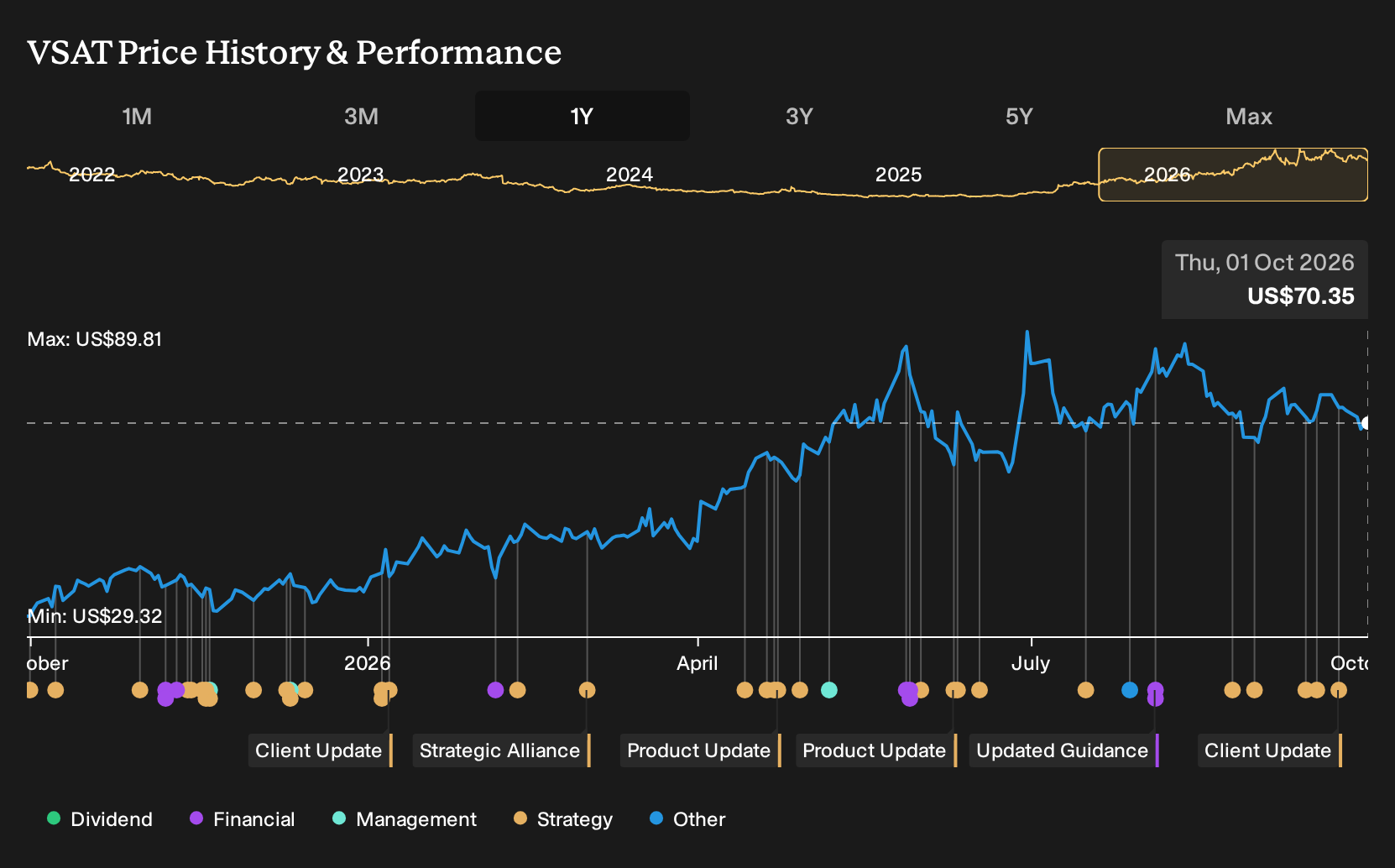
- In September 2026, Viasat, through its Inmarsat Government subsidiary, secured the MECS2 IDIQ contract from the U.S. Space Force CSCO, with an initial US$42 million task order under a potential seven year, up to US$307 million ceiling to deliver fully managed SATCOM services for the U.S. Marine Corps.
- The award leans on Viasat’s integrated L, Ku and Ka band network, including ViaSat 3 capacity and 24x7 NOC and SOC support. This reinforces its role as a managed services partner for complex, secure government connectivity needs.
- Next comes the impact on Viasat’s investment narrative, using this long term USMC satellite services award as the key reference point.
Scan the government and infrastructure stocks most closely aligned with Viasat’s defense connectivity story using our hand picked 31 resilient stocks with low risk scores for ideas with resilient profiles.
Viasat Investment Narrative Recap
To own Viasat, you need to believe the heavy investment in satellites and Inmarsat integration eventually supports steadier cash generation from secure connectivity. The MECS2 win fits that story because it reinforces demand for managed, multi orbit services. It does not change the near term reality, though. Capital intensity and leverage still sit at the center of the thesis.
The key short term swing factor is whether new contracts help offset pressure from declining U.S. fixed broadband subscribers and rising competition from rivals like Starlink and Amazon Kuiper. The biggest risk remains that earnings stay weak as spending stays high. This Marine Corps award helps revenue visibility but does not remove that earnings risk.
The Delta and T Mobile airline connectivity context matters here. Delta opted against Starlink and is using Viasat today, with Amazon Leo planned from 2028. That keeps Viasat embedded in a high profile commercial client while competition stays very real on the aviation side.
For you as an investor, that mix of contracts across airlines and defense customers is part of the same question: Does Viasat convert network breadth into durable, higher quality cash flows before debt and competitive pressure bite too hard? The MECS2 deal strengthens the operational story on government SATCOM, but execution on profitability still sits unresolved.
Viasat Forecasts Behind The MECS2 Story
Viasat's narrative projects US$5.5b revenue and US$626.3m earnings by 2029. That framework assumes 6.2% yearly revenue growth and an earnings increase of about US$655.7m from a loss of US$29.4m today.
Discover why Viasat's fair value suggests a 48% potential upside to its current price, an opportunity that could diminish quickly.
Exploring Other Perspectives
One alternate view treats competition risk as the real story for Viasat. The most cautious analysts had expected only 3.9% annual revenue growth and about US$586.0m in earnings by 2029, versus US$626.3m in the baseline. Those projections came before this MECS2 contract, so opinions may evolve once the new data is absorbed.
Explore 6 other Viasat fair value estimates, including one that suggests as much as 22% downside from the current price.
Reach Your Own Conclusion
Don't just follow the ticker. Dig into the data and build a conviction that's truly your own.
- A great starting point for your Viasat research is our analysis highlighting 3 important warning signs that could impact your investment decision.
- See our latest analysis for Viasat. The report includes a comprehensive fundamental analysis summarized in a single visual, the Snowflake, making it easy to evaluate Viasat's overall financial health at a glance.
Looking For More Investment Ideas Beyond Viasat?
If the Viasat story has sharpened your thinking about risk, cash flow quality and contract visibility, it can be useful to compare it with other businesses that share some of those traits or approach them very differently.
The Simply Wall St Screener lets you quickly shift from one detailed case like Viasat to a broader watchlist built around the factors that matter most to you, whether that is balance sheet strength, income potential or valuation support.
- For investors who care most about robust finances and cleaner balance sheets, start by scanning our list of solid balance sheet and fundamentals (25 results) to see which businesses align with that focus.
- If value is your main filter and you prefer companies that appear priced below what their fundamentals imply, take a look at our 28 high quality undervalued stocks to see what else fits that profile.
- For readers who want income as well as resilience, consider building a watchlist from our 7 dividend fortresses and see which payers match your yield and stability goals.
This article by Simply Wall St is general in nature. We provide commentary based on historical data and analyst forecasts only using an unbiased methodology and our articles are not intended to be financial advice. It does not constitute a recommendation to buy or sell any stock, and does not take account of your objectives, or your financial situation. We aim to bring you long-term focused analysis driven by fundamental data. Note that our analysis may not factor in the latest price-sensitive company announcements or qualitative material. Simply Wall St has no position in any stocks mentioned.
Have feedback on this article? Concerned about the content? Get in touch with us directly. Alternatively, email editorial-team@simplywallst.com