
3 Utility Stocks To Watch As Lower Rates Lift Dividend Appeal
Soft September jobs data, sliding Treasury yields, and an AI-fueled surge in Nvidia have pulled attention back to rate sensitive corners of the market, including dividend paying utilities. Income focused investors watching the Federal Reserve’s next move now face a rare mix of lower yield pressure and higher equity excitement. This article explains how that backdrop touches three specific utilities from our screener and why their reaction to these headlines might matter for your portfolio decisions.
The three utilities highlighted next are only a sample from this rate sensitive corner of the market, and the full screen surfaced 15 more U.S. dividend paying utility companies with similarly detailed narratives that are not covered below. If you want to move straight from headlines to hands on analysis, head into the U.S. Dividend-Paying Utility Stocks screener to identify, compare, and size up your highest conviction ideas.
ONE Gas (OGS)
Overview: ONE Gas is a regulated natural gas distributor serving about 2.3 million customers across Oklahoma, Kansas, and Texas through extensive pipeline assets.
Operations: ONE Gas generates its revenue entirely from regulated public utilities in the United States, recording about US$2.3b from this segment.
Market Cap: US$4.5b
ONE Gas fits the U.S. Dividend-Paying Utility Stocks theme as a pure regulated gas distributor, where rate-approved cash flows and dividend policy sit under the same roof for income focused investors watching interest rate moves.
"Sustained population growth and urbanization in Texas, Oklahoma, and Kansas is fueling above-trend new customer additions, including a 9% year-over-year jump in new meters installed, that supports persistent, organic top-line revenue growth.
What ultimately happens to margins and dividend headroom may hinge on how one less visible cost and funding pressure develops from here.
That hidden pressure is exactly where the full narrative for ONE Gas connects the dots between funding costs, rate decisions, and how ONE Gas could keep its income story accelerating.

OGE Energy (OGE)
Overview: OGE Energy generates and sells electricity across Oklahoma and surrounding areas, serving residential, commercial, and industrial customers within a regulated utility framework.
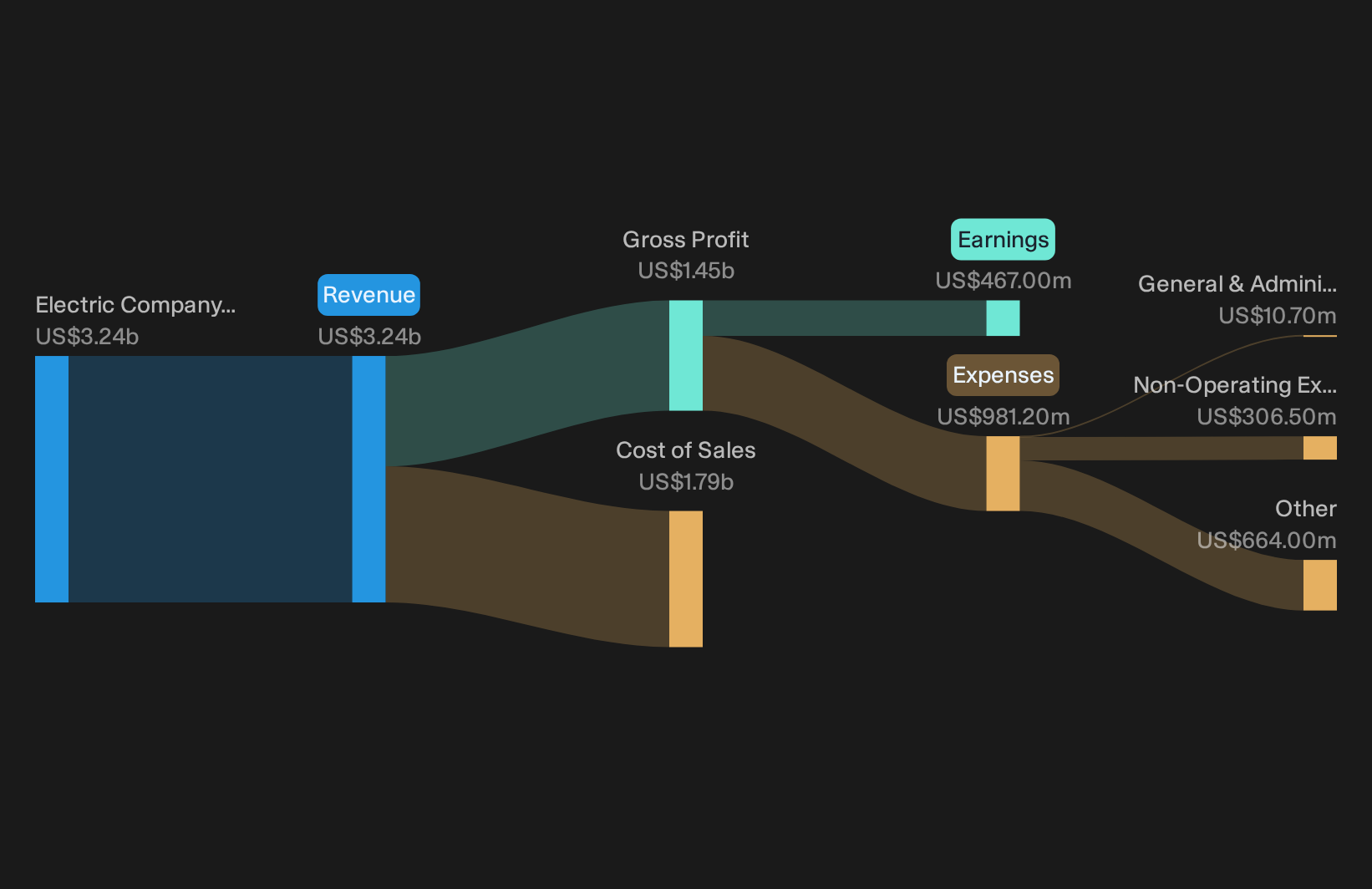
Operations: OGE Energy generates all of its US$3.2b revenue from its Electric Company segment in the United States, reflecting a focused regulated utility model.
Market Cap: US$9.4b
OGE Energy fits this dividend focused utility screen as a classic regulated electric player, where rate structures, payout policy, and load growth intersect for income minded investors watching interest rate expectations reset after the latest jobs data.
"Progress in attracting energy intensive customers such as Google data centers, supported by long-term special contracts that include minimum charges, customer funded interconnection and 600 megawatts of associated solar capacity, along with 6 to 7 additional active large-load negotiations under the new Oklahoma large-load tariff, provides a pipeline of potential multi hundred megawatt commitments that can add to future revenue and earnings visibility."
What happens to margins and dividend breathing room will likely turn on how one still unresolved regulatory and funding trade off is handled.
That trade off is exactly where the full narrative for OGE Energy shows how OGE Energy could turn tariff design, capital spending and new load into accelerating income potential, while also flagging the key regulatory risks.
New Jersey Resources (NJR)
Overview: New Jersey Resources is an energy services holding company that primarily runs a regulated natural gas utility with supporting clean energy and services arms.
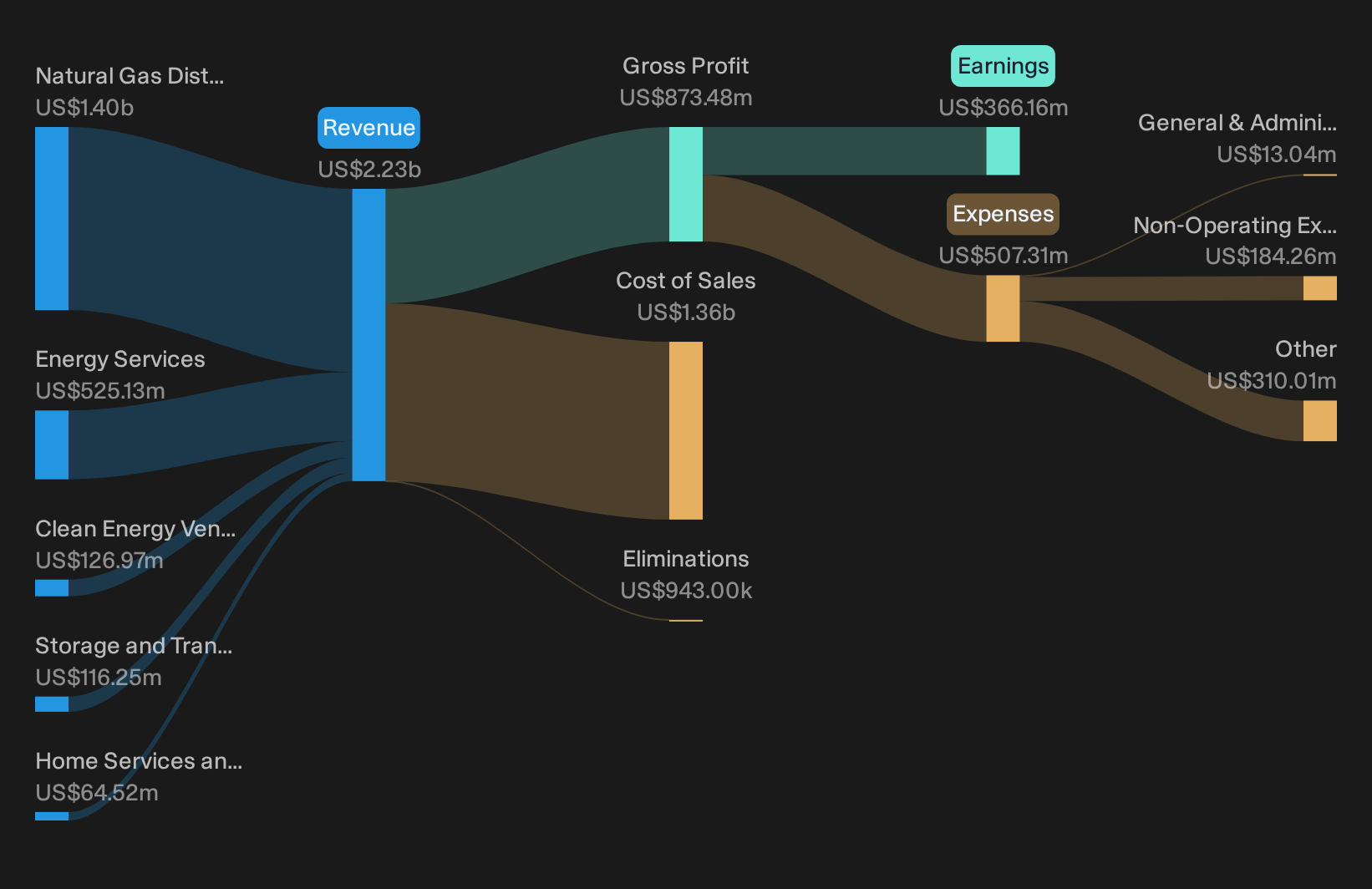
Operations: New Jersey Resources generates about US$1.4b from Natural Gas Distribution, with Energy Services, Clean Energy Ventures, Storage and Transportation, and Home Services adding roughly US$800 million.
Market Cap: US$5.2b
For a dividend focused utility screen built around regulated cash flows and rate sensitivity, New Jersey Resources plugs in neatly through its New Jersey gas network while adding a measured layer of clean energy and energy services that give income investors a different twist on the same theme.
"Expanding investments in energy efficiency through the SAVEGREEN program, which is benefiting from accelerated cost recovery, are poised to align with increasing state and federal decarbonization efforts, improving both near-term net margins and positioning NJR for long-term earnings growth."
What happens when one less visible funding and policy trade off shifts will likely set the tone for how durable those earnings feel.
That funding shift is exactly where the full narrative for New Jersey Resources shows how New Jersey Resources could turn policy trade offs into accelerating earnings power while highlighting the key pressure points.
Seeking Fresh Alternatives Before They Fly
Fresh ideas often move first. By the time every headline highlights a breakout, the ideal entry can slip away. Scan these under the radar lists while it matters and consider getting in earlier in your research process.
- Identify established payers that generate sizeable income and appear structured to handle market swings by reviewing the 7 dividend fortresses.
- Follow resilient operators that score well on financial strength and risk, then focus your research on the list of solid balance sheet and fundamentals (26 results).
- Explore long term infrastructure developments by examining grid build out companies included in the 40 power grid technology and infrastructure stocks.
This article by Simply Wall St is general in nature. We provide commentary based on historical data and analyst forecasts only using an unbiased methodology and our articles are not intended to be financial advice. It does not constitute a recommendation to buy or sell any stock, and does not take account of your objectives, or your financial situation. We aim to bring you long-term focused analysis driven by fundamental data. Note that our analysis may not factor in the latest price-sensitive company announcements or qualitative material. Simply Wall St has no position in any stocks mentioned.
Have feedback on this article? Concerned about the content? Get in touch with us directly. Alternatively, email editorial-team@simplywallst.com