
Is Imperial Oil (TSX:IMO) Fully Priced On Its Pathways CCS Commitment?
Imperial Oil (TSX:IMO) just moved deeper into the Pathways Carbon Capture and Storage alliance, joining peers and governments in a conditional plan to build shared CO2 infrastructure that could reshape long term oil sands emissions profiles.
Recent trading has been strong for Imperial Oil, with a 1-day share price return of 0.99% on September 30 and a 7-day share price return of 3.23%, even though the 30-day share price return declined 2.61%. The 90-day share price return of 9.84% and year to date share price return of 46.64%, alongside a 5-year total shareholder return of 376.28%, point to momentum that investors are weighing in relation to the Pathways CCS commitments and shifting views on long term emissions and policy risk.
Scan for other energy players trying to balance emissions plans with shareholder returns by reviewing our curated list of 8 resilient stocks with low risk scores.
Imperial Oil is already up 47% year to date and is now tied more closely to the Pathways CCS build out. Has most of the rerating played out, or does valuation still point to further potential upside?
Most Popular Narrative: 14% Overvalued
Analysts following Imperial Oil see fair value at about CA$157.12 using a 6.44% discount rate, compared with a last close of CA$179.36, which keeps the current rally firmly under the microscope.
The analysts have a consensus price target of CA$157.12 for Imperial Oil based on their expectations of its future earnings growth, profit margins and other risk factors. However, there is a degree of disagreement amongst analysts, with the most bullish reporting a price target of CA$209.0, and the most bearish reporting a price target of just CA$123.0.
See why 30 investors see Imperial Oil as 14% overvalued.
Result: Fair Value of CA$157.12 (OVERVALUED)
Still, Imperial Oil remains heavily tied to oil sands and ongoing high sustaining capex, which could pressure assumptions about long term demand and constrain future flexibility.
Find out about the key risks to this Imperial Oil narrative.
Another View on Imperial Oil Valuation
While analyst targets flag Imperial Oil as about 14% above fair value, the SWS DCF model points in the opposite direction. On that framework, the shares at CA$179.36 are trading well below an estimated future cash flow value of CA$305.02, which raises a very different question about what is already priced in.
Look into how the SWS DCF model arrives at its fair value.
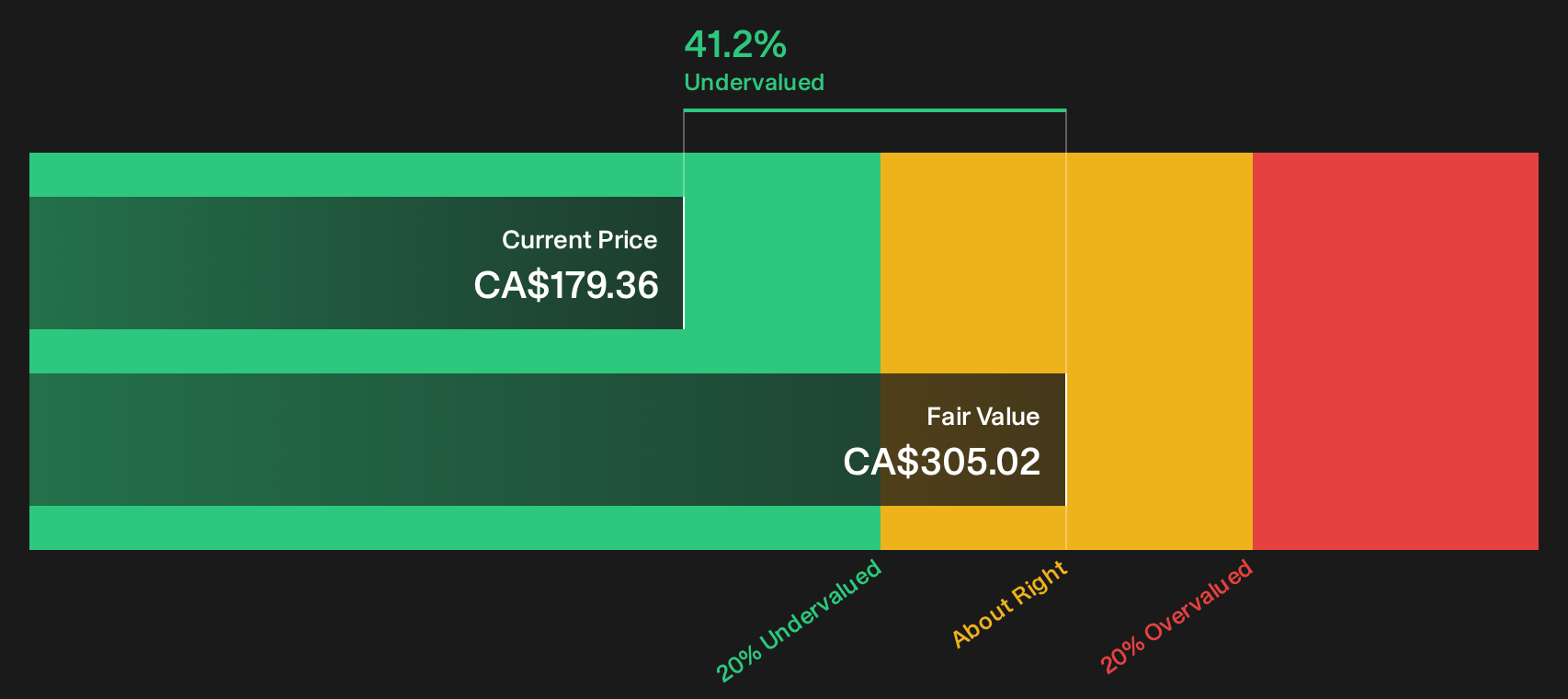
Simply Wall St performs a discounted cash flow (DCF) on every stock in the world every day (check out Imperial Oil for example). We show the entire calculation in full. You can track the result in your watchlist or portfolio and be alerted when this changes, or use our stock screener to discover 6 high quality undervalued stocks. If you save a screener we even alert you when new companies match - so you never miss a potential opportunity.
Next Steps
Mixed signals around Imperial Oil valuation and carbon commitments can pull you in different directions, so review the full picture quickly and weigh both the upside and the risk flags for yourself with 2 key rewards and 1 important warning sign.
Looking for more investment ideas beyond Imperial Oil?
If Imperial Oil already sits in your portfolio, use this moment to widen your opportunity set with a few focused screens that surface targeted ideas fast.
- Target potential mispricings by scanning companies that combine quality fundamentals with valuation support through our curated 6 high quality undervalued stocks.
- Build a steadier income stream by assessing businesses that prioritize resilient payouts with the 1 dividend fortresses.
- Protect the downside first by reviewing a list of solid balance sheet and fundamentals (7 results) that can handle tougher conditions without stretching their finances.
This article by Simply Wall St is general in nature. We provide commentary based on historical data and analyst forecasts only using an unbiased methodology and our articles are not intended to be financial advice. It does not constitute a recommendation to buy or sell any stock, and does not take account of your objectives, or your financial situation. We aim to bring you long-term focused analysis driven by fundamental data. Note that our analysis may not factor in the latest price-sensitive company announcements or qualitative material. Simply Wall St has no position in any stocks mentioned.
Have feedback on this article? Concerned about the content? Get in touch with us directly. Alternatively, email editorial-team@simplywallst.com