
Is Government LEO Partnership Altering The Investment Case For Nokia (HLSE:NOKIA)?
- ICEYE and Nokia Oyj recently announced a partnership to build secure, sovereign broadband LEO satellite communication systems for governments, targeting defense, border security, emergency services and disaster response, with initial satellites planned for launch in 2028.
- The collaboration pairs Nokia’s secure networking and defense-focused portfolio with ICEYE’s sovereign satellite mission expertise. This extends Nokia’s reach into government-grade, resilient connectivity where traditional terrestrial networks may be unavailable or compromised.
- We will look at how Nokia Oyj's investment narrative shifts as it leans into sovereign government LEO satellite connectivity with ICEYE.
Scan how Nokia Oyj fits into the broader push for resilient digital infrastructure and compare it with hand-picked 40 power grid technology and infrastructure stocks now shaping critical connectivity themes.
Nokia Oyj Investment Narrative Recap
Nokia Oyj may appeal to investors who think its combination of Network Infrastructure, Cloud and Network Services, and licensing can balance a more pressured Mobile Networks segment over time. The main near-term swing factor remains execution in mobile, where competition and flat demand are set against higher growth ambitions in cloud, fiber and private wireless.
The ICEYE LEO partnership adds an early option on government-grade, resilient connectivity rather than a clearly visible earnings driver in the next few years. The more immediate catalyst lies in delivering on forecast earnings growth despite currency headwinds, while key risks include pricing pressure, market share loss and earnings volatility.
Among the recent updates, the Zain KSA rollout of Nokia Deepfield Cloud Intelligence appears closest to the ICEYE story. Both point to a Nokia Oyj thesis built around resilient, data-driven networks in which operators and governments require clear visibility and control when traffic spikes or incidents affect critical services.
The Zain deployment sits squarely in one of Nokia’s potential catalyst areas, Cloud and Network Services, where recurring software and analytics can support margin mix if execution holds. It also highlights a risk: if competitors offer similar analytics at lower prices or with deeper hyperscaler partnerships, Nokia’s challenger position in some cloud and AI domains could limit how much benefit it ultimately captures.
Nokia Oyj Forecasts Behind the ICEYE LEO Optionality
For anyone weighing Nokia Oyj alongside the ICEYE LEO angle, the analyst model sitting underneath the story matters more than the headlines. Forecasts hinge on steady expansion in the broader network business rather than a sudden lift from sovereign satellite connectivity.
Analysts currently build their Nokia view on an annual revenue growth assumption of 4.8% over the next three years. That top line profile sits alongside an expected margin shift from 3.4% profitability today to 11.2% in three years, which would materially change how much earnings Nokia converts from each euro of sales if it plays out as expected.
On the earnings line, current profit of €702.0 million is projected to reach €2.6 billion by 2029 based on consensus estimates. That move implies an increase of roughly €1.9 billion in earnings, which is a large step up in absolute terms and means Nokia would need its higher margin segments and software heavy offerings to carry more weight inside the portfolio.
Those same expectations feed into the multiple story. To match analyst scenarios, Nokia would need to trade on a P/E of 22.0x in 2029 compared with 76.6x today, while the US Communications industry currently sits at 25.7x. That gap suggests the current valuation embeds much richer expectations than the long term framework analysts are using in their models.
On the capital structure side, forecasts assume the share count increases by 3.42% per year for the next three years. For anyone looking at per share metrics such as earnings or free cash flow, that projected dilution is worth factoring into return expectations, since it spreads any profit pool across a larger base of stock.
All of these drivers are discounted back using a rate of 7.87% in the Simply Wall St company model. That figure reflects the compensation analysts think investors require to hold Nokia given its risk profile, and it acts as the bridge between those forward estimates and today’s implied value.
Nokia Oyj's narrative projects €23.5 billion revenue and €2.6 billion earnings by 2029. This framework uses a 4.8% yearly revenue growth assumption and implies an earnings increase of about €1.9 billion from €702.0 million today.
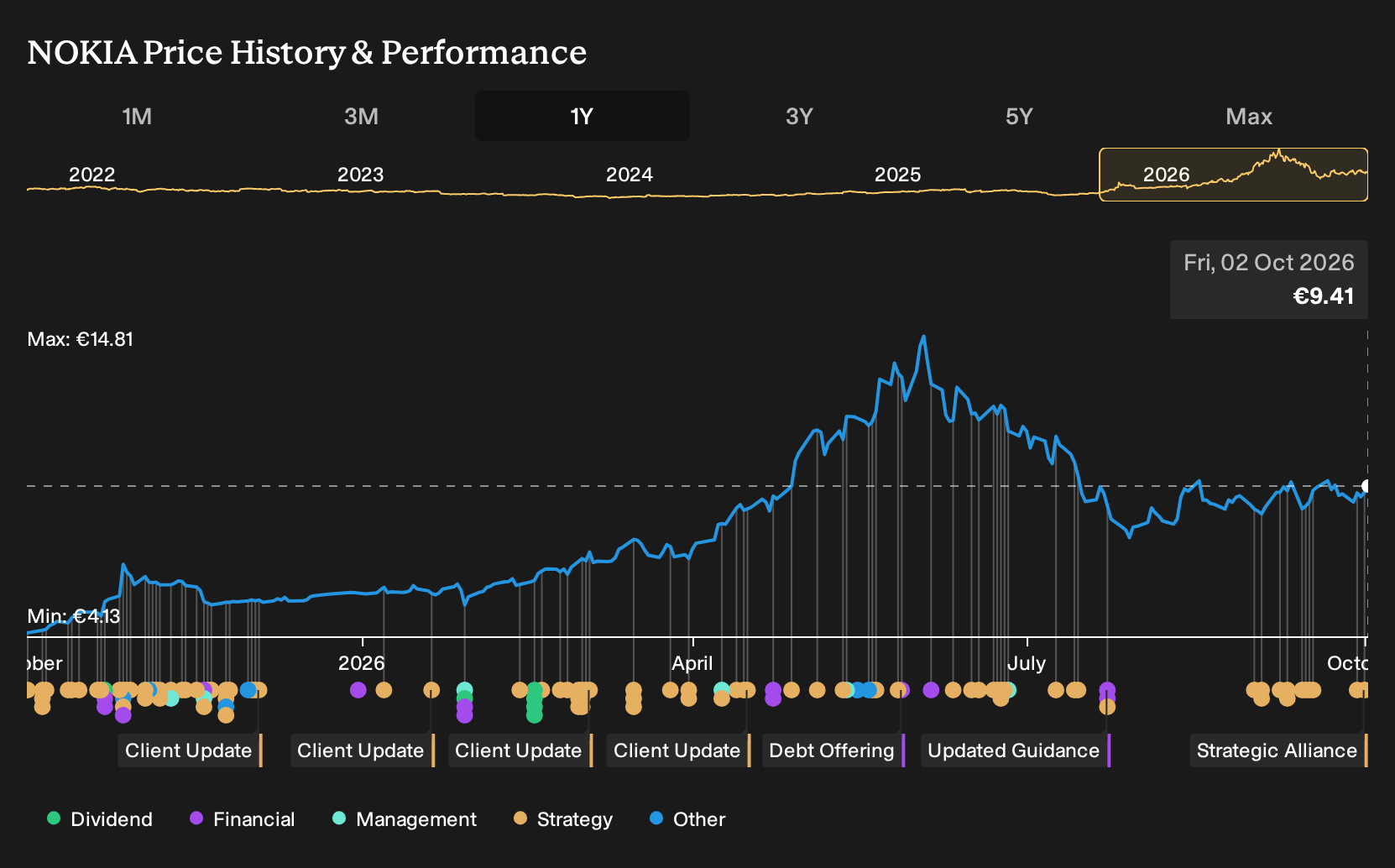
Uncover why Nokia Oyj's fair value indicates a 21% potential downside to its current price, leaving little room for error.
Exploring Other Perspectives
One alternate view leans hard into Nokia Oyj’s upside from hyperscalers. Those analysts were already pencilling in revenue rising toward €26.1b and earnings of €3.5b by 2029, well above consensus, assuming faster cloud and AI adoption. The new ICEYE LEO deal could either reinforce that optimism or prompt a reset. It is worth exploring both paths.
Explore 5 other Nokia Oyj fair value estimates, including one that suggests potential upside of up to 83% from the current price!
Decide For Yourself
Disagree with existing narratives? Extraordinary investment outcomes rarely come from following the herd, so consider trusting your own analysis.
- A great starting point for your Nokia Oyj research is our analysis highlighting 2 key rewards and 3 important warning signs that could impact your investment decision.
- See our latest analysis for Nokia Oyj. The report includes a comprehensive fundamental analysis summarized in a single visual called the Snowflake, making it easy to evaluate Nokia Oyj's overall financial health at a glance.
Looking For More Investment Ideas Beyond Nokia Oyj?
Once you have a view on Nokia Oyj, it can help to compare that thesis with other opportunities that match your own risk, income, and quality preferences. The Simply Wall St Screener offers several focused sets of companies that you can use as a starting universe rather than wading through the whole market.
- For investors hunting for mispriced quality, start with a curated pool of 196 high quality undervalued stocks that combine strong fundamentals with more modest expectations baked into their share prices.
- If durability matters most to you, narrow your research to a 228 resilient stocks with low risk scores that screens for businesses with sturdier balance sheets and more resilient risk scores.
- For those who prefer to get in early, scan a 616 high quality undiscovered gems that highlights under-the-radar companies with solid underlying metrics before they hit wider radars.
This article by Simply Wall St is general in nature. We provide commentary based on historical data and analyst forecasts only using an unbiased methodology and our articles are not intended to be financial advice. It does not constitute a recommendation to buy or sell any stock, and does not take account of your objectives, or your financial situation. We aim to bring you long-term focused analysis driven by fundamental data. Note that our analysis may not factor in the latest price-sensitive company announcements or qualitative material. Simply Wall St has no position in any stocks mentioned.
Have feedback on this article? Concerned about the content? Get in touch with us directly. Alternatively, email editorial-team@simplywallst.com