
Building Better Stock & Option Income – Part 10: A Week in the Life
Dual Edge Research publishes two powerful newsletters that work great individually — and even better together. The Bull Strangle Newsletter focuses on stocks and options, combining stock ownership with premium-selling strategies to generate consistent income and market-beating returns. The Smart Spreads Newsletter specializes in seasonal commodity futures spreads, offering a diversified approach with low correlation to equities. Together, they deliver a complete investment perspective — one focused on income, the other on diversification — all under one simple subscription.
Introduction
Over the past nine articles, we've examined every component of the Bull Strangle Strategy. We've discussed how stocks are selected, why earnings are avoided, how options and strike prices are chosen, why position sizing matters, how diversification strengthens a portfolio, and why existing holdings must continually earn their place through objective research.
This final article is different.
Rather than explaining why the process works, I'd like to show you how it works. One of the biggest misconceptions about the Bull Strangle Strategy is that the important decisions are made while the market is open. In reality, the opposite is true. The most important work is completed while the market is closed. By separating planning from execution, the strategy minimizes emotional decision-making and allows every trade to begin with objective research rather than market noise.
Friday: One Option Cycle Ends...and the Next Begins
Friday's closing bell marks the end of one option cycle and the beginning of the next.
One of the advantages of exchange-traded options is that expiration requires very little intervention. Covered calls that finish in the money are automatically assigned, stocks above the call strike are sold, and puts that finish in the money are automatically assigned, resulting in the purchase of additional shares. Options that expire out of the money disappear from the account. There is no need to exercise options or close every position before expiration manually. The exchange automatically handles those mechanics.
Once expiration has occurred, the focus immediately shifts from options to portfolio management. Which stocks remain? Which positions were called away? Which puts were assigned? Those answers establish the starting point for planning the next option cycle.
The Weekend Planning Window
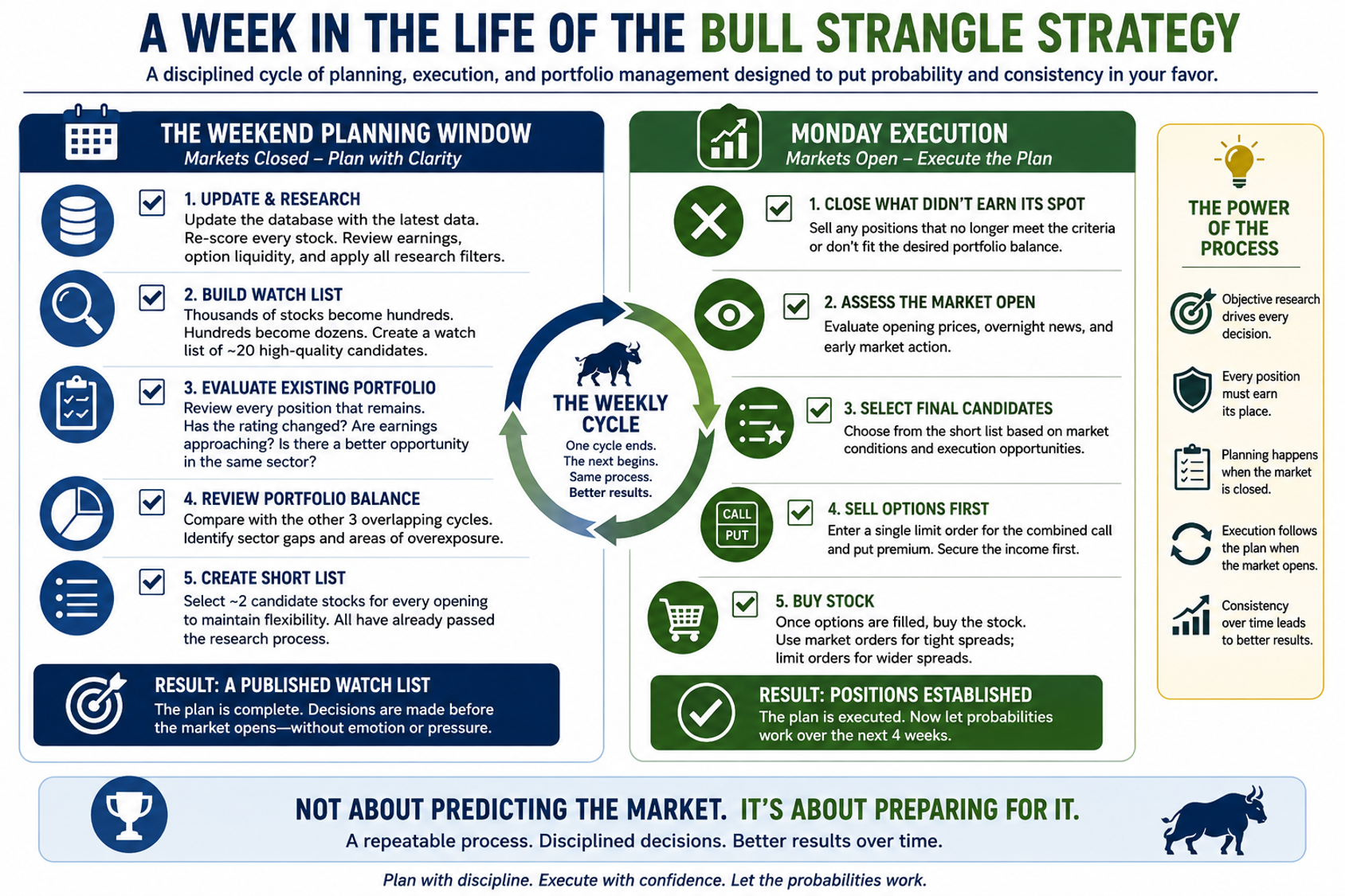
One of the defining characteristics of the Bull Strangle Strategy is the clear separation between planning and execution. The planning process begins immediately after Friday's option expiration and continues throughout the weekend, when the markets are closed, and there is no pressure to make immediate decisions. This is where the real investment work takes place.
The first step is updating the Bull Strangle database with the latest market data. Every stock is rescored using the Bull Strangle Ranking System, earnings calendars are reviewed, option liquidity is evaluated, and each research filter described throughout this series is applied. Thousands of stocks are systematically reduced to a focused watch list of approximately 20 high-quality candidates that represent the strongest opportunities for the next option cycle.
Planning, however, doesn't end with the watch list. The existing portfolio is evaluated before a single new trade is considered. Every stock that remains after expiration must earn its place again using the same objective research applied to every new candidate. Positions are reviewed for changes in their Bull Strangle Rating, upcoming earnings announcements, and whether another stock within the same sector now represents a stronger opportunity.
The portfolio is then viewed as a whole. The remaining holdings are compared with the other three overlapping Bull Strangle cycles to identify sectors that are already well represented and sectors where additional exposure would improve diversification. Rather than creating a rigid list of trades, the objective is to develop a short list of potential candidates. In most cases, approximately two stocks are identified for every available portfolio opening. This provides flexibility once the market opens while ensuring that every candidate has already passed the research process.
By the end of the weekend planning window, every major investment decision has already been made. The watch list has been published, the existing portfolio has been evaluated, sector balance has been considered, and a short list of high-quality candidates is ready for execution.
Monday: Executing the Plan
When the market opens on Monday morning, the objective is no longer to decide what to buy. The objective is to execute a well-developed plan.
The first step is closing any positions that have not earned a place in the new option cycle. Stocks that no longer represent one of the strongest opportunities, or no longer fit the desired portfolio balance, are sold to free capital for better opportunities identified during the weekend research process.
Attention then shifts to the market itself. Opening prices, overnight news, and early market activity often create small differences between the weekend plan and the final trades that are executed. Because the planning process identified more candidates than portfolio openings, there is room to adapt to changing market conditions without abandoning the discipline established over the weekend.
Once the final selections have been made, execution follows a consistent sequence. The covered call and cash-secured put are always entered first using a single limit order based on the combined option premium. This ensures that the desired option income has been secured before committing capital to the stock. As soon as the option order is filled, the stock purchase is entered immediately. Stocks with narrow bid-ask spreads can generally be purchased using market orders, while wider spreads are better handled with limit orders to improve execution quality.
The distinction between planning and execution is intentional. Planning occurs when the markets are closed, and decisions can be made objectively. Execution occurs only after the market opens and simply puts that plan into action. The more thoroughly the planning is completed before Monday morning, the fewer decisions remain once trading begins.
The Rest of the Week
One of the biggest advantages of the Bull Strangle Strategy is what happens after Monday.
Very little.
Once the positions have been established, the strategy is designed to let probabilities work over time rather than to encourage constant adjustments. Normal market fluctuations are expected and generally require no action. Aside from unexpected corporate developments or extraordinary market events, there is little reason to react to every headline or intraday price movement.
This disciplined approach allows investors to spend far less time trading and far more time focusing on research and long-term portfolio management. Instead of continually asking, "What should I do today?" the process encourages confidence in the work that was completed before the trades were ever entered.
Final Thoughts
This series began with a simple objective: explain how the Bull Strangle Strategy generates consistent stock-backed option income.
Along the way, it became clear that the strategy is about much more than selling covered calls and cash-secured puts. It's a disciplined investment process built on objective research, thoughtful planning, and consistent execution. By separating planning from execution and allowing research—not emotion—to guide every portfolio decision, the strategy seeks to direct capital toward the market's highest-probability opportunities continually.
While every individual trade will produce a different outcome, the process remains the same. Over time, that consistency is what gives the Bull Strangle Strategy its greatest strength.
Want to build a more complete trading toolkit?
The Bull Strangle Newsletter focuses on stocks and options, combining stock ownership with disciplined option-selling techniques designed to generate consistent income while managing risk.
The Smart Spreads Newsletter focuses on seasonal commodity spreads, a historically proven approach that seeks opportunities across agricultural, energy, metal, and financial futures markets.
Each strategy is designed to stand on its own, but together they provide a diversified approach that can perform across a wide range of market environments. For traders looking to deepen their education, The Bull Strangle Strategy and Trading Commodity Spreads are both available on Amazon.
Visit BullStrangle.com to subscribe for just $1 for the first month.
For a video overview of the Bull Strangle Newsletter
For a video overview of the Smart Spreads Newsletter
Darren Carlat
Dual Edge Research
(214) 636-3133
DualEdgeResearch@gmail.com
Disclaimer
This information is for informational purposes only and should not be considered as investment advice. Past performance is not indicative of future results, and all investments carry inherent risk. Consult with a financial advisor before making any investment decisions.