
UiPath Gets Hit With Downgrade Following Investor Day. Why Analysts Weren’t Impressed.
UiPath (PATH) is working to leave its robotic process automation (RPA) roots behind and position itself as an enterprise orchestration platform built for the artificial intelligence (AI) era. At its Sept. 22 Investor Day, the company highlighted Maestro, its vertical go-to-market strategy and packaged solutions aimed at reducing customers’ time to value.
However, investors wanted more evidence that it could translate into meaningful commercial gains, prompting several analysts to lower their price targets for PATH stock. One was DA Davidson analyst Lucky Schreiner, who downgraded the stock.
After conversations with six industry partners and five enterprise customers, Schreiner found the feedback was mixed, with AI pricing standing out as the most significant concern. Customers reportedly considered Maestro expensive or difficult to understand, while also questioning why they should pay UiPath to orchestrate AI when model providers can deliver comparable capabilities directly.
The pricing issue becomes more consequential given that AI already represents about 60% of UiPath’s net new ARR in the first half of the fiscal year. Schreiner sees resistance to pricing as a potential obstacle to expanding spending among existing customers. He also raised questions about the Q4 outlook, which calls for $73 million of net new ARR, representing a 28% increase from last year.
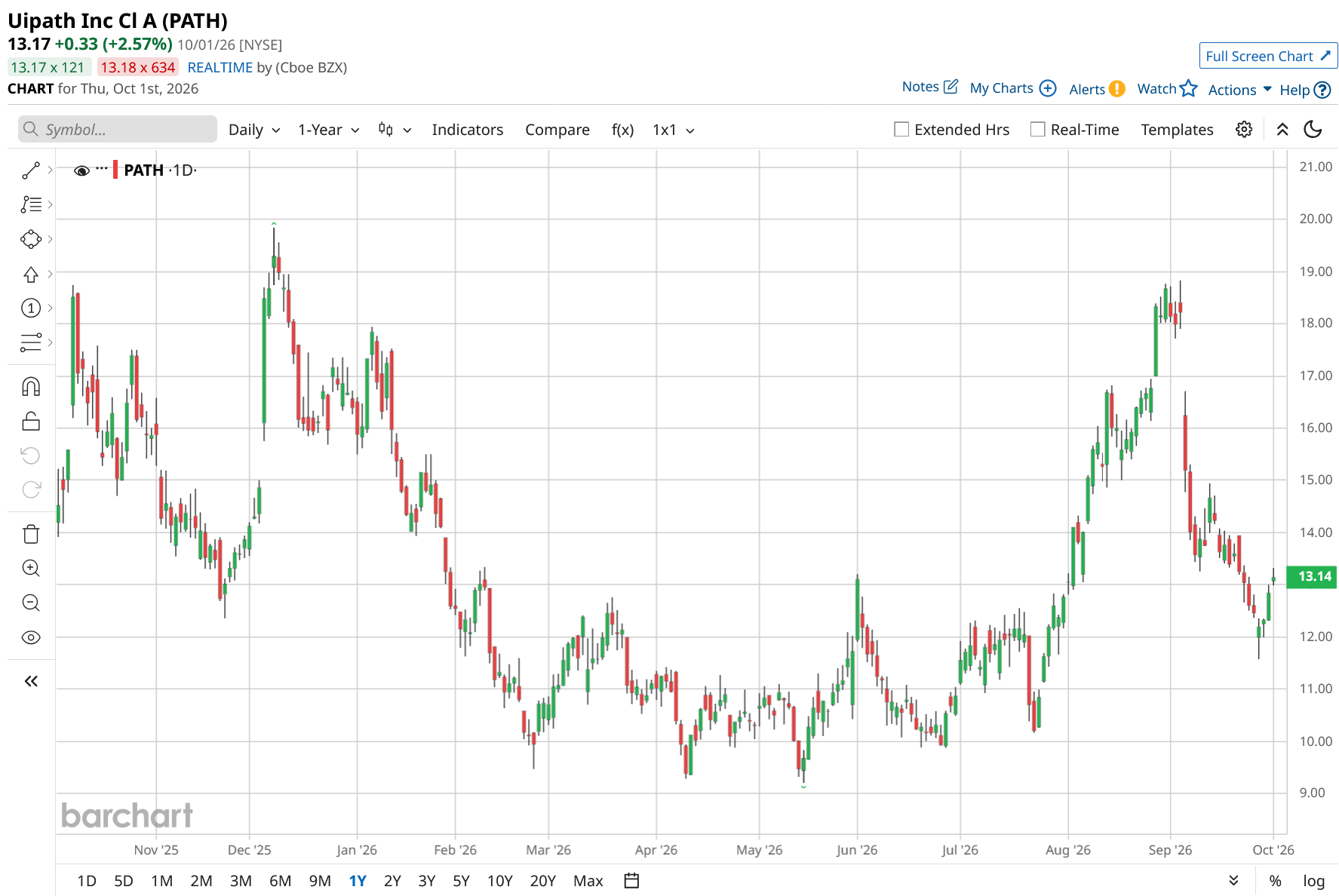
Against that backdrop, Schreiner moved UiPath to “Underperform” from “Neutral” and lowered his price target to $10 from $16. He expects competitive pressure to weigh on revenue growth into the next fiscal year. With PATH down almost 30% in the last month, let us see what lies ahead for the stock.
About UiPath Stock
Based in New York, UiPath develops enterprise automation software designed to help organizations streamline business processes through AI, RPA, and workflow orchestration. Its platform brings together AI agents, software robots, and human workers across areas including process management, document processing, application integration, and software testing.
UiPath has a market cap of roughly $6.4 billion, but PATH stock has faced a difficult stretch as investors reassess slower growth. Despite a small bounceback of about 3% this week, shares are still flat in the last year and down 21% year-to-date (YTD), with the latest pressure amplified by the Investor Day fallout, analyst downgrades, pricing concerns, and increasing competition.
The valuation picture provides some contrast. PATH stock is currently trading at 15.66 times forward adjusted earnings, a multiple below both the industry average and UiPath’s own five-year average. On that measure, the stock is trading at a discount.
A Closer Look at UiPath’s Q2 Earnings
UiPath entered the Investor Day discussion with a respectable Q2 performance. On Sept. 3, the company reported revenue of $410.3 million, up 13.4% year-over-year (YoY) and ahead of analyst estimates of $397.9 million. ARR climbed 12% to $1.938 billion, while management said it had exceeded guidance across key metrics.
Profitability provided another encouraging data point. Non-GAAP gross margin reached 82%, while non-GAAP operating income came in at $89 million. Non-GAAP net income marginally rose from the year-ago value to $80.9 million, while non-GAAP EPS remained unchanged at $0.15 and also matched analyst estimates.
Cash generation was more modest but still meaningful. Adjusted free cash flow reached $31 million, while UiPath closed the quarter with $1.4 billion in cash, cash equivalents, and marketable securities. That liquidity gives the company considerable financial flexibility as it continues developing its AI strategy, expanding its orchestration capabilities, and competing in a market where expectations are rising quickly.
UiPath’s answer is to make orchestration the bridge between its existing automation business and the broader AI opportunity. New offerings such as Maestro Case and Maestro Flow are designed to connect AI agents, robots, systems, and employees across complex processes.
Looking ahead to Q3, management guided revenue of $440 million-$445 million, ARR of $1.992 billion-$1.997 billion as of Oct. 31, and non-GAAP operating income of about $100 million. The FY2027 outlook calls for revenue of $1.789 billion-$1.794 billion, ARR of $2.065 billion-$2.070 billion as of Jan. 31, 2027, and non-GAAP operating income of approximately $445 million.
Analysts are also expecting a significant jump in earnings. Q3 FY2027 EPS is projected to grow 233.3% YoY to $0.10, while full-year FY2027 EPS is expected to rise 172.2% from the previous year to $0.49. By FY2028, EPS is projected to gain 16.3% YoY to $0.57.
What Do Analysts Expect for PATH Stock?
The disappointing Investor Day prompted a series of target reductions for PATH stock. UBS cut its price target to $15 from $19, while Truist lowered its target to $14 from $17. BMO moved to $15 from $18, Canaccord reduced its target to $14 from $17, and TD Cowen trimmed its target to $15 from $16. However, Needham maintained its “Buy” rating with a $22 target.
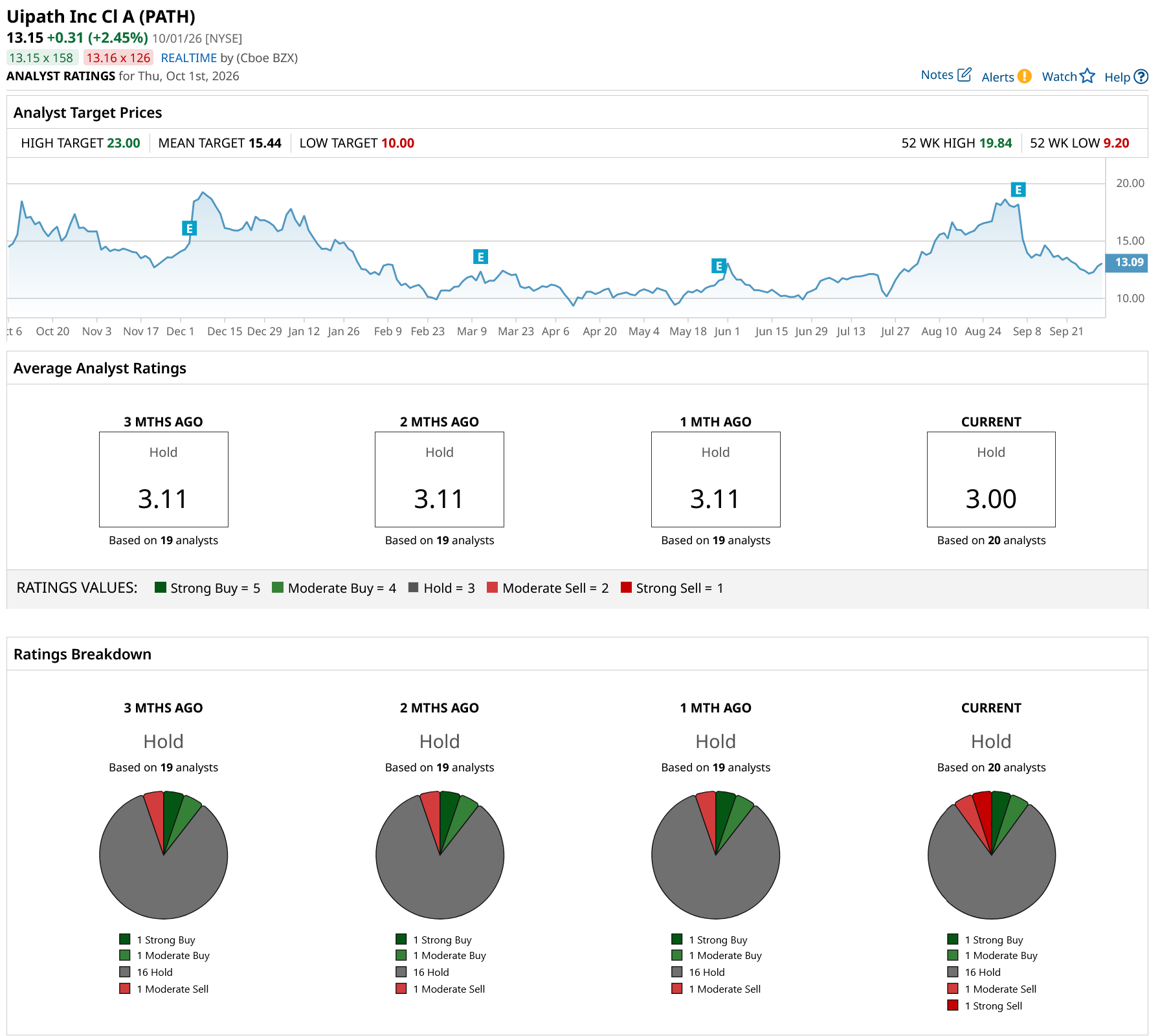
Across Wall Street, the overall rating is “Hold.” Of the 20 analysts covering PATH, one rates the stock a “Strong Buy,” one assigns a “Moderate Buy,” 16 recommend “Hold,” one suggests “Moderate Sell,” and one has flagged a “Strong Sell.”
Price targets still leave room for appreciation based on current expectations. The average price target stands at $15.44, representing potential upside of 14%, while the Street-High target of $23 implies a 70% gain from current levels.
On the date of publication, Aanchal Sugandh did not have (either directly or indirectly) positions in any of the securities mentioned in this article. All information and data in this article is solely for informational purposes. For more information please view the Barchart Disclosure Policy here.