
How Investors May Respond To Micron Stock As AI Memory Demand Surges
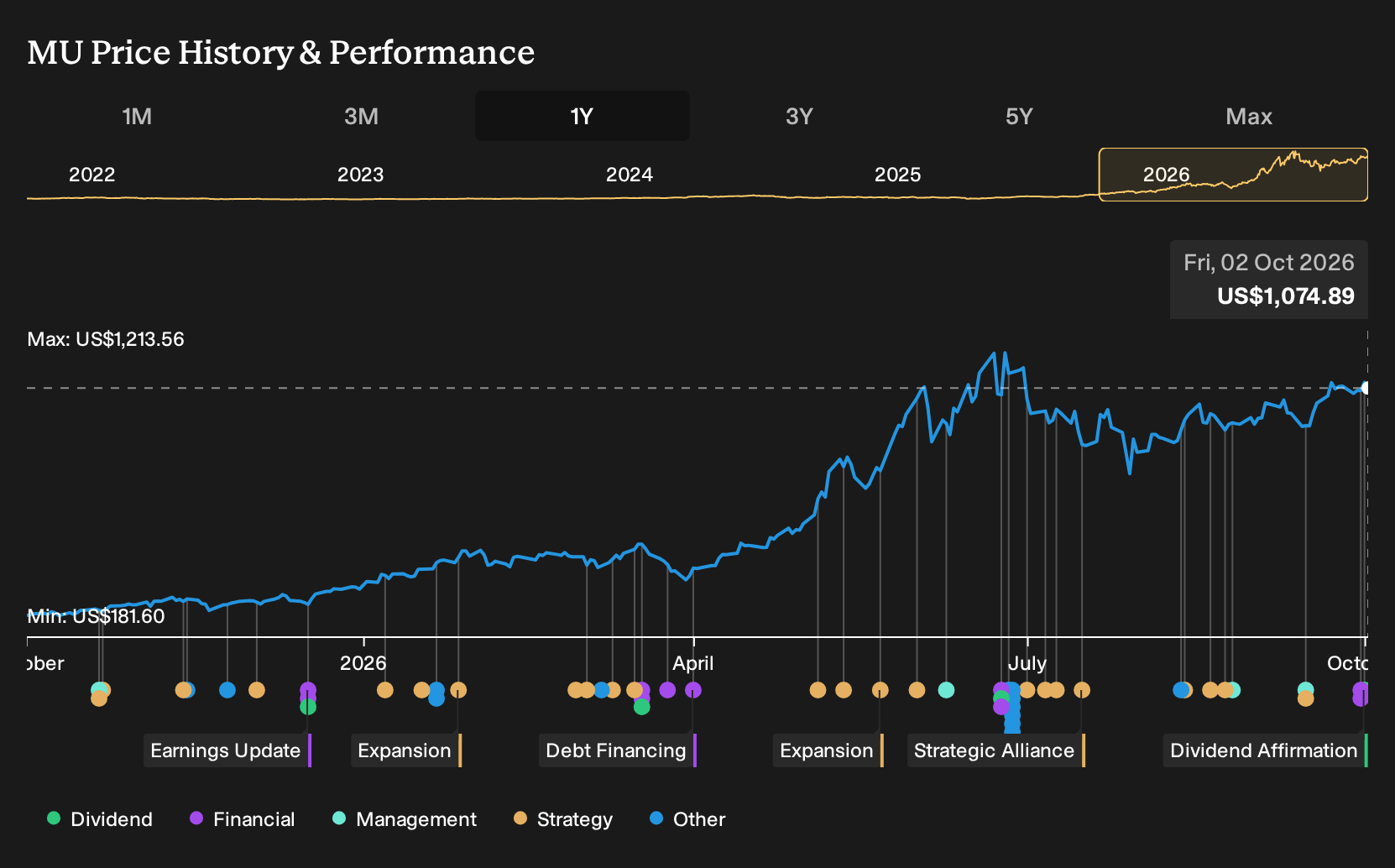
- Micron Technology reported past-year sales of US$133.188b and net income of US$84.969b, issued bullish fiscal 2027 guidance, and affirmed a quarterly dividend of US$0.15 per share payable on October 29, 2026.
- Management highlighted heavy AI driven demand for high bandwidth memory, with more than 75% of 2027 output already reserved under long dated customer commitments.
- We will look at how Micron Technology's investment narrative is shaped by record AI led earnings and multi year supply commitments.
Scan beyond Micron Technology and size up other AI exposed chipmakers with the curated 90 AI infrastructure stocks that could also be participating in this build out in data center and robotics demand.
Micron Technology Investment Narrative Recap
To own Micron Technology, you need to believe that AI-driven demand for advanced memory, including high bandwidth products, stays strong enough for the firm to keep turning its long-dated supply deals into high-margin cash flow. The short-term swing factor is whether that record AI-driven earnings base holds up as new customer commitments roll through the P&L.
The biggest risk right now sits on the cost and competition side. Micron is spending heavily on fabs and capacity, while peers in Asia are also investing. Any cooling in AI orders, pricing pressure, or disruption from the Taiwan labor dispute could hit margins and make that fixed investment load feel heavier.
The most relevant recent update for that thesis is Micron Technology’s decision to guide fiscal Q1 2027 revenue to about US$61.5b with very high gross margins and strong EPS. That outlook ties directly to tight memory supply conditions and heavy AI infrastructure demand that management says is backed by multi-year contracts.
For you as an investor, that guidance acts as a near-term test of execution. Delivery against those numbers would support the idea that long-term agreements and HBM-focused investment are converting into cash. Any shortfall, especially if linked to pricing or cost creep, would reinforce concerns about cyclicality and capital intensity at today’s scale.
Micron Technology Long Term Analyst Roadmap
Micron Technology's current analyst roadmap points to revenues of US$297.7b and earnings of US$184.0b by 2029. That profile is based on an assumed 48.9% yearly revenue growth rate and an earnings increase of about US$133.5b from US$50.5b today to the 2029 consensus mark.
Uncover why Micron Technology's fair value indicates a 41% potential upside to its current price that could close sooner than many expect.
Exploring Other Perspectives
Not every analyst reads Micron Technology’s blowout year and affirmed US$0.15 dividend in the same way. The most cautious group leans hard on geopolitical risk, which they fear could choke market access and lift costs. Before this news, they were only pencilling in 33.6% annual revenue growth and about US$112.8b in 2029 earnings. That is far below the US$184.0b consensus and highlights how wide the opinion gap already was. Use that spread as a reminder to stress test your own view, and stay open to how both narratives might shift as fresh information lands.
Explore 24 other Micron Technology fair value estimates, including one that suggests there could be as much as 49% downside from the current price.
Decide For Yourself
Don't just follow the ticker; dig into the data and build a conviction that's truly your own.
- A great starting point for your Micron Technology research is our analysis highlighting 4 key rewards and 3 important warning signs that could impact your investment decision.
- See our latest analysis for Micron Technology. The report includes a comprehensive fundamental analysis summarized in a single visual, the Snowflake, making it easy to evaluate Micron Technology's overall financial health at a glance.
Looking For More Investment Ideas Beyond Micron Technology?
If Micron Technology has sharpened your interest in AI and chip-related opportunities, it can help to widen the lens and line up a few alternative candidates that fit different risk and income profiles.
- For investors who want potential upside without paying up for quality, review a curated 19 high quality undiscovered gems that combine strong fundamentals with limited market attention.
- If capital preservation ranks high on your list, focus on stability first and comb through a 31 resilient stocks with low risk scores that screens for resilient businesses with lower risk scores.
- Income oriented investors who still care about underlying balance sheet strength can use a 7 dividend fortresses to zero in on higher yielding stocks offering at least 5% payouts.
This article by Simply Wall St is general in nature. We provide commentary based on historical data and analyst forecasts only using an unbiased methodology and our articles are not intended to be financial advice. It does not constitute a recommendation to buy or sell any stock, and does not take account of your objectives, or your financial situation. We aim to bring you long-term focused analysis driven by fundamental data. Note that our analysis may not factor in the latest price-sensitive company announcements or qualitative material. Simply Wall St has no position in any stocks mentioned.
Have feedback on this article? Concerned about the content? Get in touch with us directly. Alternatively, email editorial-team@simplywallst.com