
Will Share Cancellation Change Endesa's (BME:ELE) Narrative
- Endesa's board has approved a €21.6 million share capital reduction by cancelling 18,006,307 treasury shares. This will cut the total share count to 1,023,738,244 and will require updates to its Articles of Association and the delisting of the cancelled shares from Spain's main stock exchanges.
- The cancellation of treasury shares shrinks Endesa's equity base, which can change per share metrics and alter how investors assess capital discipline and capital return capacity.
- We will now look at how Endesa's investment narrative could shift in light of this board approved share cancellation and capital reduction.
Compare Endesa's capital move with other utilities tightening their share counts and improving their balance sheets by scanning a curated set of list of solid balance sheet and fundamentals (208 results).
Endesa Investment Narrative Recap
To hold Endesa, you need to be comfortable with a slow growth utility that leans heavily on regulated networks, Iberian power demand, and EU decarbonisation policy. The short term swing factor is still how volumes and pricing hold up while competition in retail energy stays intense and distributed solar keeps nibbling at centralised consumption. In that context, the latest capital reduction looks more cosmetic than transformational for day to day operations.
The bigger near term risk still sits in regulation and grid capacity. If remuneration on new network investment lands less favourably than hoped, it could constrain how quickly Endesa upgrades infrastructure and serves data centre and industrial demand. Earnings expectations already reflect a gentle decline over the next few years, so the key question for you is how much regulatory or pricing pressure you think the business can absorb.
The most relevant recent step alongside this capital cut is the existing share buyback activity that filled the treasury stock being cancelled. Those repurchases already concentrated earnings over a smaller share base. The formal reduction now simply keeps the share count aligned with that reality. It tightens the equity base without changing cash generation or debt directly.
For catalysts, the focus is whether Endesa continues to pair buybacks and cancellations with heavy spending on grids and renewables, or instead leans further into financial optimisation in an environment where earnings are expected to soften slightly. Execution on decarbonised generation, customer retention in a liberalised market, and management of a high debt load remain the operational levers to watch far more than this specific €21.6m reduction.
Endesa's current analyst narrative points to revenue of €22.3b and earnings of €2.5b by 2029, based on an assumed 1.8% yearly revenue growth and a projected earnings decline of €0.1b from €2.6b today.
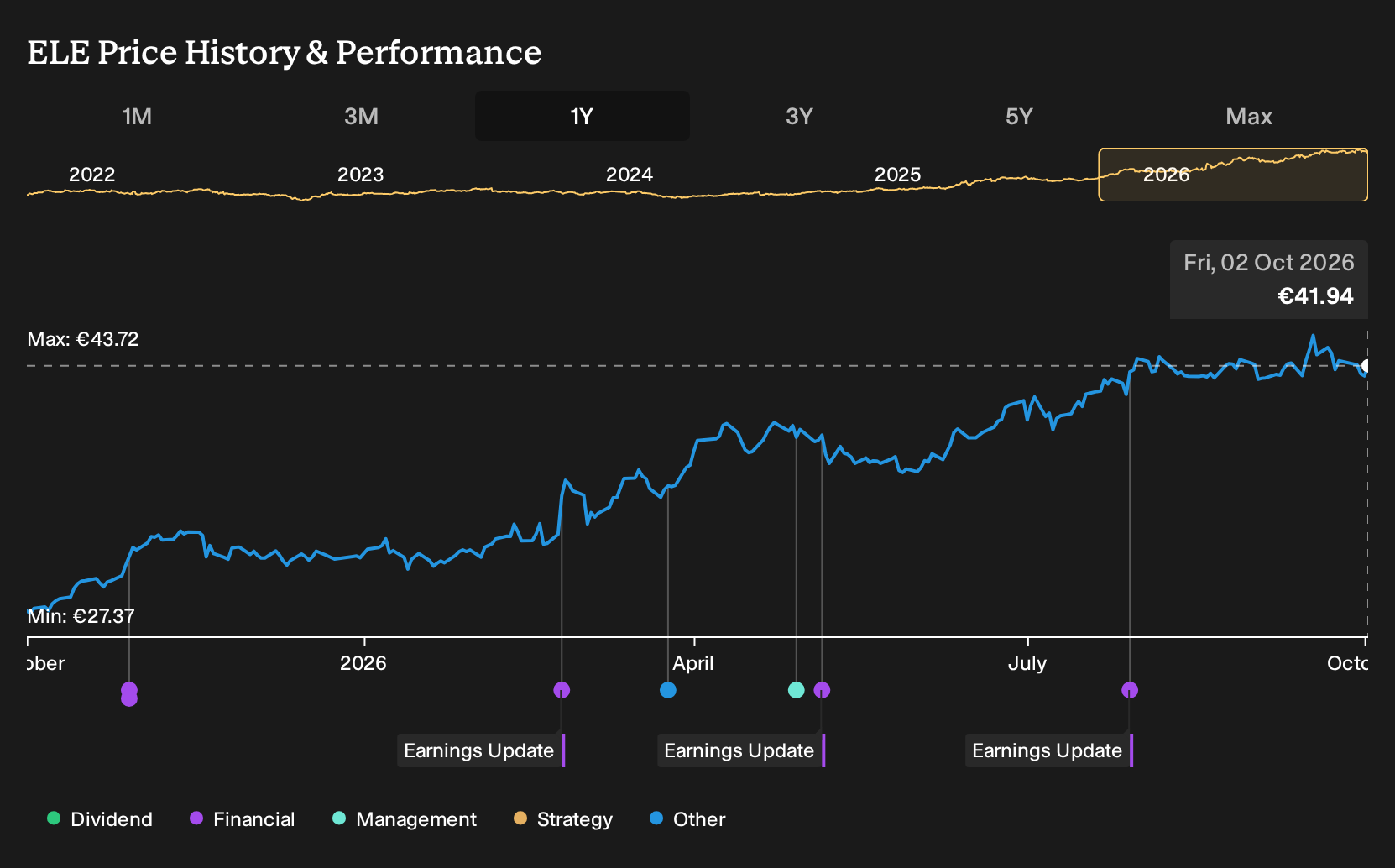
Uncover why Endesa's fair value indicates a 16% potential downside to its current price, suggesting that its current premium may not hold.
Exploring Other Perspectives
Some of the most optimistic analysts frame Endesa as a grid and renewables investment story, not just a slow growth utility. Before this capital reduction, they were pencilling in revenue of €27.6b and earnings of €2.8b by 2029. You can treat this share cancellation as a fresh reason to compare those upbeat assumptions with more cautious views and decide which story feels closer to your own.
Explore 3 other Endesa fair value estimates, including one that suggests as much as 6% upside from the current price.
Form Your Own Verdict
Don't just follow the ticker; dig into the data and build a conviction that's truly your own.
- A great starting point for your Endesa research is our analysis highlighting 1 key reward and 3 important warning signs that could impact your investment decision.
- See our latest analysis for Endesa. The report includes a comprehensive fundamental analysis summarized in a single visual, the Snowflake, making it easy to evaluate Endesa's overall financial health at a glance.
Looking For More Investment Ideas Beyond Endesa?
If the Endesa story has sharpened your thinking about regulated utilities and capital returns, it can be useful to compare it with very different types of opportunities using the Simply Wall St Screener.
- For investors who want companies that already tick a lot of quality and valuation boxes, scan a focused group of 195 high quality undervalued stocks that pair solid fundamentals with more appealing pricing.
- If capital preservation sits high on your priority list, filter for 227 resilient stocks with low risk scores that may offer calmer price moves and steadier financial profiles.
- When you are hunting for future leaders still off most radars, cast a wider net across 615 high quality undiscovered gems with strong underlying metrics but limited market attention.
This article by Simply Wall St is general in nature. We provide commentary based on historical data and analyst forecasts only using an unbiased methodology and our articles are not intended to be financial advice. It does not constitute a recommendation to buy or sell any stock, and does not take account of your objectives, or your financial situation. We aim to bring you long-term focused analysis driven by fundamental data. Note that our analysis may not factor in the latest price-sensitive company announcements or qualitative material. Simply Wall St has no position in any stocks mentioned.
Have feedback on this article? Concerned about the content? Get in touch with us directly. Alternatively, email editorial-team@simplywallst.com