
Did Weather Hit Earnings Just Shift Vail Resorts' (MTN) Investment Narrative?
- Vail Resorts reported full-year 2026 revenue of US$2.84b and net income of US$147.54 million, while affirming a US$2.22 quarterly dividend and outlining fiscal 2027 net income guidance of US$184 million to US$255 million.
- The combination of lower annual earnings, weather-hit operating conditions and a dividend that was not covered by free cash flow has sharpened investor focus on how resilient Vail Resorts' payout and balance sheet really are if snow conditions remain challenging.
- The next area of focus is how Vail Resorts' investment narrative holds up in the context of weaker earnings and a dividend now described as weather sensitive.
Vail Resorts Investment Narrative Recap
To own Vail Resorts, you need to be comfortable with a weather exposed, high fixed cost leisure business that depends on steady visitation and healthy pass demand. The big short term swing factor is how the coming ski season tracks against recent guidance for US$184 million to US$255 million of net income. Recent results with weaker earnings and a Q4 loss keep the focus firmly on execution rather than expansion.
The biggest current risk is still poor snow conditions, combined with a dividend that was not covered by free cash flow in the last year. Management has flagged that another very tough winter could force a dividend cut, so any sign of softer visitation or heavier discounting will matter more to the story than incremental cost savings or minor pricing tweaks.
The new Epic Ascent private lesson upgrade at Vail Mountain and Beaver Creek is the most relevant operational move right now. It aims to push more spending into high touch services such as instruction, concierge support and rental gear. At the same time it keeps lesson pricing at current levels aside from normal inflation. For a reader, the real question is whether this type of premium experience can offset pressure on lift and pass economics when weather is unhelpful.
Vail Resorts is also scaling the connected Ski & Ride School features in the My Epic app from 4 to 14 resorts. If execution goes well, that could support guest engagement, repeat visits and ancillary revenue, and it may soften some of the volatility in skier behavior flagged earlier in the year. The flip side is that these initiatives still run through the same weather and destination travel risks that are driving today’s debate on earnings quality and dividend resilience.
Vail Resorts' analyst narrative points to forecast revenue of US$3.2b and consensus earnings of US$264.8 million by 2029, based on an assumed 4.2% yearly revenue growth rate and an earnings increase of about US$117 million from current earnings of US$147.5 million.
Uncover why Vail Resorts' fair value is essentially aligned with its current price.
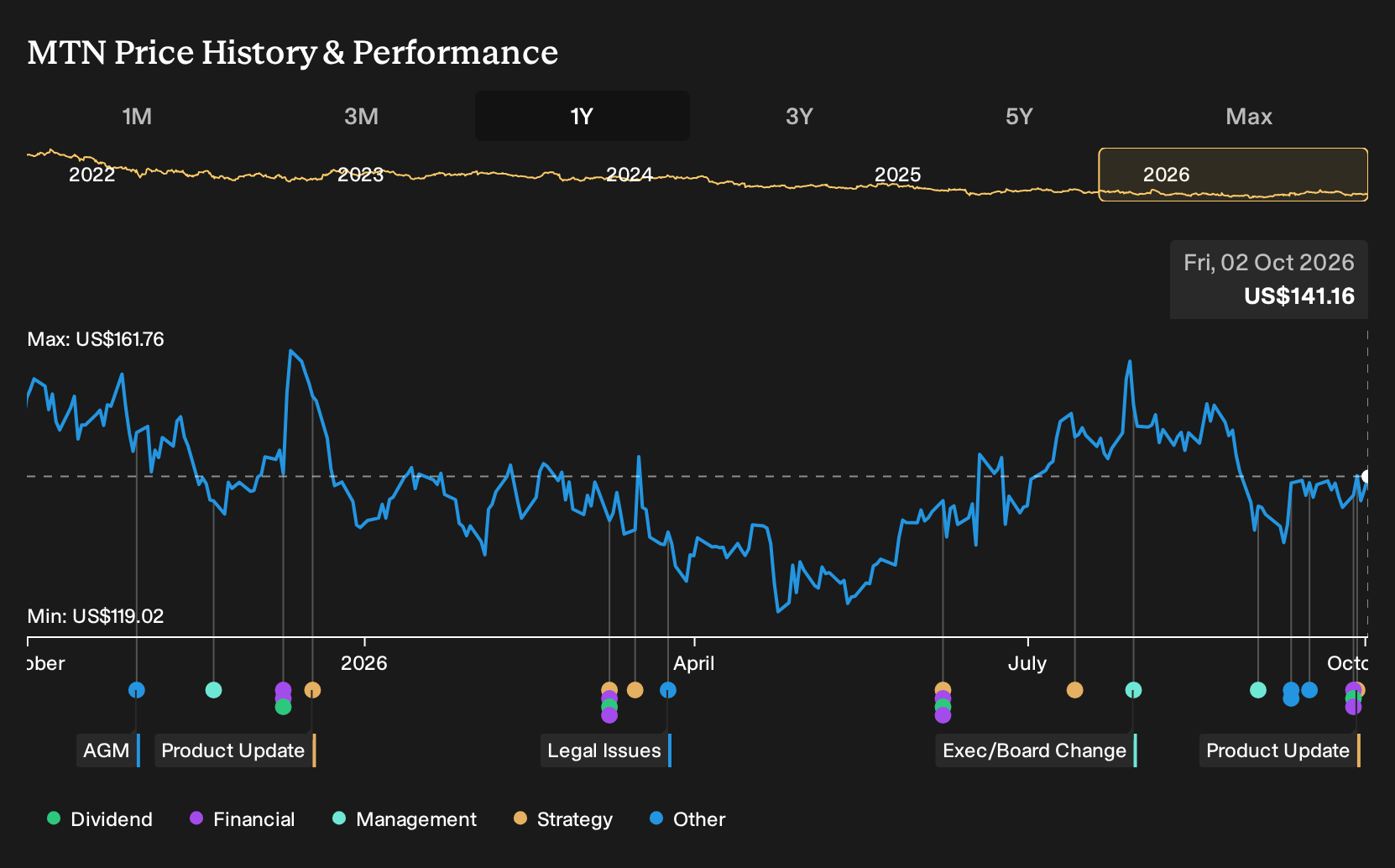
Exploring Other Perspectives
Some of the most optimistic analysts lean hard into Vail Resorts’ premium experience angle. Before this news, they were modelling revenue of about US$3.3b and earnings near US$366.5 million by 2029, assuming guest experience and four season offerings outweigh weather risk. You can compare that upbeat view with more cautious expectations and decide which story fits your own outlook.
Explore 2 other Vail Resorts fair value estimates, including one that suggests potential upside of up to 53% from the current price.
Form Your Own Verdict
Don't just follow the ticker. Dig into the data and build a conviction that's truly your own.
- A great starting point for your Vail Resorts research is our analysis highlighting 2 key rewards and 3 important warning signs that could impact your investment decision.
- See our latest analysis for Vail Resorts. The report includes a comprehensive fundamental analysis summarized in a single visual, the Snowflake, making it easy to evaluate Vail Resorts' overall financial health at a glance.
Looking For More Ideas Beyond Vail Resorts?
If Vail Resorts feels too tied to weather swings for your taste, a broader watchlist can balance that exposure. The Simply Wall St Screener can help you quickly surface other companies that better match your risk tolerance and income goals.
- If resilience and low volatility matter most to you, start with a basket of businesses screened for sturdier risk profiles using our 31 resilient stocks with low risk scores.
- For readers hunting for value opportunities on stronger fundamentals, narrow your search to companies that combine quality metrics with attractive pricing through the 31 high quality undervalued stocks.
- If portfolio income is a priority, focus on stocks with higher yields and robust cash generation by scanning the 7 dividend fortresses.
This article by Simply Wall St is general in nature. We provide commentary based on historical data and analyst forecasts only using an unbiased methodology and our articles are not intended to be financial advice. It does not constitute a recommendation to buy or sell any stock, and does not take account of your objectives, or your financial situation. We aim to bring you long-term focused analysis driven by fundamental data. Note that our analysis may not factor in the latest price-sensitive company announcements or qualitative material. Simply Wall St has no position in any stocks mentioned.
Have feedback on this article? Concerned about the content? Get in touch with us directly. Alternatively, email editorial-team@simplywallst.com