
3 Bank Stocks With Low Cost Deposits As Higher Rates Test Funding Costs
Interest rates have snapped higher as the Fed lifts the funds rate to 3.75% to 4.00%, putting a spotlight on banks that rely on sticky, low cost retail deposits rather than expensive funding. That shift can change which stocks benefit from the new math on cash and which do not. This piece walks through three U.S. bank stocks exposed to this rate shock and explains why some investors are watching them closely right now.
The three banks covered next are only a small slice of the opportunity set, and the full screen surfaced 27 more U.S. franchises with equally compelling deposit stories that are not included in this article sample. To identify and analyze those additional banks with strong low cost funding, head straight to the US Banks With Strong Low-Cost Retail Deposit Franchises screener.
Forbright (FRBT)
Forbright plugs directly into the screener theme, using a national digital deposit platform and traditional checking and savings products to lean on granular, low cost funding while running a single Banking segment that produced about $325 million of revenue on a roughly $903 million market value.
Forbright is a US-based bank focused on national lending strategies and a proprietary digital deposit platform.
"Expansion of the proprietary digital deposit platform, including promotion tools and the upcoming digital checking product, is building a lower cost, granular funding base that can support asset growth and influence net interest margin and overall funding costs."
What happens when that funding engine meets a longer period of higher policy rates will likely matter a lot for future margins.
That funding mix could be the quiet gearshift in Forbright’s story, so read the full narrative for Forbright to see how management aims to turn deposits into accelerating earnings power.

Southern First Bancshares (SFST)
Southern First Bancshares runs a regional bank across the Carolinas and Georgia, funding a broad mix of commercial, consumer, and mortgage lending with checking, savings, and other retail deposit products. It generated about $129 million from Banking Operations in the US and carries a roughly $576 million market cap.
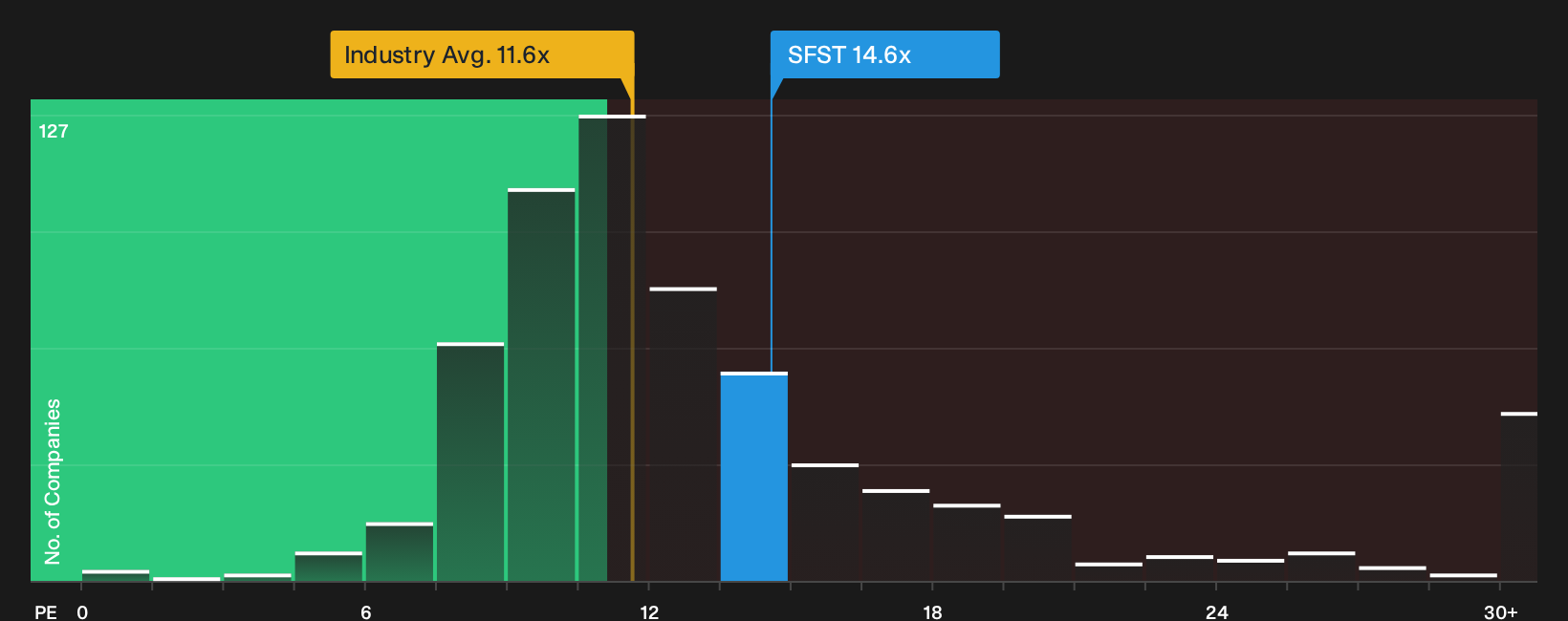
Southern First Bancshares fits into this deposits-focused screen as a regional lender that leans on checking and savings balances to support its commercial and consumer loan book. This can matter when the Fed lifts short-term rates and funding costs start to affect banks unevenly. Strong profitability, high forecast revenue and earnings growth, and a P/E above many peers all indicate that investors are already paying up for that retail funding profile. As a result, attention shifts to what may happen if deposit pricing pressure and loan yields start moving in opposite directions.
If that pricing tug of war worries you, scan the 3 key rewards and 2 important warning signs to see where Southern First Bancshares might surprise on deposits or loan returns.
NB Bancorp (NBBK)
NB Bancorp runs Needham Bank, a community-focused retail lender in Greater Boston that leans on local checking and savings accounts consistent with the low-cost core deposit theme. It generates about $249 million from Banking activities and carries a roughly $921 million market cap.
NB Bancorp ties directly into this retail deposit screen as a Greater Boston bank that relies on local checking and savings balances to fund a broad loan book while operating in a higher rate world in which deposit costs and loan yields can move at different speeds. With all Banking revenue of about $249 million and a market value near $921 million, the focus for investors is on how that familiar community deposit franchise interacts with ongoing pressure around how much of each additional rate increase reaches net interest margins.
That tug of war around deposit costs and loan yields makes the analyst forecasts for NB Bancorp a useful next step to see where NB Bancorp’s earnings trajectory could decouple.

Curious About The Next Big Alternatives
Fresh opportunities can move fast. Some ideas build breakout momentum while they are still under the radar for now. Do not get caught reacting late; consider acting early instead of waiting.
- Spot companies with strong balance sheets before the crowd by running the list of solid balance sheet and fundamentals (25 results). This tool may highlight businesses investors have not fully priced in.
- Explore potential momentum in resilient dividend payers by scanning the 7 dividend fortresses, focusing on yields and payout strength based on today’s numbers.
- Track where robotics and automation could reshape industries by checking the curated 89 robotics and automation stocks, which focuses on themes that may be building early traction.
This article by Simply Wall St is general in nature. We provide commentary based on historical data and analyst forecasts only using an unbiased methodology and our articles are not intended to be financial advice. It does not constitute a recommendation to buy or sell any stock, and does not take account of your objectives, or your financial situation. We aim to bring you long-term focused analysis driven by fundamental data. Note that our analysis may not factor in the latest price-sensitive company announcements or qualitative material. Simply Wall St has no position in any stocks mentioned.
Have feedback on this article? Concerned about the content? Get in touch with us directly. Alternatively, email editorial-team@simplywallst.com