
How Strong Earnings At Dycom Industries (DY) Has Changed Its Investment Story
- Dycom Industries recently reported Q2 FY27 earnings of $115.64 million on a profit margin of 5.76%, reflecting its role in U.S. digital, telecom, and utility infrastructure projects across the Communications and Building Systems segments.
- The business is tightly linked to long term fiber and broadband buildouts, with demand for fiber to the home, data center connectivity, and BEAD funded broadband work shaping Dycom Industries’ contract mix and revenue visibility.
- We will now look at how Dycom Industries’ profit margins and earnings affect the durability of its existing investment narrative.
Compare what Dycom Industries is doing in fiber and broadband buildouts with other critical infrastructure players by scanning our hand picked 40 power grid technology and infrastructure stocks for your next idea.
Dycom Industries Investment Narrative Recap
To own Dycom Industries, you need to believe that U.S. fiber to the home projects, long haul routes and data center builds keep translating into steady contract work and that the current 5.76% profit margin can at least be defended. The latest Q2 FY27 earnings of US$115.64 million support that narrative without really changing it.
The near term swing factor is execution on Dycom Industries backlog as BEAD related work ramps and large telecom clients refine their build schedules. The biggest risk remains customer concentration and project timing. Any slowdown in awards, permitting or data center phasing could show up quickly in margin pressure and lower utilization.
The most relevant data point around this update is how Dycom Industries is already tied into long haul, middle mile and data center interconnect projects that contribute to a roughly US$12.2b backlog. That work, plus more than US$1b of contracted fiber corridors, explains why current quarterly earnings matter for you.
Q2 profitability provides a real time check on whether labor availability, cost inflation and project complexity are being managed inside the margin ranges investors monitor. It also intersects with BEAD engineering revenue, where execution quality today influences how much of that multi year broadband catalyst actually converts into resilient cash generation later on.
Dycom Industries’ current analyst narrative points to revenues of US$10.0b and earnings of US$631.4 million by 2029, built on an assumed 13.3% yearly revenue growth rate and an earnings increase of about US$301.8 million from US$329.6 million today.
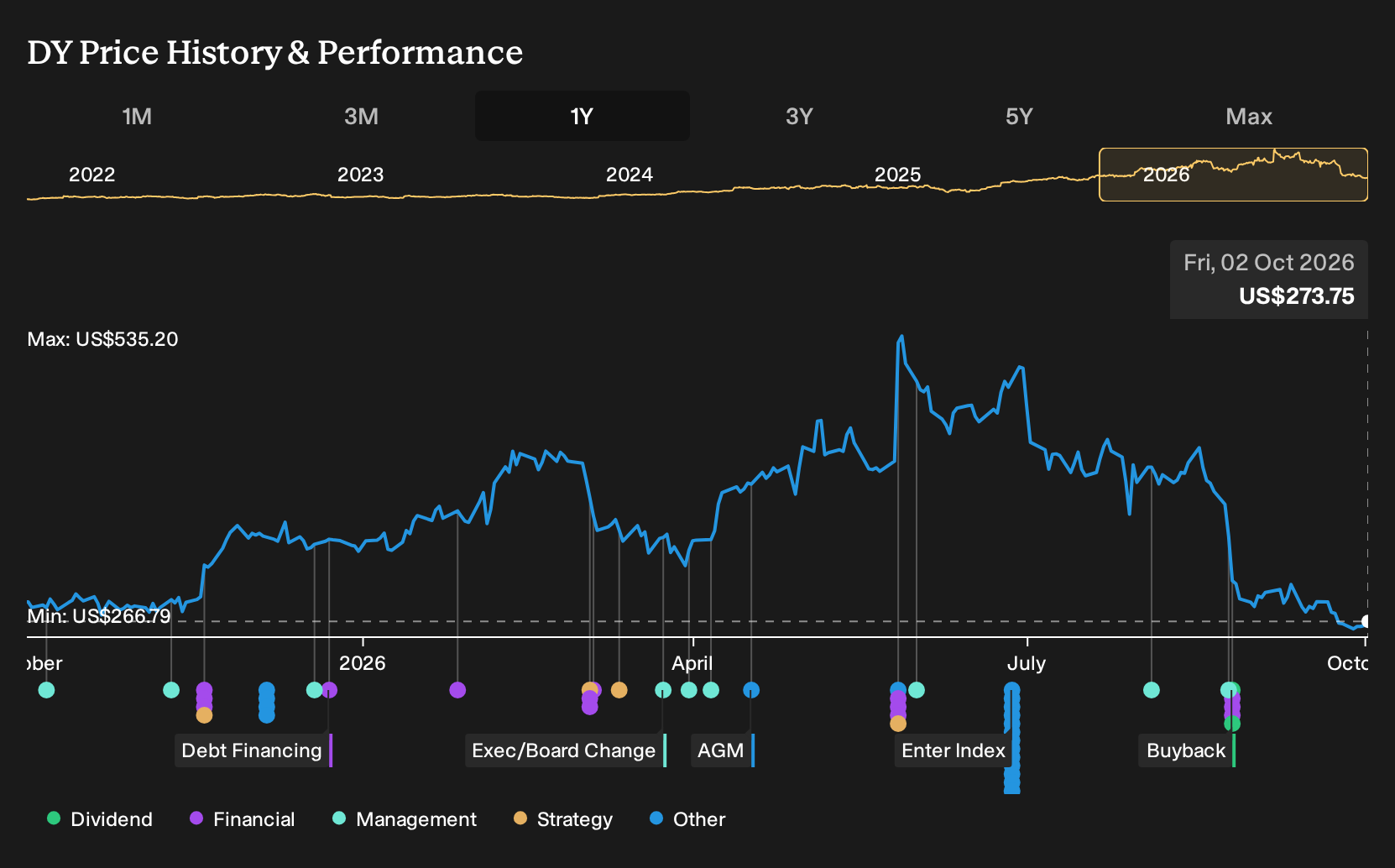
Uncover why Dycom Industries' fair value indicates a 90% potential upside to its current price that could narrow quickly.
Exploring Other Perspectives
One alternate view on Dycom Industries focuses on wireless program timing risk. The most pessimistic analysts were already flagging the US$150 million shift of wireless revenue into fiscal 2028 and still penciling in about US$10.1b of 2029 revenue and US$702.1 million of earnings. That is a very different story. Treat this Q2 update as a chance to test those contrasting assumptions and explore where you sit between them.
Explore 2 other Dycom Industries fair value estimates, including one that suggests it could be worth just $370.92!
Form Your Own Verdict
Disagree with existing narratives? Extraordinary investment returns rarely come from following the herd, so go with your instincts.
- A great starting point for your Dycom Industries research is our analysis highlighting 5 key rewards and 1 important warning sign that could impact your investment decision.
- See our latest analysis for Dycom Industries. The report includes a comprehensive fundamental analysis summarized in a single visual, the Snowflake, making it easy to evaluate Dycom Industries' overall financial health at a glance.
Looking For More Investment Ideas Beyond Dycom Industries?
Once you have a view on Dycom Industries, it can help to line it up against a wider watchlist so you can see where the risk and reward trade offs really differ.
The Simply Wall St Screener gives you a way to filter for specific traits that match your own style. Here are a few angles worth considering if you want to broaden your watchlist thoughtfully rather than at random:
- If capital preservation is your priority, focus on companies that pair resilient earnings with modest volatility by starting with a 31 resilient stocks with low risk scores that already clears strict risk filters.
- For investors who care most about balance sheet strength, begin with a list of solid balance sheet and fundamentals (25 results) that only includes businesses with robust financial footing and cleaner funding profiles.
- If you are hunting for under followed potential opportunities, use a 19 high quality undiscovered gems that narrows the field to financially sound companies that are not yet widely tracked.
This article by Simply Wall St is general in nature. We provide commentary based on historical data and analyst forecasts only using an unbiased methodology and our articles are not intended to be financial advice. It does not constitute a recommendation to buy or sell any stock, and does not take account of your objectives, or your financial situation. We aim to bring you long-term focused analysis driven by fundamental data. Note that our analysis may not factor in the latest price-sensitive company announcements or qualitative material. Simply Wall St has no position in any stocks mentioned.
Have feedback on this article? Concerned about the content? Get in touch with us directly. Alternatively, email editorial-team@simplywallst.com