
As Starship Finally Reaches Orbit, Here’s How You Should Place SpaceX Stock
SpaceX's (SPCX) Starship recently achieved a major milestone when it reached orbit for the first time. Overcoming engine problems and 13 previous failed attempts, the company's next-generation rocket, which is designed to carry crew and cargo, deployed 26 Starlink V3 satellites at an altitude of about 275 kilometers on Flight 14. However, the mission was not without a major issue.
The company reported that one of Starship's engines experienced stoppages. This led to the mission being curtailed to just three hours, down from the 10 hours planned. Yet the mission can be deemed a success, as notwithstanding the engineering issues, SpaceX hit its target of deploying the V3 satellites and achieving orbit.
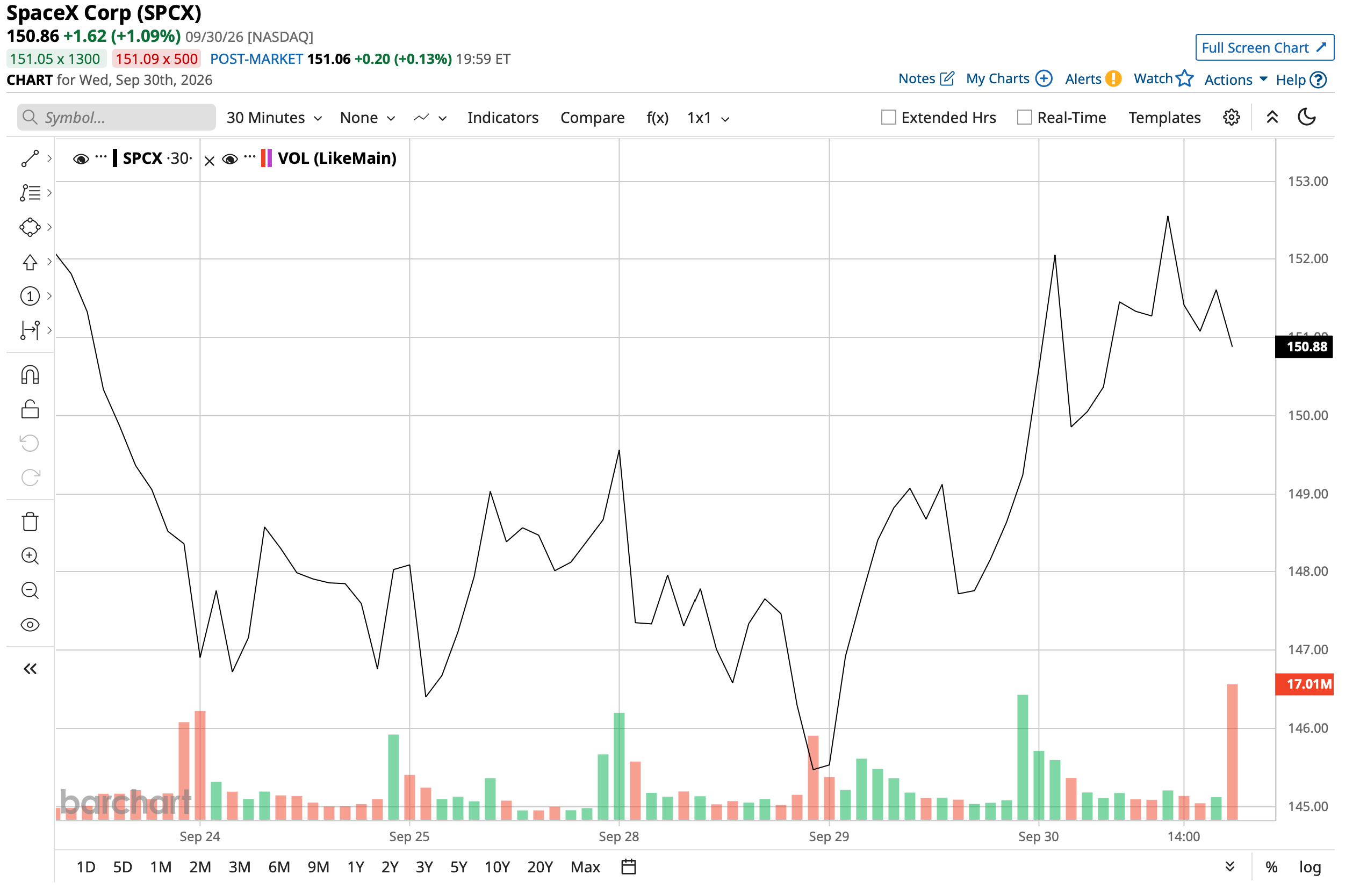
Valued at a market capitalization of roughly $2 trillion, SpaceX stock reacted positively to the news. Overall, SPCX stock is up roughly 18% from its initial public offering (IPO) price of $135, but still is quite a ways away from its all-time high of $225.64.
Can reaching orbit for the first time help propel SPCX stock to previous highs and beyond? Let's take a closer look.
Wings to Bigger Goals
Apart from the consequential nature of Starship reaching orbit for the first time, the development has wider ramifications for the broader SpaceX story. Starlink, the company's broadband business, is currently its biggest cash cow. Not only is Starlink its biggest revenue generator, but it is also SpaceX's only profitable segment. Making up about 55% of total revenue in the most recent quarter, the Connectivity segment reported an operating profit of $1.66 billion in the second quarter of 2026.
Accordingly, if Starlink thrives, SpaceX's AI ambitions will be easier to realize. Moreover, building orbital compute capabilities is a crucial stated goal of the company. Here, the V3 satellites come as a material upgrade from the V2 Mini. At 1 Tbps and 160 Gbps, the V3's downlink and uplink capacities are about 10 times and 22 times better than the V2 Mini, respectively. Further, the V3 is designed in such a way that each Starship launch can add about 20 times more capacity than a Falcon 9 V2 launch.
Notably, V3's bigger purpose warrants attention. The company intends to reuse the V3 hardware platform for AI1, its first dedicated orbital data-center satellite drawn at 150 kW peak and about 120 kW average, with a 70-meter wingspan. Two AI1 prototypes are slated for early 2027, with a goal of about 1 GW of space-based compute per year by late 2027.
However, despite the improvements and SpaceX's leading position in terms of deployment, the company needs to be mindful of the competition. Alphabet's (GOOGL) Project Suncatcher pairs radiation-tested Trillium TPU v6e chips with Planet Labs buses and aims for two prototypes in early 2027. Meanwhile, Jeff Bezos' Blue Origin has TeraWave aiming for about 5,400 networking satellites. Finally, China has discussed 200,000 satellites for sovereign processing.
Q2 Built a Base
SpaceX has achieved notable top-line expansion over recent years, with revenue climbing from $10.4 billion in 2023 to $18.7 billion in 2025. The company recorded net income of $791 million in 2024 before reporting a net loss of $4.9 billion the following year. Operating cash flow strengthened during this timeframe, advancing to $6.8 billion in 2025 from $4.5 billion in 2023. SpaceX closed 2025 with a robust cash balance of $24.7 billion and minimal short-term debt, which helps address liquidity risks.
During Q2 2026, SpaceX generated revenue of $7.8 billion, reflecting a 92% year-over-year (YOY) increase. Net loss improved to $541 million from a loss of $1 billion in the same period a year earlier. At the end of the quarter, the company held $93.5 billion in cash and cash equivalents.
Capital spending has also increased substantially over the past three years, rising from $4.4 billion in 2023 to $20.7 billion in 2025. Investments related to artificial intelligence (AI) have grown especially quickly, beginning at $463 million in 2023 as the smallest category among Space, Connectivity, and AI before expanding to $12.7 billion in 2025. This evolution shows how SpaceX, which originally concentrated on space operations and connectivity offerings, is now establishing AI as a foundational element for future growth. AI capex alone reached $15.8 billion in Q2 2026.
Reviewing the revenue mix for Q2, Connectivity continued to lead with $4.29 billion. The AI segment produced $2.56 billion in revenue, while the Space segment added $962 million.
From a valuation standpoint, SPCX stock remains significantly elevated relative to peers. For example, the price-to-sales (P/S) ratio of 104.5 times is substantially higher than the sector median.
What Do Analysts Think of SpaceX Stock?
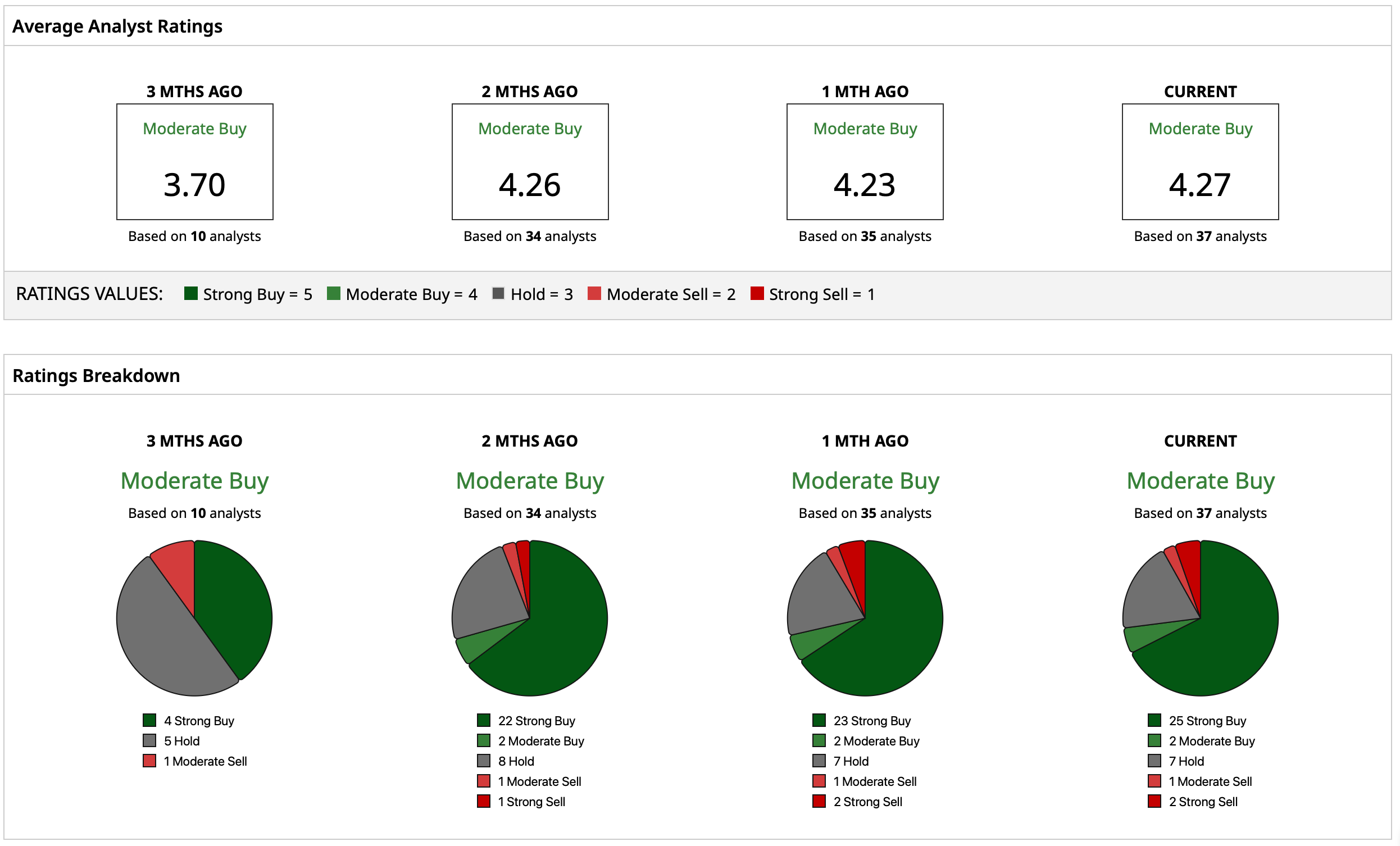
Overall, analysts have a consensus “Moderate Buy” rating for SPCX stock. Out of 38 analysts covering the stock, 25 have a “Strong Buy” rating, three have a “Moderate Buy” rating, seven have a “Hold” rating, one has a “Moderate Sell” rating, and two analysts have a “Strong Sell” rating. The mean target price of $220.31 indicates potential upside of 39% from current levels.
On the date of publication, Pathikrit Bose did not have (either directly or indirectly) positions in any of the securities mentioned in this article. All information and data in this article is solely for informational purposes. For more information please view the Barchart Disclosure Policy here.