
Following a Major Business Transformation, ChronoScale Is Doubling Down on AI Infrastructure Bet
Having covered the stock market for almost two decades, I've seen plenty of corporate makeovers, but few have moved as fast as ChronoScale's (CHRN) transformation.
Earlier this year, part of this company made robotic exoskeletons that help people with physical disabilities move again. Today, it wants a seat at the table in the race to power artificial intelligence.
For a business that recently relied on one customer for almost every dollar of sales, the key question is simple. Is there demand for its products? ChronoScale now says yes.
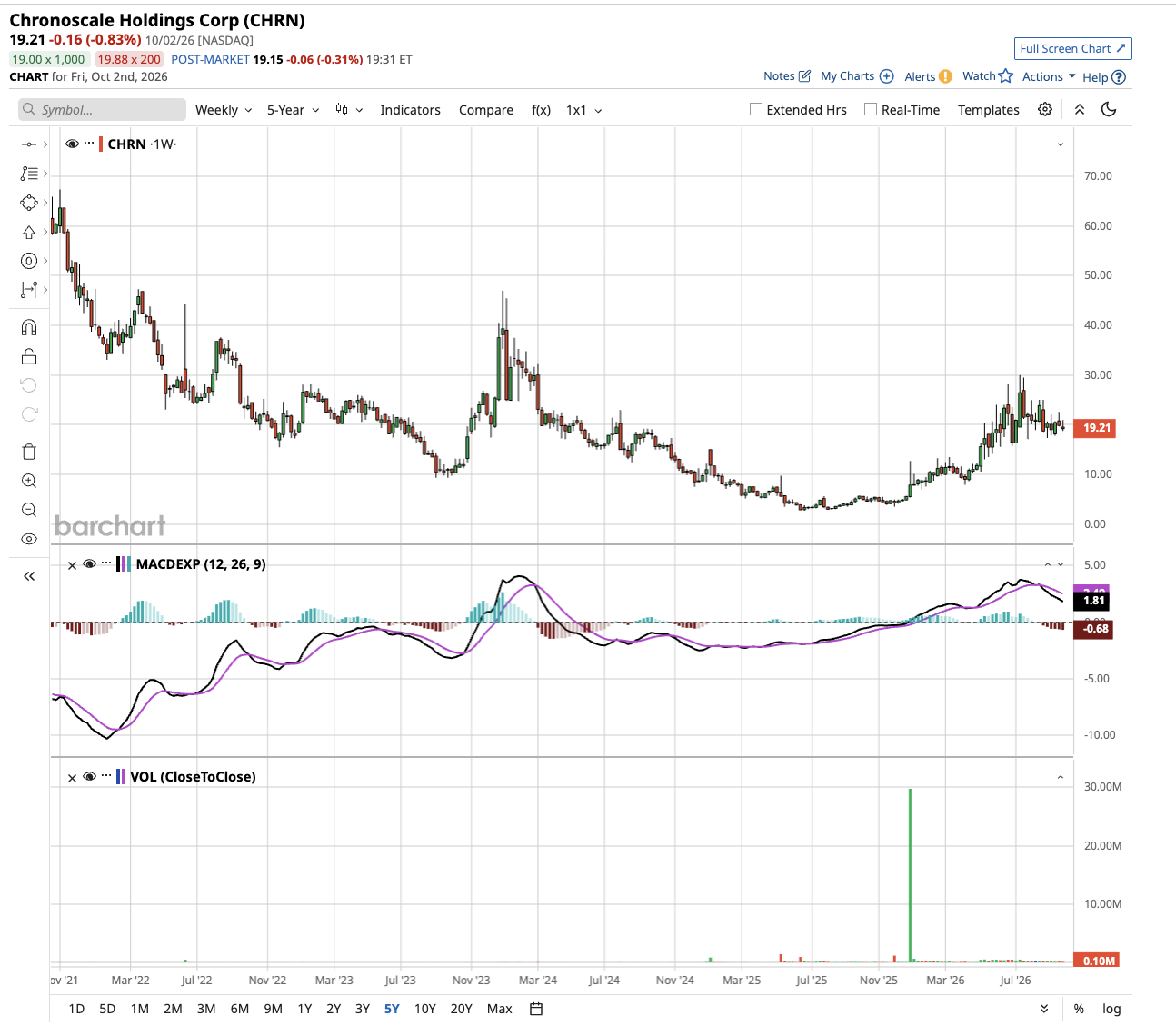
ChronoScale Stock Grew Out of an Unlikely Merger
ChronoScale took shape on May 5, 2026, when Applied Digital's (APLD) cloud business combined with Ekso Bionics Holdings. Weeks later, the board decided to sell the exoskeleton unit and focus solely on cloud computing.
The business model is easy to picture. ChronoScale rents space in data centers in Colorado, Minnesota, and Utah. It fills that space with powerful Nvidia (NVDA) chips and rents out the computing power to AI developers by the hour.
As of May 31, it had 6,144 Nvidia H100 chips in service. They all served one customer, Together AI, and cloud services made up about 99.5% of total revenue.
The numbers show a company still finding its footing. For the fiscal year ended May 31:
- Revenue fell 15% to $71.6 million.
- Operating loss narrowed 32% to $37.5 million.
- Net loss totaled $50.3 million.
In plain terms, losses are shrinking, while sales are lumpy given its customer concentration.
New Deals Put a $1 Billion Goal in Sight for ChronoScale Stock
That's what makes the Oct. 1 announcement important. ChronoScale said it signed a contract extension with an existing AI infrastructure customer and a separate deal with a new one, according to a company statement. ChronoScale says these deals, together with its current contracts and deployment schedule, provide for an annualized revenue run rate of $1 billion by calendar Q3 of 2027.
A run rate takes one period of sales and stretches it over a full year. So, a $1 billion run rate means ChronoScale would be bringing in about $83 million a month. That's more than it earned for all of fiscal 2026.
"We view the expansion of this existing customer relationship and the onboarding of the new customer as an important validation of both the demand we are seeing and our ability to grow alongside our customers," said ChronoScale CEO Cenly Chen.
In August, ChronoScale unveiled plans with Microsoft (MSFT) for a 50-megawatt AI computing project in North America. The site will use Nvidia GB300 NVL72 systems and liquid cooling to handle tightly packed, power-hungry chips. For perspective, ChronoScale's three current sites total about 14 megawatts. The Microsoft project alone is more than three times that size. The partnership runs for two years, with completion expected in the first quarter of 2027.
Earlier in August, ChronoScale teamed up with Nutanix (NTNX) to sell AI infrastructure to large businesses, according to a joint statement.
What Could Move the CHRN Stock Price Next
IDC projects worldwide AI infrastructure spending will hit about $487 billion in 2026, up roughly 53% from the previous year, according to ChronoScale's annual report. Gartner expects about 55% of AI cloud spending in 2026 to support inference. Inference means running AI apps every day, rather than training them.
Still, investors should watch the fine print. The company says reaching its $1 billion goal depends on building new capacity on time, securing power and equipment, and raising money on acceptable terms. The Microsoft project also depends on financing. If ChronoScale misses certain milestones, it could owe penalties or credits.
Competition is fierce, too. Rivals such as CoreWeave (CRWV), Crusoe Energy, Lambda Labs, and Nebius Group (NBIS) often have more locations and deeper pockets, the company acknowledges.
Meanwhile, ChronoScale has now completed the sale of its Ekso Bionics unit.
"We intend the sale of the Ekso Bionics business to allow us to further sharpen our focus and concentrate our resources on what we see as the significant opportunity ahead in AI infrastructure," Chen said.
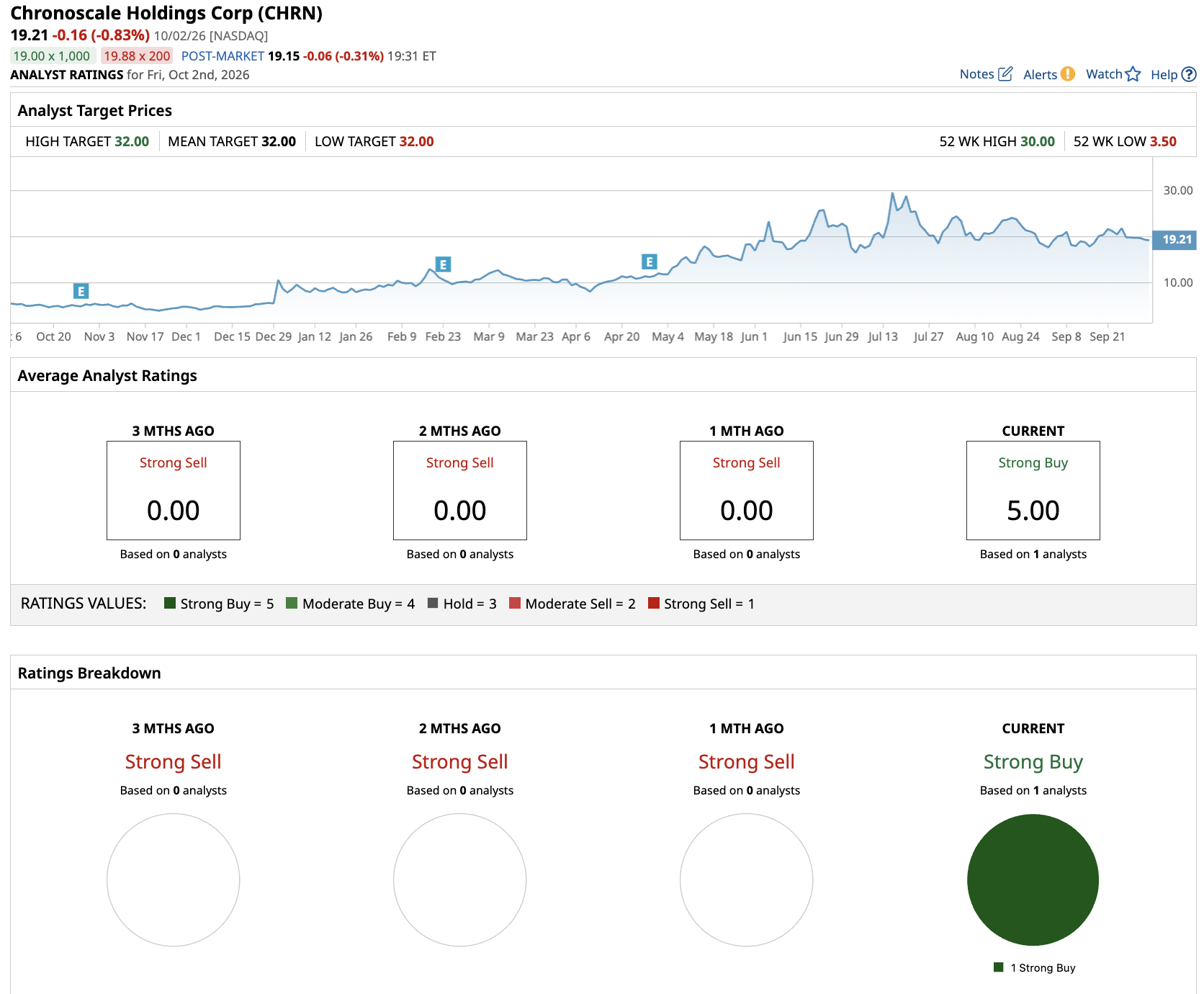
The exoskeletons are gone. What's left is a pure AI bet, and the next 12 months will show whether ChronoScale can build fast enough to cash in. A single analyst who tracks CHRN stock has a “Strong Buy” recommendation and a price target of $32, above the current price of $19.
On the date of publication, Aditya Raghunath did not have (either directly or indirectly) positions in any of the securities mentioned in this article. All information and data in this article is solely for informational purposes. For more information please view the Barchart Disclosure Policy here.