
Can the Grain Bulls Come Back?
(WEAT) (SOYB) (CORN) (ZWZ26) (ZSX26) (ZCZ26) (TAGS) (DBA)
“Can the Grain Bulls Come Back?”
by Jim Roemer - Meteorologist - Commodity Trading Advisor - Principal, Best Weather Inc. & Climate Predict - Publisher, Weather Wealth Newsletter and Co-Producer of Climatelligence
Scott Mathews - Editor and Co-Producer of Climatelligence
- October 6, 2026
Midwest farmers probably deserve a weather medal after 2026. Parts of the western Corn Belt battled summer heat and dryness, while other areas dealt with bouts of excessive rain. Then September flipped the script: portions of Nebraska, Iowa and the Midwest were absolutely soaked. Some locations received more than 15 inches, with Iowa experiencing one of its wettest Septembers on record.
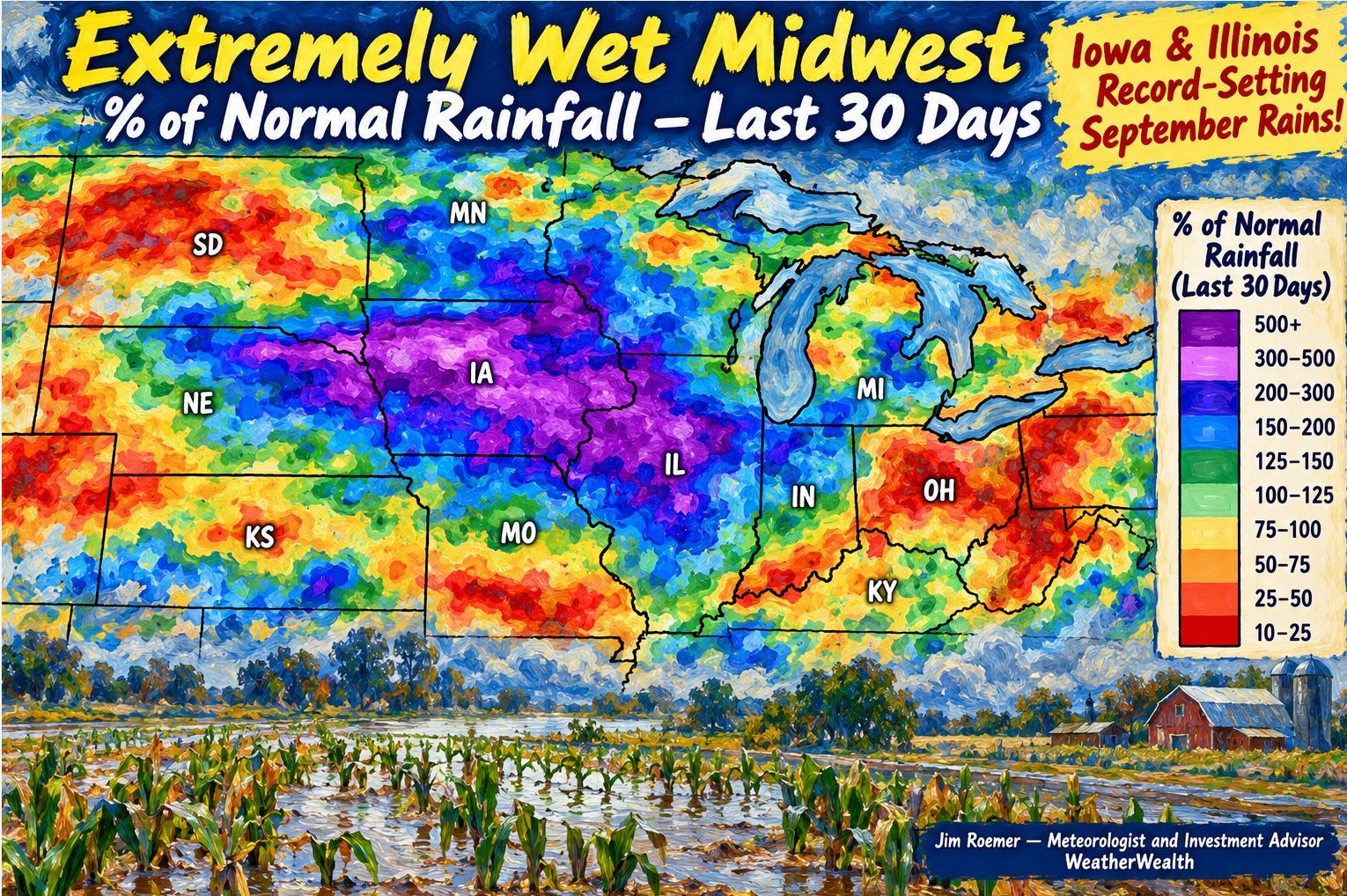
Image design by BestWeather, Inc. rendered by ChatGPT (with a little help from our friend, Claude Monet)
That makes Friday’s October 9 USDA report particularly interesting. Private estimates suggesting bigger crops may prove correct—but I would not automatically assume that all this September rain was beneficial. By this stage, excessive moisture can mean lodging, stalk and root rot, sprouting corn, disease and harvest losses, rather than adding bushels. Those problems are already being reported in Iowa and Illinois.
The bears have ammunition: USDA just found a whopping 2.10 billion bushels of September 1 corn stocks, (35% above last year!!!). Our forecast for much drier Midwest harvest weather would also allow combines to finally roll, potentially bringing a wave of corn and soybeans to market.
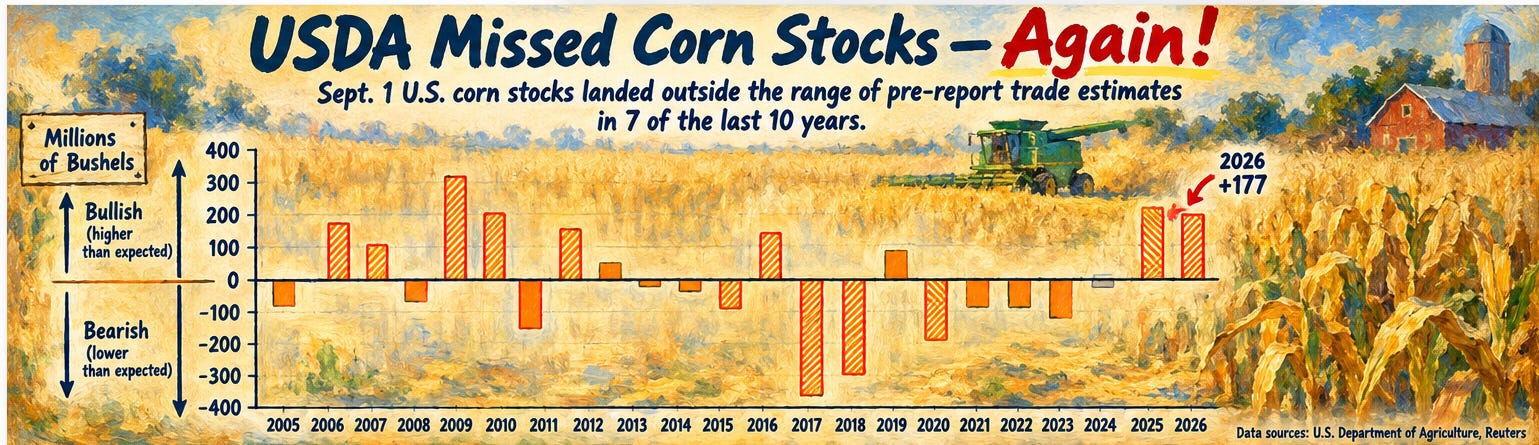
Image design by BestWeather, Inc. rendered by ChatGPT (with more help from Monet)
But don’t bury the bulls yet. If actual field yields disappoint, harvest losses mount, or USDA trims production, corn could recover later. Soybeans may have an even better bullish argument because old-crop stocks were actually 3% below last year.
What Could a Powerful El Niño Mean for Corn & Soybeans in 2027?
The developing El Niño could become increasingly important to grain prices—not necessarily because of what it does to the Midwest this winter, but because of what happens after the combines stop rolling.
For corn, the immediate problem is supply. On September 1st, stocks were a huge 2.10 billion bushels, 35% above last year. That’s a pretty heavy anchor to drag around. But USDA has already reduced its 2026/27 U.S. corn production expectations, and global coarse-grain production was cut again in September. Thus, if final U.S. yields disappoint following this summer’s erratic weather, the bearish stocks story could gradually lose some punch.
Soybeans may be more interesting. USDA currently has the crop near 4.5 billion bushels and 52.8 bu/acre, but projected ending stocks are only around 310 million bushels.That’s considerably less breathing room than corn.
And then comes the South American wild card.
A powerful El Niño often tilts rainfall toward southern Brazil, Argentina and Paraguay, while sometimes producing more erratic conditions farther north in Brazil. That doesn’t automatically mean crop trouble—in fact, Argentina could benefit enormously from improved moisture. But excessive southern rains, planting delays, flooding, or dryness/heat farther north could quickly turn a comfortable world soybean balance sheet into something much more exciting.
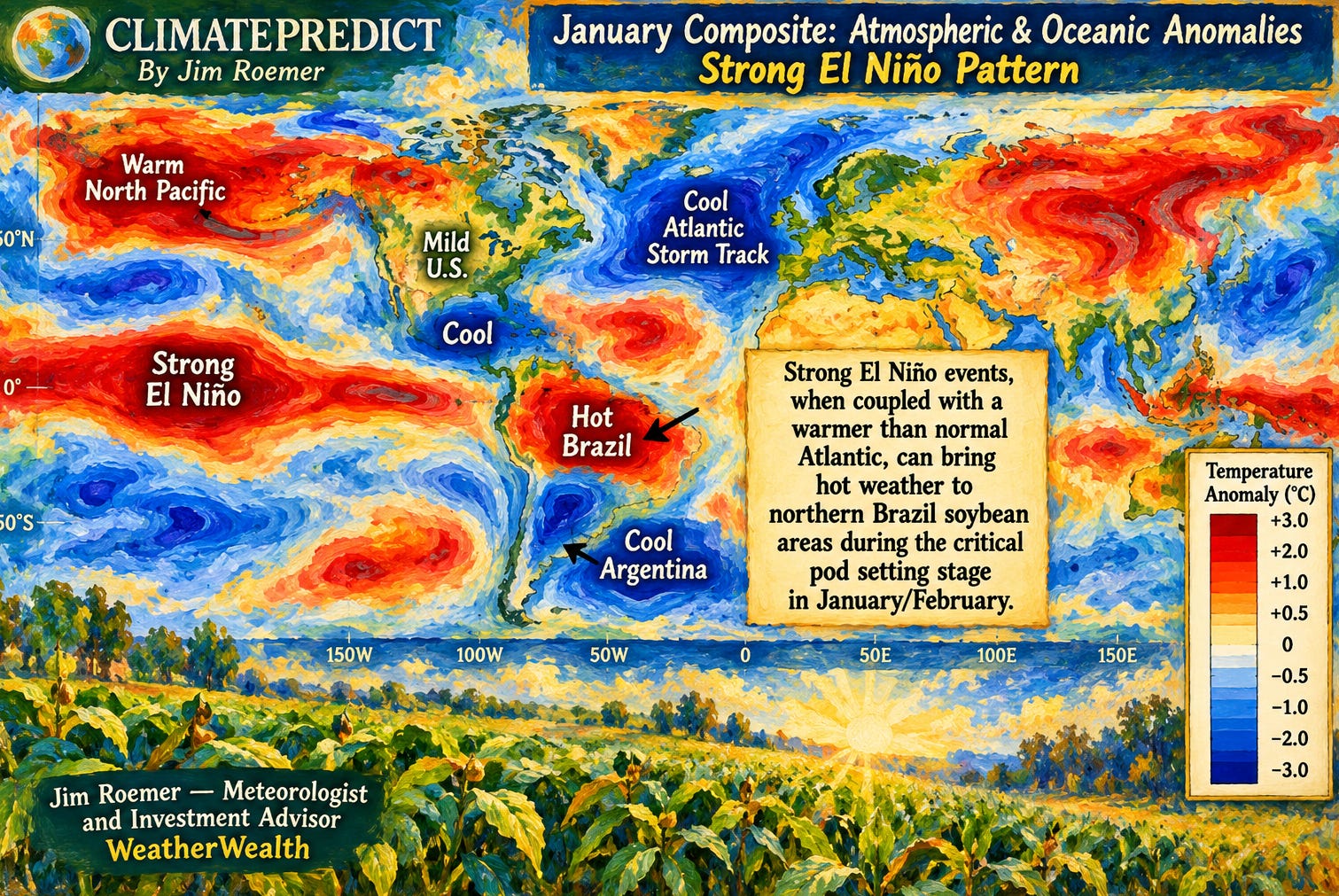
Image design by BestWeather, Inc. rendered by ChatGPT (Claude is really getting into this)
Then there’s summer 2027. Some of my weather models are especially intriguing: most ensemble members flip from the exceptionally strong El Niño this winter toward below-normal tropical Pacific temperatures by next summer. That’s far from a guaranteed La Niña, but such a rapid transition would make the 2027 Midwest growing season worth watching very closely.
My takeaway: I would separate the grain outlook into two acts:
Act I—Harvest 2026: Big supplies + better harvest weather = bearish pressure, particularly corn.
Act II—Winter through summer 2027: South American weather + falling U.S. stocks + a potentially dramatic ENSO transition = increasing upside risk.
Ah, yes—I think there is hope for the grain bulls. Corn probably needs a supply or demand surprise to escape its large carryover. This could happen from strong European demand following one of the worst droughts in France, etc. that we forecasted last summer.
Soybeans have the more explosive setup because their cushion is smaller. And if this historic El Niño eventually collapses rapidly toward La Niña during 2027, the weather market could become much more interesting than today’s harvest prices suggest.
SO…
WHAT SHOULD YOU DO IN THE GRAIN MARKETS?
GET A TWO-WEEK FREE TRIAL TO WEATHERWEALTH,
OR, CHECK OUT OUR LOWER PRICED CLIMATELLIGENCE NEWSLETTER BELOW

https://www.bestweatherinc.com/membership-sign-up/
https://climatelligence.substack.com/
We greatly appreciate your interest in Commodity Weather Intelligence!
Jim Roemer, Scott Mathews, and the BestWeather Team
… and
Un grand merci de notre amie:

Mr. Roemer owns Best Weather Inc., offering weather-related blogs for commodity traders and farmers. He is also a co-founder of Climate Predict, a detailed long-range global weather forecast tool. As one of the first meteorologists to become an NFA-registered Commodity Trading Advisor, he has worked with major hedge funds, Midwest farmers, and individual traders for over 35 years. With a special emphasis on interpreting market psychology, coupled with his short-term and long-term trend forecasting in grains, softs, and energy markets, he holds a unique standing among advisors in the commodity risk management industry.