
Dear Delta Air Lines Stock Fans, Mark Your Calendars for October 9
For airlines, the skies may be crowded, but the economics can still feel like turbulence. Demand can soar when travelers are willing to pay up for a seat, only for higher fuel, labor, and operating expenses to come along and eat into those gains. That balancing act is particularly important for carriers such as Delta Air Lines (DAL), where a premium-heavy customer base can provide a valuable cushion when broader passenger volumes become less predictable.
And Delta is heading into its next earnings checkpoint with plenty for investors to watch. The airline is scheduled to report its third-quarter 2026 results on Oct. 9 at 10 a.m. ET, giving Wall Street its first detailed look at how the carrier navigated the September quarter. Passenger demand and pricing trends have remained encouraging, supported by robust premium travel, double-digit main-cabin growth, and resilient corporate demand. Its powerful American Express (AXP) loyalty ecosystem also continues to add an indispensable layer to the revenue mix.
But there is a catch, and it comes in the form of fuel. Energy prices have moved higher, while non-fuel expenses remain elevated, putting fresh pressure on margins. The lingering effects of a refinery outage could further complicate the cost picture. Delta’s July investment-community update offered some reassurance, with management saying September-quarter revenue remained on a solid trajectory, but that outlook was based on a lower fuel-price assumption than today's market environment.
That makes Oct. 9 more than another date on the earnings calendar. Analysts expect Delta’s third-quarter revenue and earnings to rise year over year, building on the airline’s solid history of earnings surprises. But with rising costs creating fresh storm clouds, investors will find out on Friday whether Delta’s strong revenue mix and pricing power can keep profits airborne without losing altitude.
About Delta Air Lines Stock
Founded in 1924, Delta Air Lines has grown from a regional carrier into one of the world’s leading airlines, connecting travelers across more than 300 destinations worldwide. Headquartered in Atlanta, Georgia, the airline operates through major U.S. hubs and international gateways with a fleet of more than 1,000 aircraft.
Yet Delta’s story is not just about scale. With roughly 100,000 employees operating more than 4,000 daily flights, the carrier has built its brand around service, reliability, and a premium travel experience. Delta flew more than 200 million passengers in 2025, underscoring the reach of its global network.
As of now, Delta has a market capitalization of approximately $55.3 billion, placing it firmly among the heavyweight names in the U.S. airline industry.
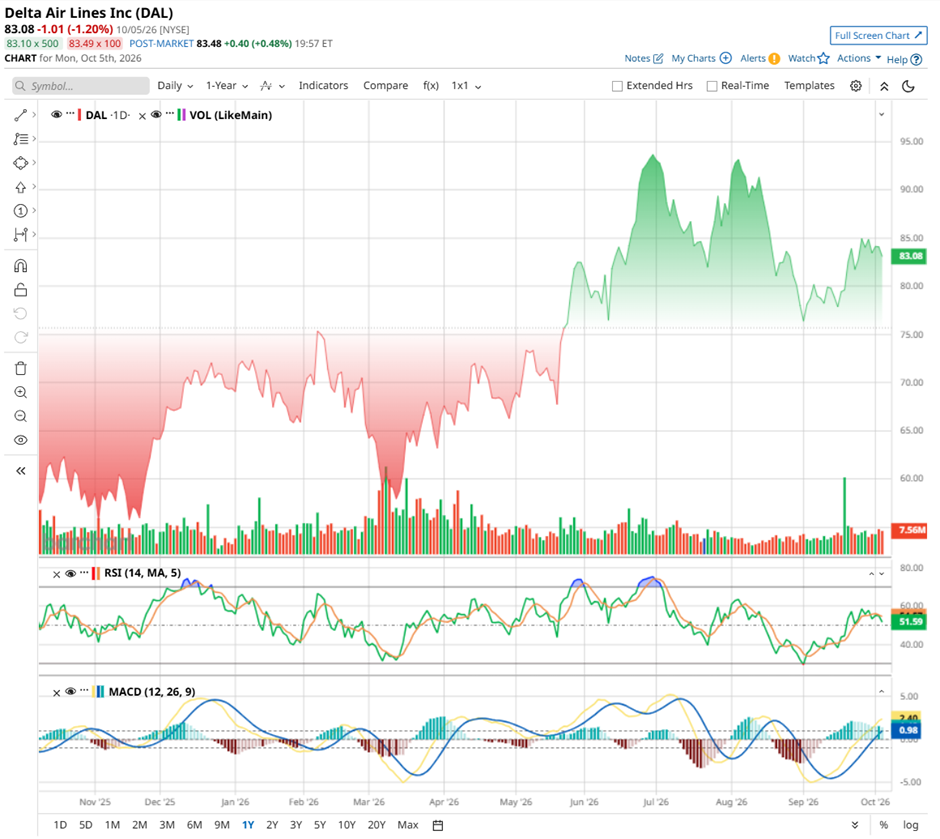
Delta’s stock has had quite the flight this year, with plenty of altitude, a little turbulence, and now what looks like an attempt to regain cruising speed. The shares climbed to an all-time high of $95.68 in July, riding a wave of better-than-expected Q2 results, resilient premium travel demand, solid pricing, and a more favorable oil-price backdrop.
That rally did not exactly come with a permanent boarding pass. After hitting its July peak, DAL pulled back as investors began weighing the less glamorous side of the airline equation—rising fuel costs and lingering questions around travel demand. Still, the bigger picture remains surprisingly sturdy. The stock is up 45% over the past 52 weeks and 26% over six months, despite losing about 8% over the past three months.
More recently, though, the mood has started to thaw. DAL has gained 5% over the past month, suggesting investors may be looking beyond the recent wobble and toward the upcoming earnings catalyst.
Technically, DAL is looking less battered. The 14-day RSI has recovered to around 52 after nearing oversold territory in September, putting the stock back in neutral territory with a modest bullish tilt. The MACD oscillator is offering another encouraging clue—the MACD line has crossed above the signal line, while the histogram has turned positive. That combination points to improving momentum. It is hardly a victory lap yet, but the chart is starting to indicate that Delta’s recent pullback may be losing some steam.
Delta’s valuation hardly looks like it is wearing a luxury price tag. At roughly 14.3 times forward adjusted earnings, the stock trades below many airline peers. Its 0.75x price-to-sales (P/S) multiple also sits beneath the sector average, suggesting investors are not paying much of a premium for Delta’s revenue engine.
Delta also gives shareholders a little something to smile about through its quarterly dividend. The airline declared a $0.215-per-share payout in September, scheduled to be paid on Nov. 5. That works out to $0.86 per share on an annualized basis, translating into a forward yield of about 1.02%. With a forward payout ratio near 14.2%, Delta is returning cash without stretching its balance sheet, leaving some breathing room for future dividend growth.
Q2 Earnings Snapshot
Delta’s second-quarter numbers, released in July, came with a familiar airline-industry contradiction—travelers kept showing up, but fuel costs made sure the celebration did not last too long. The results still cleared Wall Street’s expectations, with pricing strength and a premium-heavy customer mix doing plenty of heavy lifting.
Operating revenue climbed 14% year-over-year (YoY) to a record $17.7 billion, while adjusted EPS fell 26.4% annually to $1.56 from $2.12 a year earlier. Adjusted net income followed the same downward path, sliding to $1.03 billion. So yes, Delta made more money at the top, but getting that money to the bottom line proved considerably harder.
The culprit was hardly mysterious. Adjusted fuel expense jumped a whopping 77% to $4.4 billion, with average fuel prices reaching $3.93 per gallon.
Yet Delta had a few tricks up its sleeve. Premium revenue rose 17%, loyalty revenue advanced 19%, and cargo revenue soared 39%. Capacity, meanwhile, grew just 1%, suggesting management was not exactly throwing seats into the market and hoping for the best.
Looking ahead, Delta has held the line on its full-year 2026 outlook, maintaining adjusted EPS guidance of $6.50 to $7.50. Management remains confident that resilient travel demand, firm fares, and continued strength in premium and loyalty revenue can help absorb the pressure from elevated fuel costs.
Delta is all set to release its Q3 numbers this Friday. The management estimates adjusted EPS to be between $2.00 and $2.50, with revenue expected to grow in the mid-teens. Delta is also targeting an operating margin of 11% to 13%.
Meanwhile, analysts monitoring Delta predict the airline company’s EPS for the third quarter of fiscal 2026 to grow 14.6% YoY to $1.96, while revenue is anticipated to be around $18.8 billion. For fiscal 2026, EPS is expected to be $5.99, up 2.9% YoY and then rise by another 37.6% annually to $8.24 in fiscal 2027.
What Do Analysts Expect for DAL Stock?
Earlier this month, TD Cowen analyst Tom Fitzgerald trimmed his price target for DAL stock to $101 from $105 while keeping a “Buy” rating. The analyst remains confident in Delta, but he is hardly ignoring the elephant in the room—fuel prices remain volatile, clouding the sector’s earnings and free-cash-flow outlook for 2027. He favors Delta’s shares, although he noted that more leveraged carriers could outperform if fuel prices finally settle down.
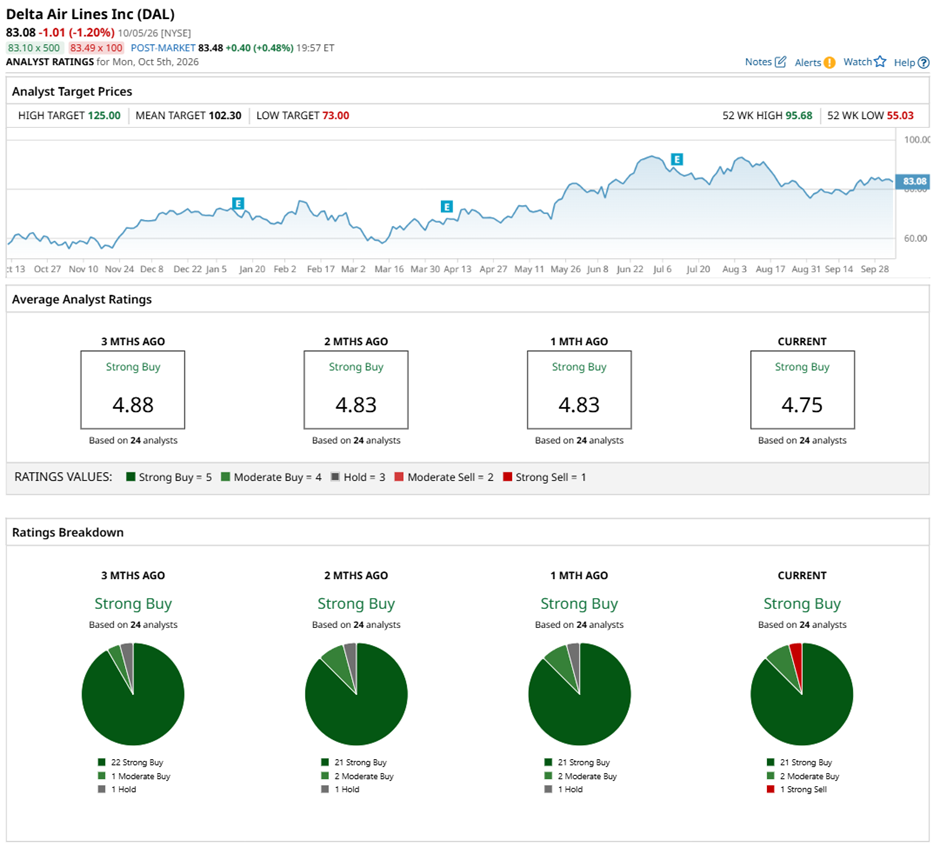
Wall Street, for now, is firmly in Delta’s corner. DAL stock carries a “Strong Buy” consensus overall, with 21 of the total of 24 analysts recommending a “Strong Buy,” two are leaning moderately bullish and advising a “Moderate Buy,” while the remaining one is outright skeptical, giving a “Strong Sell” rating.
As for where the stock could head next, the mean price target of $102.30 suggests that DAL has potential upside of 23% from the current levels. The Street-high of $125 implies the airline stock could rise as much as 51% from here.
On the date of publication, Sristi Suman Jayaswal did not have (either directly or indirectly) positions in any of the securities mentioned in this article. All information and data in this article is solely for informational purposes. For more information please view the Barchart Disclosure Policy here.