
3 Bank Stocks That Could Gain From Higher Long Term US Rates
Long-term U.S. borrowing costs are back in the spotlight, and traders are again testing where the ceiling on yields really sits. That shift can punish some corners of the market, yet it can also pull fresh attention toward businesses that might cope better if the curve steepens and discount rates stay elevated. This article walks through three stocks exposed to this rate story and why each deserves a closer look right now.
The three stocks below are a small sample of this rate-sensitive theme. The full screen on Simply Wall St surfaces 546 more U.S. financial companies with similarly interesting stories that do not fit into a short article. To see the broader field and identify which banks and lenders look most interesting for your watchlist, head straight to the US Financials and Banks Benefiting from Higher Long-Term Interest Rates screener.
Wells Fargo (WFC)
Wells Fargo is one of the clearest plays on the higher long term rates theme in this list, thanks to its large U.S. lending and deposit engine that feeds directly into net interest income when the curve steepens.
Wells Fargo runs a broad U.S. focused banking franchise, with Consumer Banking and Lending generating about US$35.1b of revenue, Corporate and Investment Banking US$20.2b, Commercial Banking US$11.9b and Wealth and Investment Management US$17.3b, and the group carries a market value of roughly US$246.3b.
"The removal of the asset cap and resolution of regulatory orders has already allowed Wells Fargo to grow average loans 12% year over year and average deposits 10% in 2Q26, and continued deployment of this larger balance sheet alongside a targeted CET1 range of 10% to 10.5% with potential 7% lower risk weighted assets is set up to influence revenue and earnings."
What happens to Wells Fargo’s earnings power from higher long term yields now largely hinges on how one quiet pressure on margins plays out.
That quiet margin pressure is exactly what the full narrative unpacks in the full narrative for Wells Fargo, including how Wells Fargo could react if rate tailwinds stall or accelerate.

Bank of America (BAC)
Bank of America is one of the purest ways to play higher long term U.S. rates, since so much of its consumer and commercial banking earnings turn on the spread between what it earns on loans and securities and what it pays on deposits.
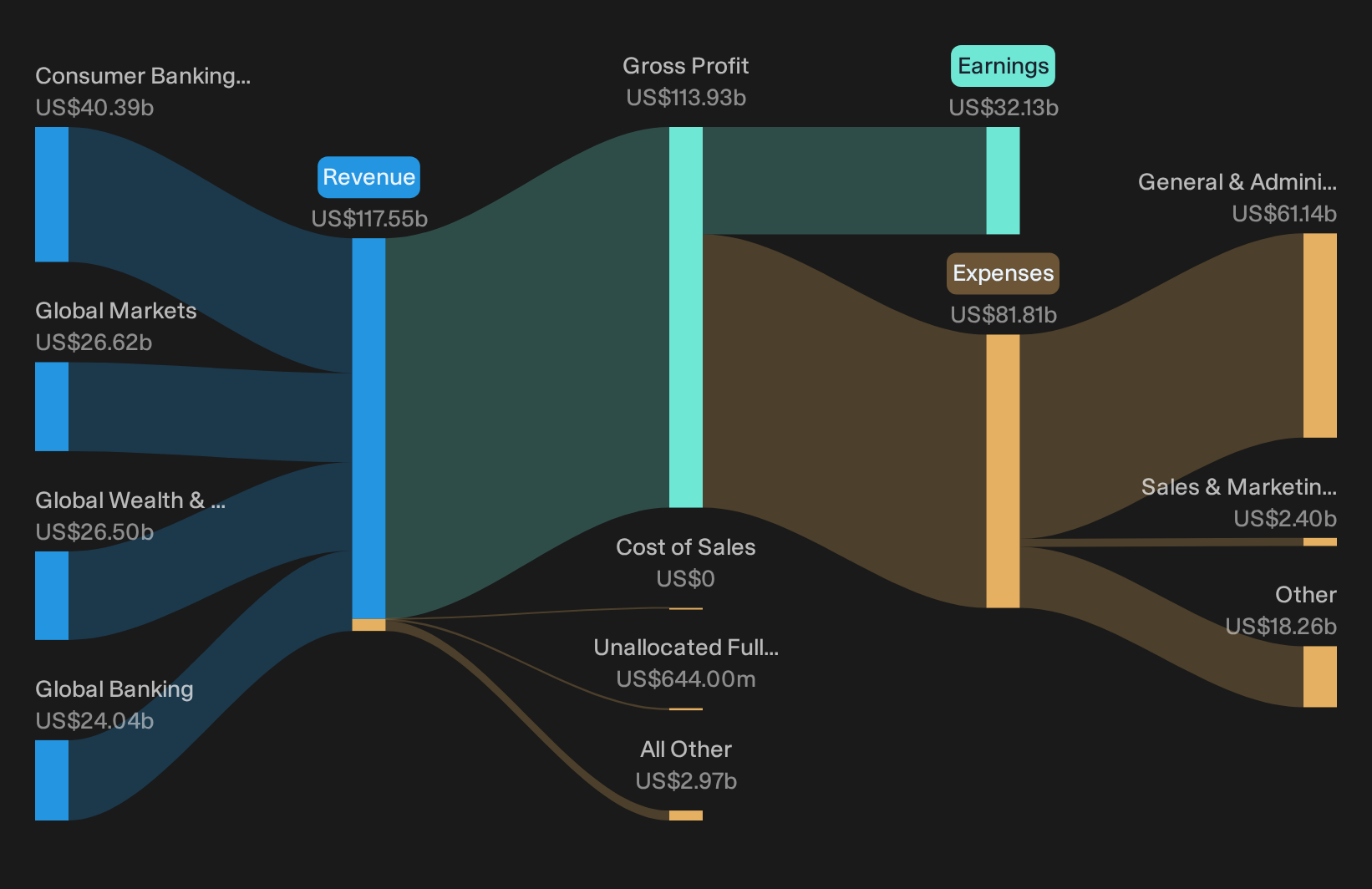
Bank of America runs a global universal banking model, but its rate sensitive Consumer Banking arm generates about US$40.4b of revenue, alongside Global Banking at US$24.0b, Global Markets at US$26.6b and GWIM at US$26.5b, supporting a market value of roughly US$377.6b.
"The company's focus on growing commercial loans and adding new clients, particularly in sectors like international markets and healthcare, suggests potential future revenue growth as these investments mature."
What that ultimately means for Bank of America’s margins now depends on how one quiet tug of war inside its funding costs plays out.
That funding tug of war is exactly what the full narrative for Bank of America unpacks, showing where Bank of America’s earnings power could accelerate if deposit costs and loan yields decouple.
JPMorgan Chase (JPM)
JPMorgan Chase is the heavyweight in this higher long term rates theme, with a large loan book, global payments reach and a deep deposit base that all feed directly into net interest income when longer dated yields stay elevated.
"Higher Payments revenue alongside card fee and net interest income growth, supported by card outstandings growth and solid new card acquisition, reflects effective digital banking expansion that can keep driving lower unit operating costs, stronger customer acquisition and improving net margins."
What happens next for JPMorgan Chase’s margins now largely turns on how one less visible cost line tracks against that higher rate tailwind.
JPMorgan Chase is a global banking and financial holding group that fits this higher long term rates theme through its lending, payments and deposit heavy model, generating about US$67.7b from Consumer & Community Banking, US$85.4b from the Commercial and Investment Bank and US$25.8b from Asset & Wealth Management, and it currently carries a roughly US$883.5b market value.
If that quiet cost line matters to your thesis, the full narrative for JPMorgan Chase shows where higher rates could be accelerating strengths or quietly masking emerging risks.

Seeking Alternatives Before The Crowd
Fresh stock ideas can move from quiet to full breakout before most investors notice. Momentum shifts fast, information ages quickly, and early entries often matter most, so consider acting promptly.
- Explore potential income momentum by scanning companies in the 8 dividend fortresses that could help anchor a portfolio when payouts and balance sheet strength both matter.
- Look for early secular shifts by reviewing the 44 power grid technology and infrastructure stocks that focuses on businesses tied to grid upgrades, electrification, and long term infrastructure demand.
- Monitor niche growth by checking the 34 healthcare AI stocks where healthcare and machine learning intersect in a curated set of focused small and mid caps.
This article by Simply Wall St is general in nature. We provide commentary based on historical data and analyst forecasts only using an unbiased methodology and our articles are not intended to be financial advice. It does not constitute a recommendation to buy or sell any stock, and does not take account of your objectives, or your financial situation. We aim to bring you long-term focused analysis driven by fundamental data. Note that our analysis may not factor in the latest price-sensitive company announcements or qualitative material. Simply Wall St has no position in any stocks mentioned.
Have feedback on this article? Concerned about the content? Get in touch with us directly. Alternatively, email editorial-team@simplywallst.com