
Micron Is About to Triple to $3,000, Says Analyst: ‘If You Don’t Buy It, They Will’
The AI infrastructure buildout continues to reshape semiconductor valuations in 2026. Memory chips, once viewed as pure cyclical commodities, now sit at the center of model performance, inference speed, and context windows. That shift has lifted several chip names this year, yet one stands out for both its gains and its still-modest multiple.
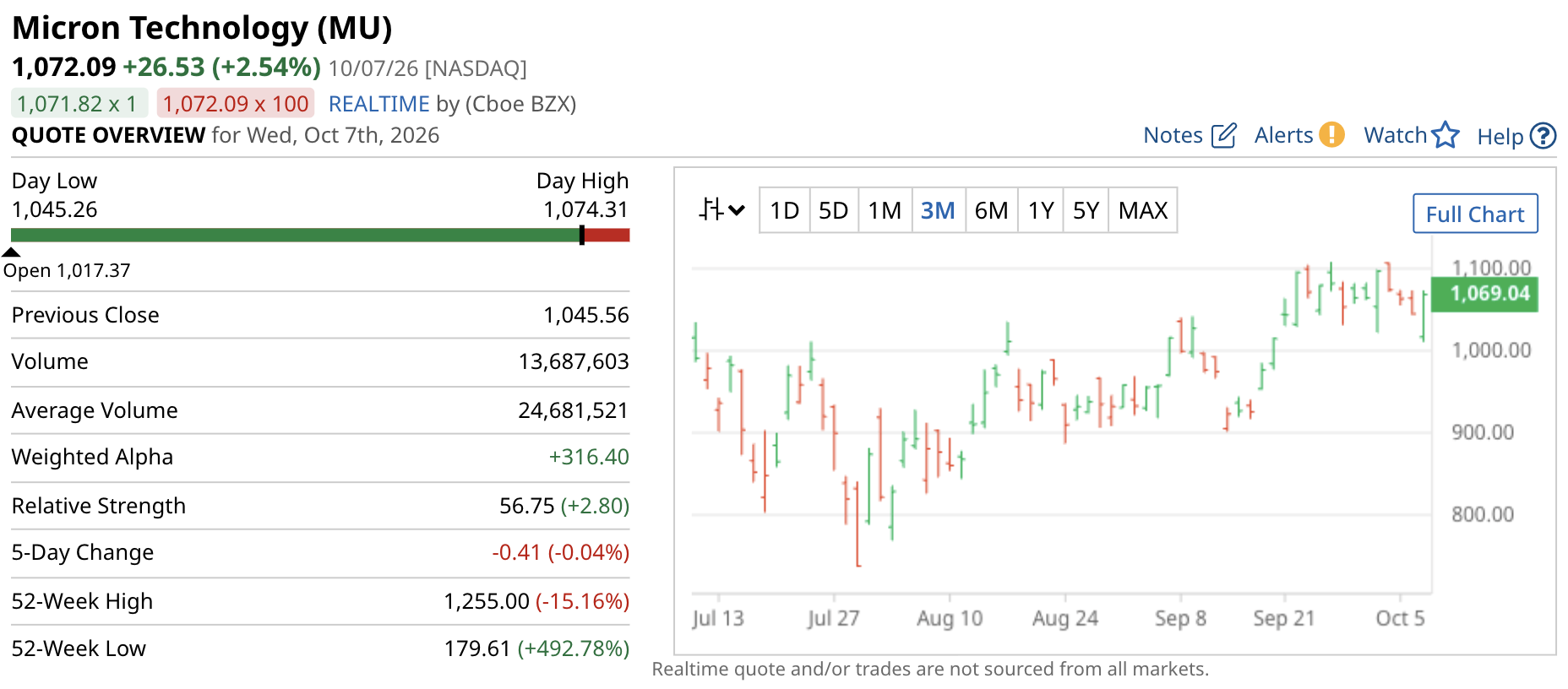
D.A. Davidson analyst Gil Luria raised his price target on Micron Technology (MU) to $3,000 from $2,100 on Oct. 7 while maintaining a “Buy” rating. The new target implies the stock could roughly triple from recent levels near $1,016. Luria argues the broader market still underappreciates a multi-year structural shortage in which memory demand is expected to outpace supply through 2027 and 2028.
His core line captures the thesis cleanly: “If you don’t buy it, they will,” referring to the largest technology companies locking in Micron’s capacity through long-term supply contracts. Specifically, Luria points to Amazon (AMZN), Microsoft (MSFT), Alphabet’s (GOOG) (GOOGL) Google, Nvidia (NVDA), and Apple (AAPL) as the primary counterparties guaranteeing overwhelming demand for AI memory chips at least through 2028.
The Structural Shortage Driving Micron’s Outlook
Luria’s view rests on a simple observation: more memory improves AI results. Larger capacity delivers better model performance, faster inference, and longer context windows. Hyperscalers and AI developers therefore have a powerful incentive to secure every available bit of high-bandwidth memory and advanced DRAM.
Micron has already signed multi-year agreements that lock in volume and pricing visibility. Those contracts cover a meaningful portion of its DRAM and NAND output and stretch years into the future. Management has guided for both volume and price gains through 2028, a point Luria says the company itself validated in its latest results.
The numbers already reflect the change. Micron’s fiscal fourth-quarter revenue reached $54.23 billion, up roughly 379% year-over-year (YoY), with adjusted earnings of $33.42 per share. The company guided first-quarter revenue near $61.5 billion.
Shares have risen 281% year-to-date (YTD), yet the forward multiple has compressed because earnings expectations have climbed even faster. The stock currently trades at about six times the estimated fiscal 2027 earnings. Luria’s $3,000 target applies roughly a 19-times multiple to his fiscal 2027 EPS estimate.
Valuation Gap Versus Peers and the Investing Thesis
Compare that multiple with other AI-exposed names. Advanced Micro Devices (AMD) and Intel (INTC) have traded at far higher earnings multiples even as the market questions the durability of their growth. Micron, by contrast, is still priced as if the classic memory boom-and-bust cycle remains intact. Wall Street has already begun questioning that old assumption.
Luria’s thesis is straightforward for retail investors: the customers with the deepest pockets and strongest balance sheets are guaranteeing demand. Even if public-market investors hesitate, those counterparties are securing capacity years ahead. That visibility is rare in the memory industry and underpins the higher multiple he expects the market to eventually assign.
Granted, memory remains a capital-intensive business. New fabs take years and billions of dollars to bring online. Competitors such as Samsung (SMSN.L.IX) and SK hynix (SKHY) are also expanding. Pricing power can fade if supply catches up faster than expected. Long-term agreements themselves are not ironclad guarantees against every demand swing. Some observers note the limits of those contracts.
That said, the current mismatch between AI-driven consumption and available high-end capacity looks structural rather than purely cyclical through at least 2028.
An additional near-term catalyst is an expected large share-repurchase program later this year once certain Chips Act restrictions lift. Buybacks would reduce share count and support earnings-per-share growth on top of the operating leverage already visible in recent results.
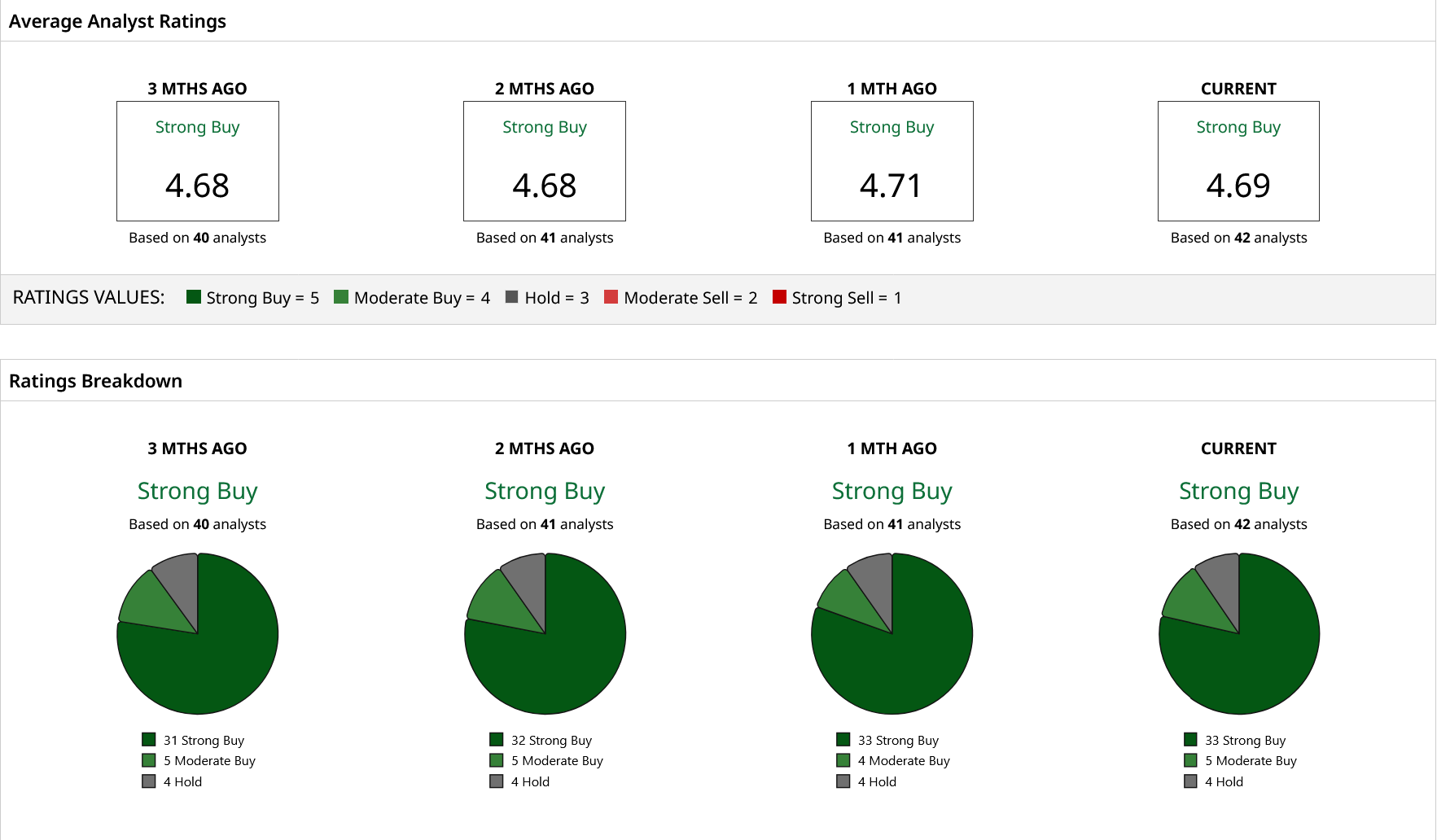
Of the 42 analysts covering Micron, Luria's $3,000 price target is the new Street-high and sits 42.8% above the current high price. It is also 95% above the consensus mean target of $2,100. MU stock has a “Strong Buy” recommendation, with 33 analysts endorsing that view, five assigning a “Moderate Buy” rating, and four ranking it as a “Hold.”
Bottom Line
Micron sits at the intersection of the two most powerful forces in semiconductors right now: explosive AI demand and constrained advanced memory supply. Luria’s $3,000 target is aggressive, yet it is grounded in a clear multiple expansion from today’s roughly 6 times fiscal 2027 earnings to 19 times, supported by multi-year contracts with the world’s largest technology buyers.
For investors willing to accept the historical cyclicality of the memory sector, the combination of locked-in demand, rising prices and volumes, and a still-compressed valuation presents a compelling multi-year opportunity. The smartest money in tech is already buying the capacity. The question for shareholders is whether they want to own the company that supplies it before the multiple catches up.
On the date of publication, Rich Duprey did not have (either directly or indirectly) positions in any of the securities mentioned in this article. All information and data in this article is solely for informational purposes. For more information please view the Barchart Disclosure Policy here.