
Disney Is Slashing Jobs Again. Here’s What DIS Investors Need to Know.
Disney (DIS) is once again trimming the payroll under new CEO Josh D'Amaro, who is continuing his efforts to reduce expenses and refocus the entertainment giant. The latest layoffs come as the company also reportedly considers restructuring its television operations. Can Disney find ways to cut costs while still investing enough to remain competitive in movies, television, and its signature theme parks? That’s the question facing DIS stock shareholders today.
Deadline reports that Disney's latest workforce reductions will affect approximately “a few hundred” employees, mostly from technology and human resources. This marks the company's third round of layoffs since D'Amaro succeeded Bob Iger in March 2026.
Disney eliminated approximately 1,000 positions in April, largely through a consolidation of its marketing operations. Several hundred additional jobs disappeared in July, affecting businesses including Pixar, ESPN, and National Geographic. The company also offered voluntary early retirement packages to some executives in August.
These reductions are part of a larger strategy. In an August shareholder letter, D'Amaro and CFO Hugh Johnston outlined plans to lower labor and administrative expenses, freeing up capital for future growth investments.
Meanwhile, Reuters reports that Disney is considering a television overhaul that could eliminate hundreds of additional positions and reorganize its businesses around streaming rather than traditional television brands. That initiative remains separate from the latest layoffs and may not be finalized until year-end.
Disney has some hard choices ahead. The entertainment giant faces declining traditional television audiences and the challenge of building a streaming business in an increasingly crowded market.
About Disney Stock
Disney is one of the most recognized entertainment companies in the world. Based in Burbank, California, the company owns theme parks in Florida, California, France, Japan, China, and Hong Kong, a cruise line, and film studios that include Disney, Pixar, Marvel Entertainment, and Lucasfilm. In addition, the company operates the Disney+ streaming service, ABC, and the ESPN platform. Disney has a market capitalization of $179 billion.
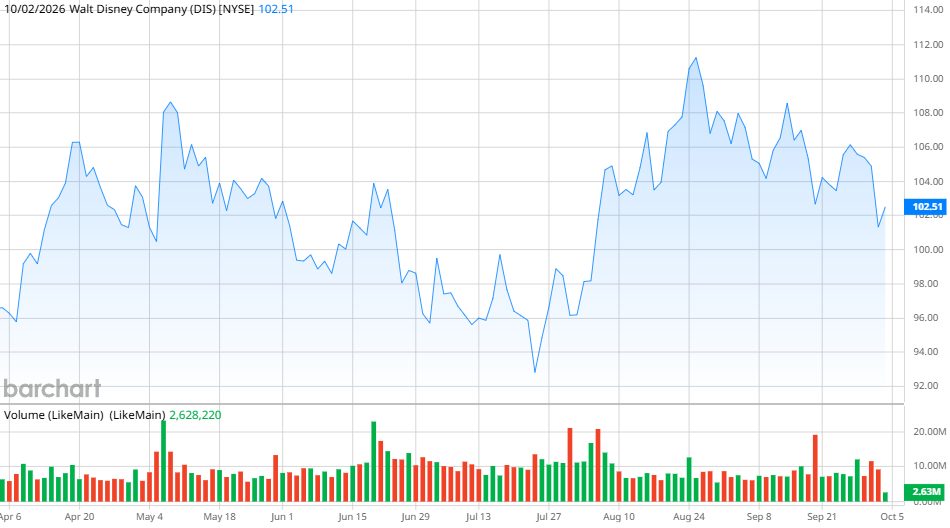
However, the price of DIS stock has been a disappointment this year. Disney stock is down 8% so far this year and down nearly 7% over the past 52 weeks. In the last five years, shares have dropped by 41%, even as the broader market continues to show strong year-over-year (YOY) gains.
Disney stock, however, trades at an attractive valuation right now, with the forward price-to-earnings (P/E) ratio currently at 13.8 times. The company also rewards investors with a small annualized dividend of $1.50 per share, paid in two installments, with a yield of 1.45%.
Disney Beats on Earnings
Disney's latest quarterly earnings exceeded Wall Street's expectations. For its fiscal third quarter, the company reported adjusted EPS of $2.06, beating the consensus estimate of $1.88 per share. Disney also reported Q3 revenue of $25.2 billion, up 6% YOY. Total segment operating income increased 21% to $5.6 billion, supported by growth across its businesses.
In a letter to shareholders, the company highlighted the theatrical release of Toy Story 5 on June 19, the latest installment in the Pixar franchise that features Tim Allen as Buzz Lightyear and Tom Hanks as Woody. “This film's value also extends well beyond the theatrical window,” D’Amaro and Johnston said in the letter. “Its release further lifted the franchise on Disney+, which has over two billion hours streamed, while Toy Story merchandise helped deliver our strongest quarter of year-over-year growth in consumer products revenue in 20 quarters. And as our fans know well, Toy Story has a presence at every park and on every cruise ship we operate around the world.”
Management reiterated its forecast for approximately 16% adjusted EPS growth in fiscal 2026, including the additional 53rd week, as well as double-digit adjusted EPS growth in fiscal 2027 excluding that calendar effect. Disney also raised its fiscal 2026 share repurchase target to at least $9 billion.
Wall Street expects Disney to report EPS of $1.68 in Q4, representing YOY growth of 51%. Analysts also project EPS to climb 17% to $6.92 in fiscal 2026, then increase 8% YOY to $7.47 in fiscal 2027. These figures represent analyst estimates rather than company-issued guidance.
What Do Analysts Expect for Disney Stock?
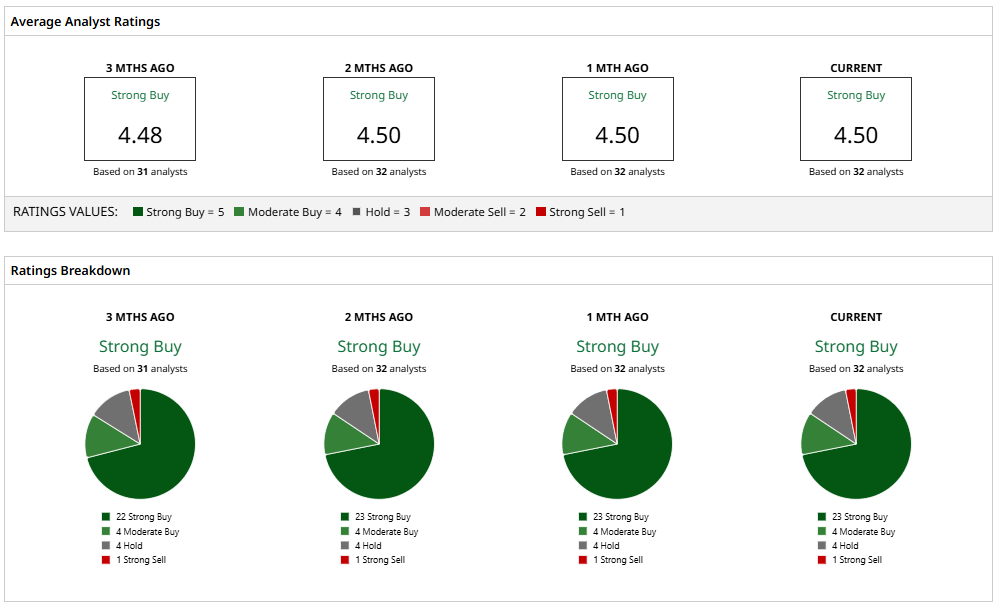
Wall Street remains bullish on Disney despite its ongoing restructuring. DIS stock carries a consensus “Strong Buy” rating among 32 analysts with coverage. Of those analysts, 23 have a “Strong Buy” rating, four have a “Moderate Buy,” four have a “Hold” rating, and only one analyst recommends a “Strong Sell.” The mean price target of $127.60 represents potential upside of about 22% from current levels.
Disney hasn’t set a date for its next earnings report, but management will surely be pressed to discuss how the company will invest in future growth while being in a cost-cutting mode. If Disney shows it can restructure, cut costs, and maintain its position in the entertainment industry, the current dip in DIS stock could be short-lived.
On the date of publication, Patrick Sanders did not have (either directly or indirectly) positions in any of the securities mentioned in this article. All information and data in this article is solely for informational purposes. For more information please view the Barchart Disclosure Policy here.