
3 Space Stocks With Earnings Growth Up To 67%
AI mega-IPOs are sucking up investor attention, yet SpaceX is still private and much of the new orbital buildout is happening quietly in listed companies. That gap creates an opening for anyone tracking the next phase of the global space economy. This article breaks down three stocks from a curated global space infrastructure universe that could help you get exposure before the crowd refocuses.
The stocks highlighted below are only a small sample of the global space race theme, and the full screen surfaced 21 more companies with equally compelling stories that do not fit into a short article format.
If you want to see the wider universe and quickly size up your own ideas, head straight to the Global Space Race Stocks screener to identify, analyze, and rank the space infrastructure contenders that best fit your watchlist.
AeroVironment (AVAV)
Overview: AeroVironment builds uncrewed aircraft, defense robotics, and space-qualified communications hardware that link satellites, drones, and high energy laser systems across multiple domains.
Operations: AeroVironment generates about $1.4b from Autonomous Systems and $584 million from Space, Cyber and Directed Energy, mostly in the United States.
Market Cap: $7.27b
AeroVironment matters for the Global Space Race theme because its space-qualified antennas, laser links, and control electronics are already wired into real orbital infrastructure, not just PowerPoint roadmaps.
"The quarter arrived loaded with confirming data (EHEL awarded, LOCUST international sale announced, Titan contract wins stacking). Yet the call’s analytical interest lies less in the headlines than in what shifted underneath them: a narrative architecture built previously around anticipated inflection has now converted to one anchored in achieved inflection, and the pressure to explain why guidance wasn’t raised has become the new center of gravity."
What matters next for AeroVironment is how one unresolved tension between ambitious buildout plans and near term financial caution ultimately shapes investor confidence.
That push and pull is exactly what the full narrative for AeroVironment unpacks in detail, showing where cautious guidance could be masking an accelerating space infrastructure story.

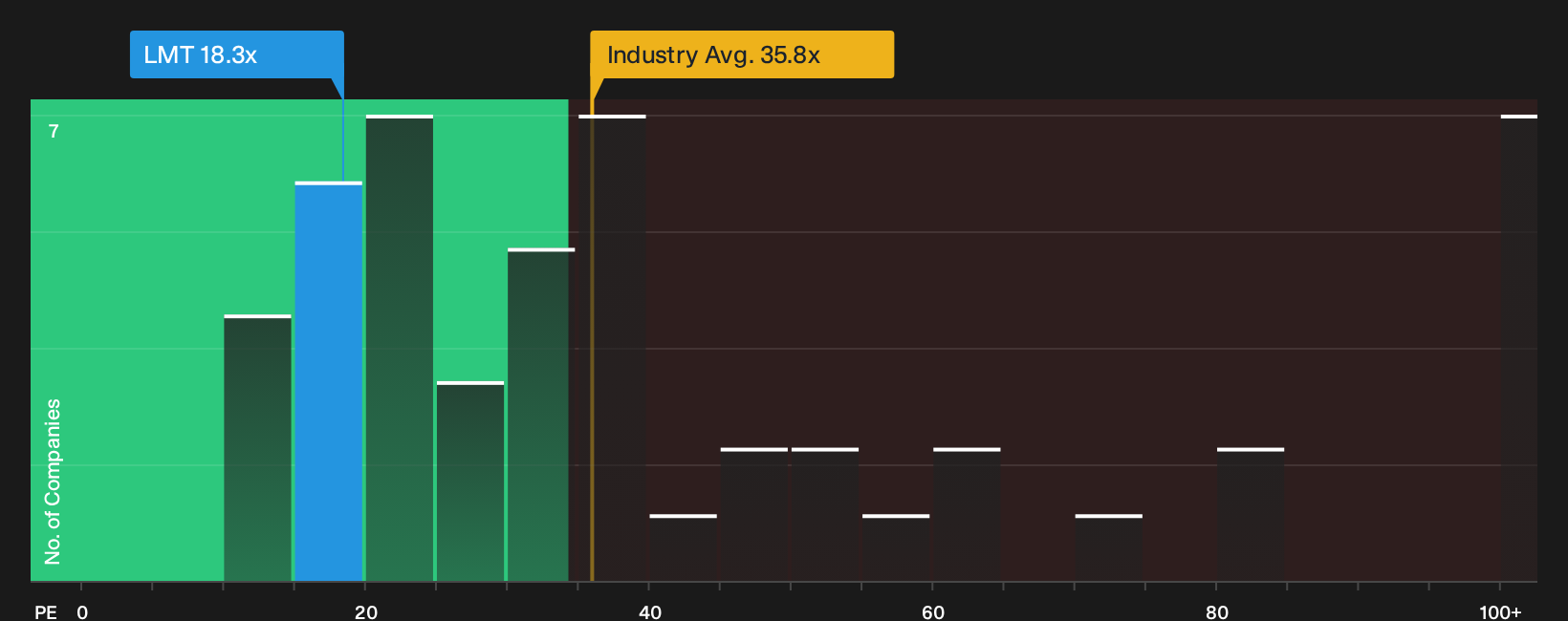
Lockheed Martin (LMT)
Overview: Lockheed Martin develops advanced aircraft, missile defense systems, and a major Space segment that builds satellites and space transportation for government customers.
Operations: Lockheed Martin generates about $31.2b from Aeronautics, $19.8b from Rotary and Mission Systems, $16.4b from Missiles and Fire Control, and $13.8b from Space, with most revenue earned in the United States.
Market Cap: $117.7b
Lockheed Martin matters for the Global Space Race theme because its Space segment supplies satellites, space transport platforms, and secure orbital systems that sit directly in the critical infrastructure layer governments are racing to build.
"Lockheed Martin is moving munitions like PAC-3, THAAD, PrSM and JATM onto seven year framework agreements that aim to triple or quadruple production and allow the company to retain a larger share of cost savings from capacity investments such as robotics in Camden. This can support higher future revenue and structurally stronger net margins."
What happens to those margin ambitions depends on how one less visible constraint on scaling high volume defense programs eventually resolves.
That hidden bottleneck is exactly where the full narrative for Lockheed Martin shows how Lockheed Martin’s ramp, contract structures, and capital spend could be quietly decoupling earnings power from old cycle patterns.
Kratos Defense & Security Solutions (KTOS)
Overview: Kratos Defense & Security Solutions supplies virtualized satellite ground systems, mission software, and defense technologies that tie space assets into wider military operations.
Operations: Kratos Defense & Security Solutions generates about $1.2b from Kratos Government Solutions and $317 million from Unmanned Systems, largely tied to U.S. programs.
Market Cap: $8.21b
Kratos Defense & Security Solutions matters for the Global Space Race theme because its OpenSpace style satellite ground networks and mission software help run the constellations that defense customers are pouring fresh capital into.
"Kratos is well positioned to benefit from a historic surge in global defense spending and modernization initiatives by the U.S., NATO, and Pacific allies, as ongoing geopolitical tensions drive a multi-year expansion in defense budgets."
What happens when heavy upfront spending into these space linked programs meets one stubborn constraint on cash generation will be crucial for investors watching KTOS.
When that cash squeeze meets rising defense demand, the full narrative for Kratos Defense & Security Solutions shows how Kratos Defense & Security Solutions could be quietly accelerating or stalling the whole space-ground story.

Seeking Fresh Alternatives Beyond Space?
Some of the sharpest breakouts start quietly, then momentum snaps into focus once the crowd finally catches on. Scan fresh ideas while it matters and get in early.
- Spot fast movers before headlines catch up by scanning the 20 high quality undiscovered gems that have been filtered for quality fundamentals and kept under the radar for now.
- Target resilient cash generators while others chase hype by reviewing the list of solid balance sheet and fundamentals (25 results) curated for strong finances and durable business models.
- Ride structural demand instead of short lived hype by tracking the 43 power grid technology and infrastructure stocks powering the massive upgrade of aging electricity networks worldwide.
This article by Simply Wall St is general in nature. We provide commentary based on historical data and analyst forecasts only using an unbiased methodology and our articles are not intended to be financial advice. It does not constitute a recommendation to buy or sell any stock, and does not take account of your objectives, or your financial situation. We aim to bring you long-term focused analysis driven by fundamental data. Note that our analysis may not factor in the latest price-sensitive company announcements or qualitative material. Simply Wall St has no position in any stocks mentioned.
Have feedback on this article? Concerned about the content? Get in touch with us directly. Alternatively, email editorial-team@simplywallst.com