
NASDAQ's record high ignites expectations for the US stock earnings season! Citigroup predicts a “profit surprise” of nearly 90% of technology stocks, with Nvidia and AMD leading the list that exceeded expectations
The Zhitong Finance App learned that after the Nasdaq Composite Index hit a record high in one fell swoop and the “AI chip superpower” Nvidia, which has a high weight in the NASDAQ and S&P 500 indices, reached a record high, the third quarter earnings season for US stocks is about to begin. Global investors' enthusiasm for the revenue and profits of US companies to exceed expectations, particularly that the revenue and profits of tech giants closely linked to AI computing power have surpassed analysts' agreed expectations is once again heating up.
On October 6, the Nasdaq Composite Index, which covers the world's most popular technology stocks such as Nvidia, AMD, and Micron, rose 0.45% to 27,599.79 points, hitting a new all-time closing high at the same time as the US stock market benchmark. Among them, the NASDAQ also set the highest trading point in history during the intraday period; the Philadelphia Semiconductor Index, which has a “global AI computing power and semiconductor sector trading trend vane”, rebounded about 4.7% from the end of September, and is getting closer to reaching a record high. Although there was a correction the next day, the global stock market The focus has gradually turned to whether the core performance data of technology companies in the US stock market exceeded expectations during the earnings season to support a further upward trend in the bull market above the new high.
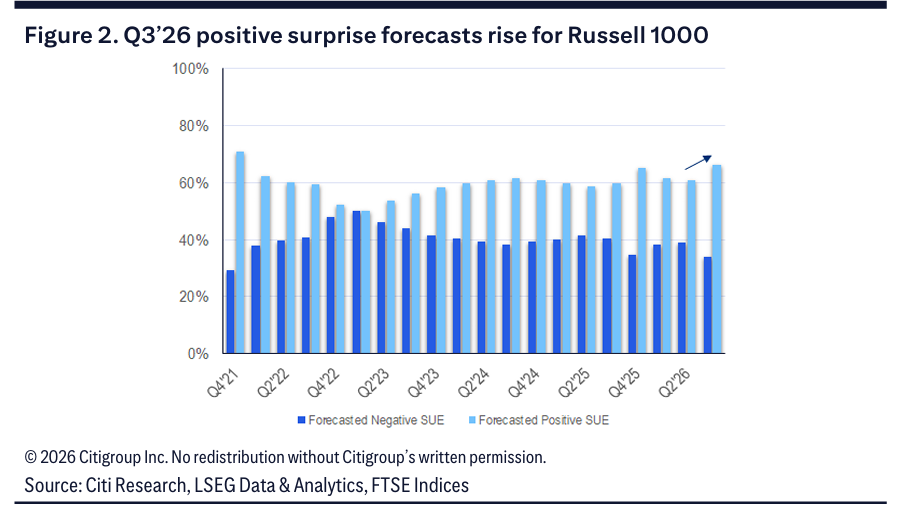
Wall Street financial giant Citigroup's latest quarterly quantitative study released by Wall Street financial giant Citigroup provides a specific basis for this main profit line (that is, technology companies lead S&P and NASDAQ component companies to exceed expectations): Citigroup's exclusive model predicts that 66.2% of the Russell 1000 constituent stocks will experience positive profit surprises (that is, profits exceed consistent market expectations) and related positive stock price return trajectories (that is, the Citigroup model also predicts the positive direction of related stock price returns), which is significantly higher than the already strong 60.9% in the previous quarter, reaching 60.9% since the fourth quarter of 2021 The highest level; the information technology, healthcare, and industrial sectors of the US stock market are leading the way with 88.1%, 75.9%, and 73.8% positive profit surprise forecasts and positive share price returns, respectively, and Citi emphasizes that investment opportunities are further biased towards large market capitalization companies such as Nvidia, AMD, Intel, Texas Instruments, Applied Materials, and Kelei, which focus on AI computing infrastructure construction topics. In the future, a new round of bull market rotation is expected to spill over into the medical and industrial business.
At the same time, the Citigroup strategist team said that Wall Street analysts agree that the S&P 500 index's profit increase in the third quarter has been significantly revised from 26.7% at the beginning of the quarter to 29.6%. The energy and AI technology topics are the main source of incremental improvements, and all 11 industries are expected to achieve year-on-year profit growth. Citigroup also combined earnings forecasts with fundamental ratings of stock stocks and crowding in long transactions to select candidates such as Nvidia, AMD, Intel, Applied Materials, and Ke Lei for “Surprise Forecast for the Positive Earnings Season + the Most Optimistic Stock Rating of 'Buy'”, and pointed out that healthcare and industry also have a wide range of opportunities to realize their performance.
Citigroup's latest research report's most investmentally-significant judgment is that the overall profit support of the US stock market is still concentrated on a few technology leaders closely linked to the AI computing infrastructure frenzy, but opportunities that can surpass market expectations are rapidly spreading and penetrating the medical and industrial sectors; the next stage where stock prices exceed the alpha performance benchmark will depend more on the specific level of profit growth and fulfillment, and how much optimistic expectations investors have taken into account before and whether the market's bullish positions are overcrowded.
The AI superbull market currently sweeping the global stock market seems to be looking for a “profit takeover window” — that is, when 10-year US bond yields hit new highs for more than 20 years, leading to DCF's denominator expansion, as long as earnings per share continue to grow, the stock market does not need to rely on the price-earnings ratio to rise again to a high level; if interest rate/US bond yield pressure then eases, stable valuations may also increase earnings space.
Another Wall Street financial giant, J.P. Morgan Chase, said that what the agency's strategist team is optimistic about is a rearrangement opportunity formed by easing position congestion, falling valuations, and profit resilience. They particularly prefer semiconductors. According to the latest research report released by the agency, since June, the earnings forecast for semiconductors per share for the next 12 months has been raised by about 30% to 40%, and the profit forecast for the global software sector has not improved accordingly; the capital expenditure forecasts for hyperscale cloud computing vendors recently quoted by the agency are: about 950 billion US dollars in 2026, about 1.4 trillion US dollars in 2027, at least 3 trillion US dollars in 2030, and it is expected that the pace of AI-related revenue growth in 2027 will show a blowout expansion trajectory.
The core change brought about by the recently popular Meta Muse AI agent and the OpenAI Astra large model/AI agent “comparable to AGI” is that a single user command can trigger continuous, multi-stage computational work. A research, programming, or office task may in turn include planning, retrieving, reading documents, calling tools, executing code, checking results, and fixing errors. Multiple steps require reinvocation of models, and complex tasks may also use parallel exploration and verification. Such an almost endless and increasingly complex AI workload will accelerate the transmission of growth opportunities to a complete AI inference load computing power system beyond the GPU.
From the perspective of AI inference system architecture, more complex AI tasks led by Meta Muse often include longer context, multiple rounds of model calls, tool execution, and result verification: prefill (prefill) requires processing input, decode (decode) continuously generates output, and key value cache (KV Cache) takes up more memory as context and concurrency scale expand, and computational throughput, memory bandwidth, and capacity need to be increased collaboratively. Therefore, as cutting-edge intelligence such as Meta Muse further detonates demand for AI computing power, the core reasoning for the AI computing power industry is that GPUs and TPU undertake model computation, high-performance data center CPU tool execution and task orchestration, and HBM, server DRAM, storage and high-performance network infrastructure, and data center optical interconnect devices all support efficient data transportation and state management; ultimately, a complete set of AI computing power server clusters will be needed to deliver sustainable services.
After the NASDAQ hit a new high in one fell swoop: technology led Citi's “profit surprise” list, and healthcare and industry are expected to join the rotating ranks of the super bull market
The Citigroup strategist team said that the positive signs of the US stock earnings season were reflected in the continued expansion of the coverage of the “positive forecast” list, while the advantages of large market capitalization companies such as Nvidia, AMD, and Broadcom were further strengthened. Citi expects the share of positive profit surprise and positive return candidates in Russell 1000 to rise from 60.9% to 66.2%, a significant increase of 5.3 percentage points; divided into five groups by market capitalization, the largest market value group accounted for 77.0%, followed by 68.3%, 66.7%, and 60.7%. The minimum market value group was only 46.6%, down 3.4 percentage points from the previous quarter.
Looking at changes in the industry, the positive forecast for healthcare increased by about 18 percentage points compared to the previous quarter, with material and optional consumption each increasing by about 10 percentage points, and the industrial increase by about 9 percentage points; mandatory consumption and utilities each declined by about 6 percentage points, and the negative forecast for utilities reached 72.2%. Citi said that these model estimates mean that the market is forming a financial reporting structure where “technology maintains leadership, medical and industrial improvements, and large companies dominate”, rather than all sectors strengthening at the same time. Therefore, for market capitalization-weighted benchmark indices, the profit realization of large enterprises has a stronger index-driving effect; improvements in healthcare and industry provide a critical foundation for the upward momentum to expand from a few technology companies linked to AI computing power to more industries.
The profit growth rate of listed companies in the US stock market and their ability to exceed expectations determine the investment appeal of the earnings season. The comparison between the healthcare and energy sectors is particularly enlightening for global stock market investment strategies. The S&P 500 index's profit growth forecast for the third quarter was 29.6%, up 2.9 percentage points from the beginning of the quarter; among them, the energy profit growth rate was raised from 79.3% to 118.6%, the profit growth rate of the technology sector was raised from 57.1% to 65.0%, the communications services sector is expected to grow by 51.5%, and the industry is 14.5%.
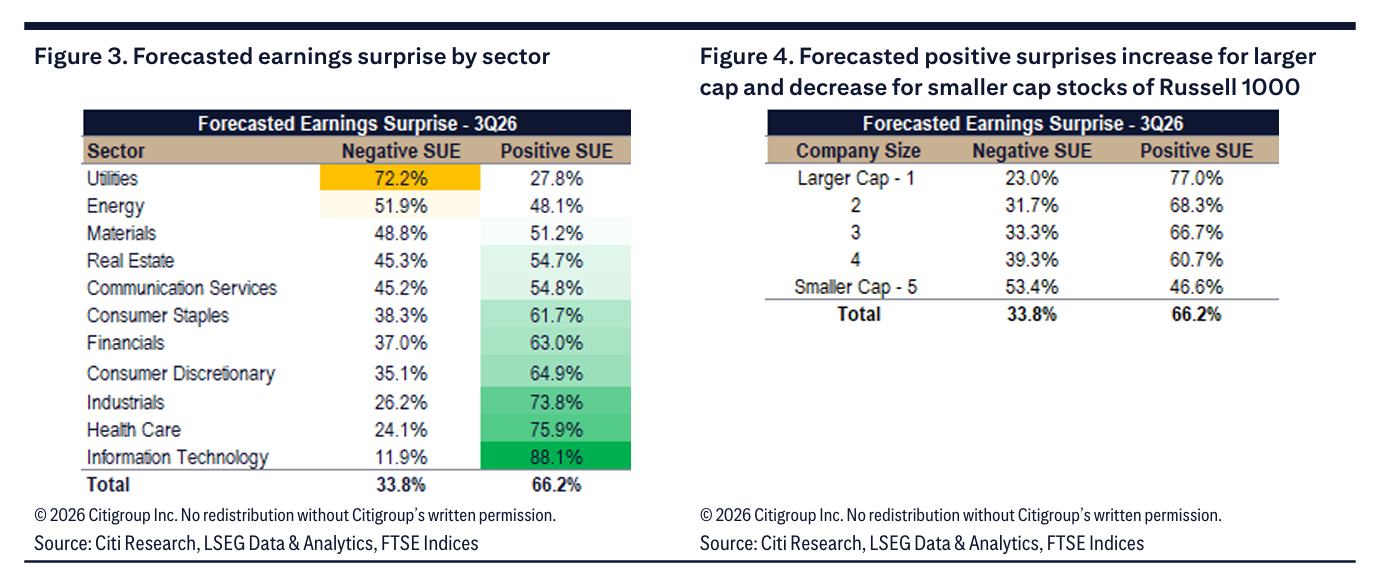
However, according to Citi's forecast data and model estimates, the healthcare sector's profit growth forecast was lowered from 8.7% to 5.1%, and its share of positive surprise candidates reached 75.9%; although Energy has the highest expected profit growth rate, only 48.1% of positive surprise candidates. The underlying logic of Citi's quantitative model calculation is that the stock price response depends on the gap between actual performance and previous expectations: the healthcare sector is more likely to show companies with better fundamental performance than the market's original judgment after being revised down; the energy sector needs to cross the profit threshold that has already been clearly raised.
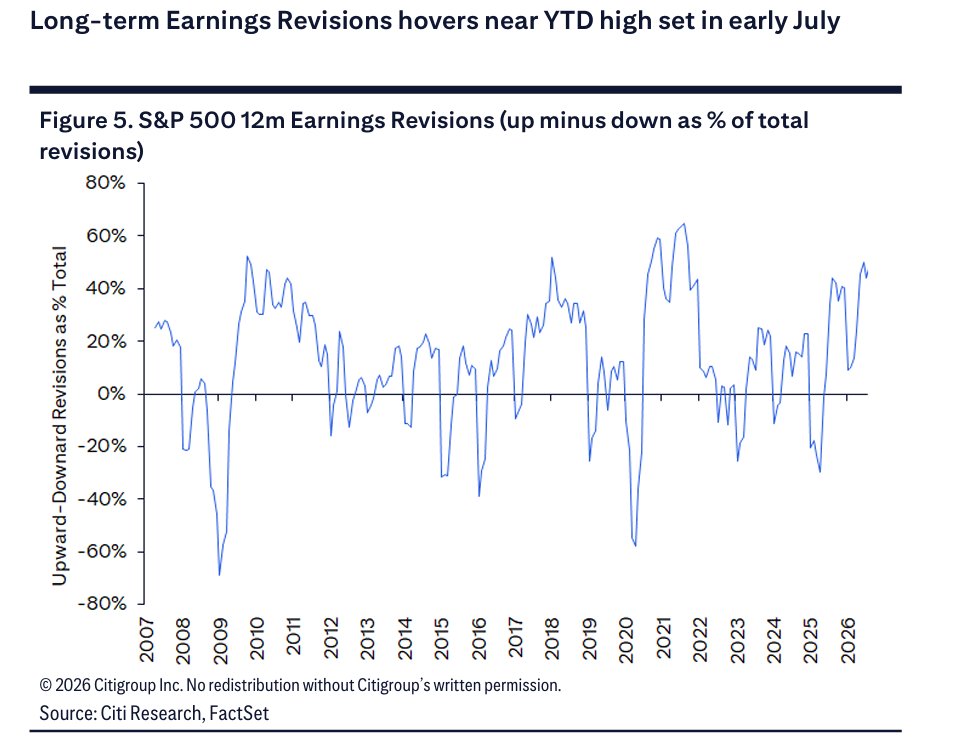
The 12-month revised profit forecast index of top Wall Street analysts in the US stock market compiled by Citibank is still close to the high level of the year set in early July, showing that analysts' strength to raise profit expectations is still strong, but the 29.6% growth forecast for the third quarter is significantly lower than the 52.4% announced in the second quarter. Therefore, the positive changes in this quarter were mainly an increase in profit expectations and an expansion in positive surprise coverage.
The Citigroup model is looking for a combination that “performs better than expected and can translate into a rise in stock prices.” The report measures profit surprise using standardized windfall — SUE = the difference between actual quarterly earnings per share and analysts' agreed average expectations, divided by the standard deviation predicted by analysts — and indicates that about 38% of companies in the historical sample experienced a situation where the direction of profit surprise was opposite to the direction of stock price return. This explains why “earnings exceeding expectations” may still be accompanied by falling stock prices.
In order to improve the targeting of financial reporting events, Citi uses logical regression to calibrate data from the past 24 quarters to include SUE for the past four quarters, surprise direction for the first two quarters, expected profit momentum for nine weeks, total return relative to the market for the past 20 trading days, consistent ratings from analysts, and rating changes in nine weeks, and rule out specific situations where profit surprises are opposite in the direction of stock price reaction. The investment logic of the Citigroup strategist team is to simultaneously seek continuity in profit performance, improvement in analysts' expectations, and confirmation of market prices. Therefore, the value of 88.1% of the technology industry specifically measures the proportion of companies in the industry classified as “positive prediction” by the model, reflecting the breadth of positive signal coverage.
From strong orders for AI chips to sector relay: looking for “unanticipated dividends” for the earnings season
According to information, the positive semiconductor sector list shown on Citigroup's “Positive Candidate” list covers the core area of the AI computing infrastructure frenzy — that is, AI computing chips such as AI GPU/AI ASICs and data center CPUs. It also covers simulation and power management, manufacturing equipment, testing, and materials, providing a complete semiconductor industry chain perspective to observe how strong profits in the technology sector have exceeded expectations.
Nvidia, AMD, Intel, Texas Instruments, Adderall, Core Systems, Microchip Technology, Applied Materials, Clay, Terada, Entegris, and MKS all simultaneously met the “model predicts positive profit surprise and positive return” and Citibank's fundamental “buy” ratings. Looking at engineering and industrial logic, these companies each correspond to the core computing power supply, chip power supply and signal processing, semiconductor manufacturing process and control covering etching and thin film deposition, advanced semiconductor packaging and testing, and material purity: AI computing power construction requires the entire supply chain to complete delivery together, and the profitability of different enterprises also depends on product portfolios, capacity utilization, and cost structures.
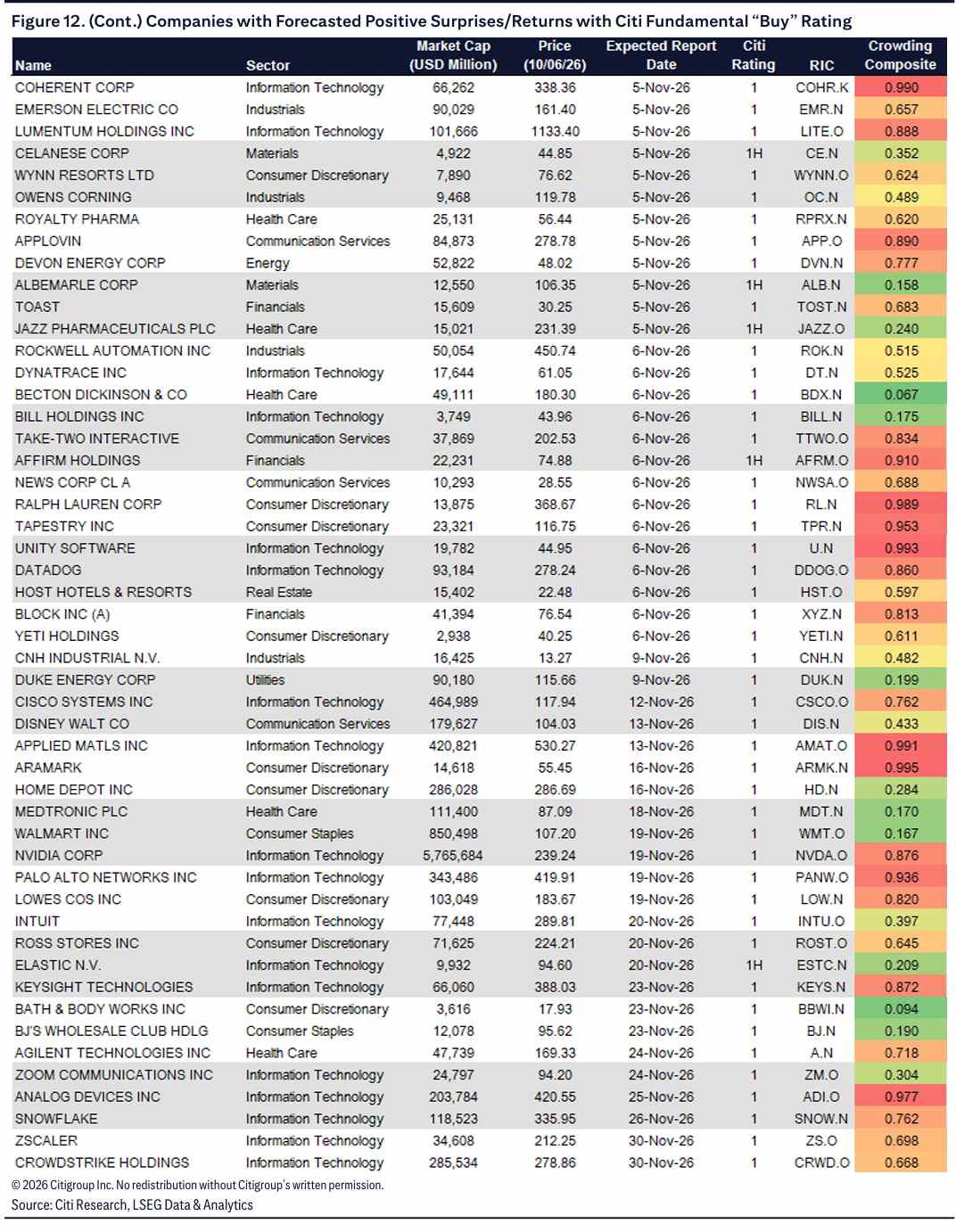
The positive forecast list compiled by Citi, which covers a number of US listed companies, also covers chip companies serving traditional industries and other terminal markets, thus providing significant candidates for observing the semiconductor boom's drastic expansion into more investment segments/fields. Relevant positive candidates also include optical communication companies — Coherent and Lumentum, leaders in the data center optical interconnection industry chain in the US stock market; Western Digital, a leading US storage equipment company; and software companies such as Cadence and ServiceNow. The prices provided in the report were all stock prices on October 6, 2026, and no specific target price or expected increase was given.
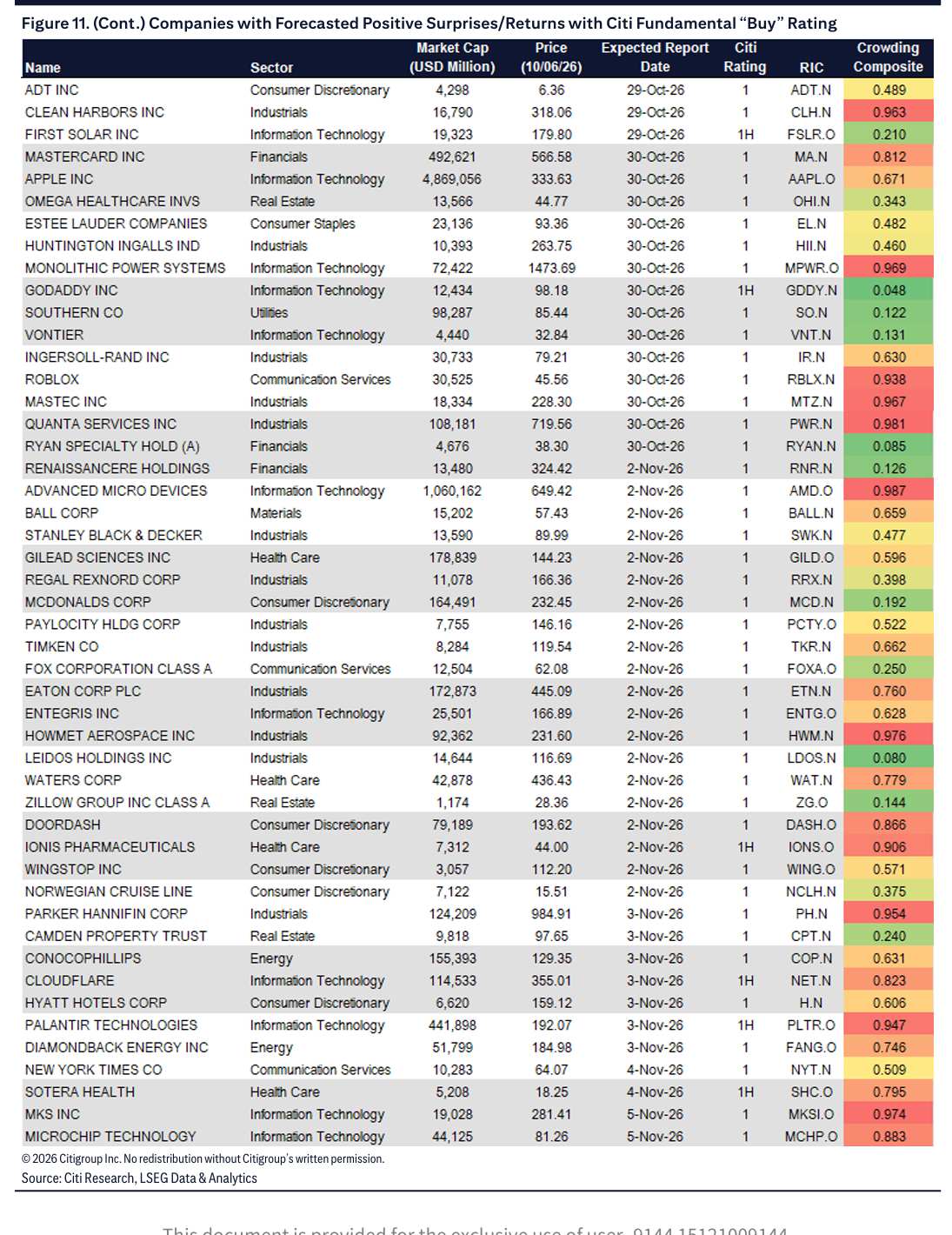
The significance of healthcare and the wider industry is to provide various sources of profit surprises and positive return on investment during the earnings season, extending investment opportunities from popular computing power transactions to broader business operation improvements. According to the Citigroup strategist team, medical candidates include Johnson & Johnson, Abbott, Intuitive Surgery, Danaher, Thermo Fey, Dekang Healthcare, Edwards Life Sciences, and Medtronic, covering pharmaceuticals, medical devices, surgical robots, diagnostic and life science tools; industrial candidates include GE Aerospace, RTX, Caterpillar, as well as Vidus, Eaton, Quanta Services, Carrier, Emerson, and Rockwell Automation.
From an industrial chain perspective, companies such as Weidi and Eton provide specific targets for observing the global AI computing power infrastructure investment landscape to accelerate the spread and transmission of power supply and distribution, thermal management, and data center infrastructure revenue; aerospace, machinery, and automation companies represent other sources of profit in the industrial sector. As a result, technology and industry have a business link to invest in AI infrastructure, while healthcare provides a main line of financial reporting driven by adjustments in its own operating performance and expectations. According to Citigroup model calculation data, the congestion level of some healthcare candidates is also significantly lower than that of popular computing power stocks, such as Medtronic 0.170, Intuitive Surgery 0.266, Dekang Healthcare 0.287, while Vidi reached 0.970 and GE Aerospace reached 0.980. This makes the combination of “a significant increase in positive forecasting and lower transaction congestion for some companies” in the healthcare sector, making it an incremental opportunity worth watching in the Citigroup Research Report.
Another real “positive” difference in stock selection during the earnings season also depends on whether the good news has been fully traded. As a result, Citi places congestion in the same important position as profit forecasting. Among the seven major tech giants in the US stock market (that is, the Magnificent Seven), Google's parent companies Alphabet, Microsoft, Apple, and Nvidia received positive model measurement signals, with Tesla, Meta, and Amazon showing negative signals; among them, Meta and Amazon's fundamental ratings are still buying, reflecting the stark difference between the short-term financial reporting judgments shown by Citigroup's model estimates and medium- to long-term investment ratings. Meta's congestion level was 0.955, Nvidia was 0.876, Microsoft was 0.684, and Apple was 0.671; Microsoft's congestion level increased from the beginning of the quarter, while Tesla declined markedly. Based on this, Citi emphasized that once companies with more crowded transactions experience negative surprises, they are more likely to withstand the pressure of centralized adjustments; if undercrowded companies hand over major surprises at the positive profit level, they may attract more new investors.
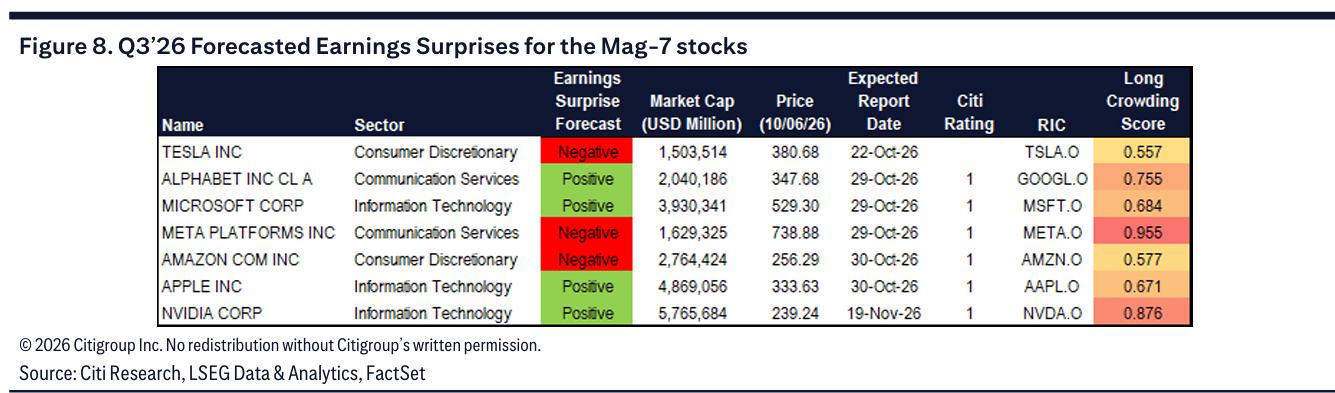
As a result, the Citigroup strategist team specifically listed low-congestion positive buying candidates such as GoDaddy, Bidi Healthcare, Leidos, and Procter & Gamble, as well as high-congestion negative neutral or selling candidates such as Phillips 66, Vornado, and PPL; subsequent negative lists also included Qualcomm, AbbVie with neutral ratings, and Moderna and The Trade Desk with selling/high risk ratings. Citigroup's investment path for the earnings season is based on strong profits from AI computing power-related technology leaders as the core of the strategy, finding new sources of return from positive candidates in healthcare, industry, and low congestion, and using a benchmark strategy for differentiating opportunities for different companies within the same industry/sector.