
Deutsche Bank is optimistic about US stocks at the end of the year: the Q3 profit growth rate is expected to remain 34%, and AI and cyclical growth are still strong
The Zhitong Finance App learned that Deutsche Bank released a US stock earnings forecast report for the third quarter of 2026, saying that the multiple downwinds that drove the profit growth rate of the S&P 500 index to a record high of 34% in the second quarter were still strong in the third quarter. The growth rate is expected to remain at 34% in the third quarter, and there will be no deceleration in profit growth.
In contrast, the market unanimously expected a growth rate of 26.7% in the third quarter, implying a 7.5 percentage point decline from the second quarter. Deutsche Bank's forecast was about 6 percentage points higher than the agreed forecast, while the average margin of exceeding expectations in the historical earnings season was only 3.3%. The bank believes that this season will once again usher in higher-than-average performance than expected.
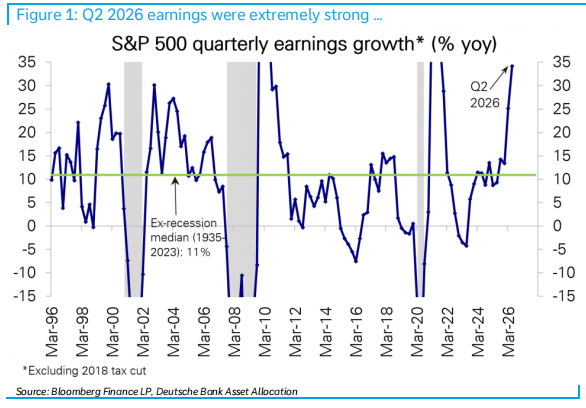
Driven by the three major downwinds
Deutsche Bank pointed out that the profit boom stemmed from the three major downturns simultaneously: the increase in AI demand, which reached 54% year-on-year growth, contributing 20 percentage points to the overall growth rate; the cyclical growth rebound, excluding the technology, energy and materials sectors, the growth rate was 14%, contributing 8 percentage points; and rising petroleum and commodity prices contributed 108% to the profit growth of the energy and materials sector, contributing 7 percentage points.
It should be clarified that the 34% growth rate has been adjusted, excluding one-time items such as earnings from Alphabet's sale of assets and unrealized returns from Amazon's investment. The unadjusted growth rate was as high as 53%.
Three major differences between Deutsche Bank and the market
AI demand shows no signs of slowing down
In response to the market's concerns about whether AI demand can continue, Deutsche Bank believes that several indicators show that AI demand growth in the third quarter was still very strong. As an example, the bank said that the growth rate of South Korea's semiconductor production and exports accelerated further from the second quarter to the third quarter, while the continued rise in GPU rental prices indicated that the supply and demand situation was still very tight.
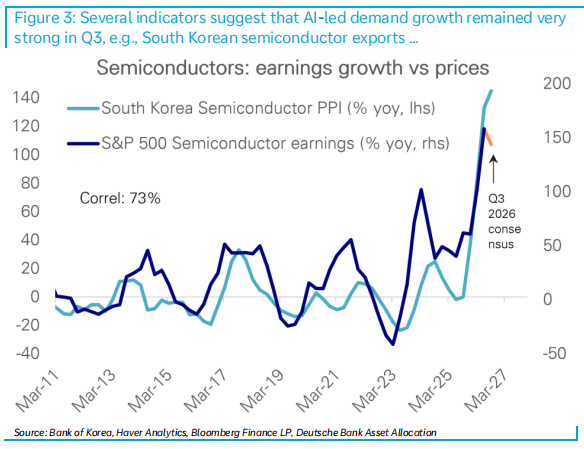
South Korea's semiconductor export growth rate rises
The bank expects that AI demand will drive the profit growth rate of large-cap growth stocks and the technology sector to maintain a high level of 54% in the third quarter, and as its weight in S&P 500 earnings rises, its contribution to the overall growth rate will rise from 19.5 percentage points in the second quarter to 21 percentage points.
Cyclical growth further accelerated
Deutsche Bank pointed out that numerous indicators showed a further strengthening of cyclical growth in the third quarter. The US ISM manufacturing index rose sharply to its highest level in four and a half years in the third quarter, and this indicator has always been the leading cyclical indicator of the S&P 500's profit growth rate.
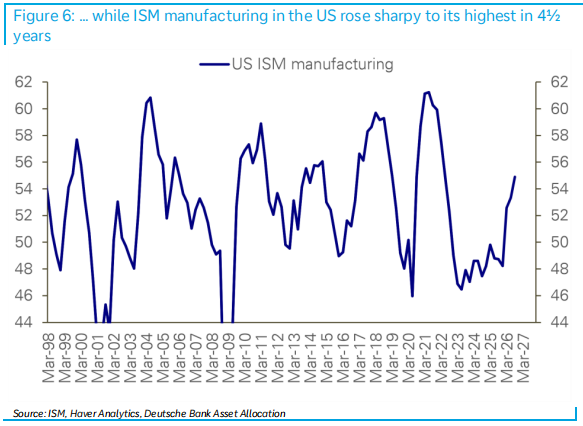
The US ISM manufacturing index rose
The consistent macroeconomic forecast shows that the US GDP growth rate will accelerate from 2.2% in the second quarter to 2.8% (month-on-month discount) in the third quarter, and the Atlanta Federal Reserve's tracking forecast is as high as 3.7%. Furthermore, growth in retail sales, industrial production and capital goods shipments remained strong, and cyclical employment continued to pick up after bottoming out in February.
The impact of lagging oil prices is limited, and tariff refunds have added further support
Deutsche Bank believes that the negative impact of the lag in high oil prices is still moderate and concentrated in specific sectors. According to the research report, historically, the impact of oil price shocks on profits in other sectors of the S&P 500 lags behind 2 to 3 quarters, and the magnitude is usually moderate, because most companies respond by raising prices and increasing productivity.
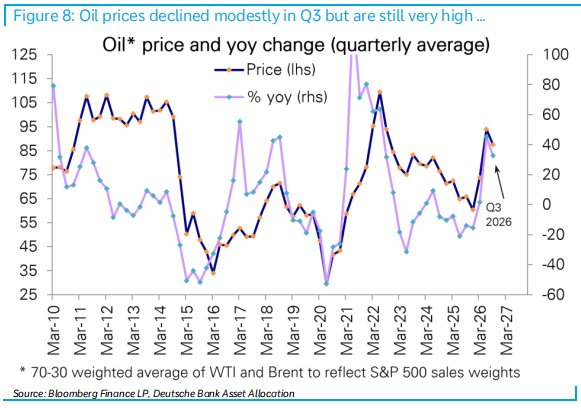
The aviation, automobile, and some consumer sectors have been hit faster and harder, but profit expectations for these sectors have been drastically lowered since the outbreak of the war in Iran. The aviation sector has been lowered by 17%, the automobile and packaging sector by 9% each, and the travel sector other than aviation by 6%. Furthermore, after the Supreme Court ruled that the IEEPA tariffs were invalid, the company continued to receive tariff refunds. The bank expects this to be the same as in the second quarter, contributing about 2 percentage points to the overall profit growth rate in the third quarter.
The earnings season is compounded by the midterm elections, and the year-end market risk returns are beneficial
Deutsche Bank emphasized that the earnings season has always been good for the stock market. Since the financial crisis, the S&P 500 has risen in three-quarters of the earnings season, with an average increase of 2%. This characteristic was even more obvious in the past year. Although this season coincides with the FOMC meeting at the end of October and the US midterm elections in early November, which may bring additional fluctuations, historical patterns show that the market rebounded after major risk events landed sideways or weakened.
The bank also pointed out that risk-return in the fourth quarter of the midterm election year has always been very favorable. Of the past 23 election years, the S&P 500 rose in the fourth quarter in 21, with an average increase of 7%. Taken together, the bank believes that the current risk-return on US stocks is still beneficial.