
$285 million, 10.3%, and 0.163: One of These Numbers Is the Real Reason This Energy Stock Is a Screaming Buy Right Now.
Key Points
Oil tanker company DHT Holdings boasts a dividend yield of 10.3%.
The company has lower net debt and a lower debt-to-equity level than its peers.
DHT's revenue is a blend of long-term deals and short-term charter rates.
DHT Holdings (NYSE: DHT) is an independent crude oil tanker company operating very large crude carriers (VLCCs). It has a fleet of 23 VLCCs and is reporting record profits amid upheaval in the crude tanker market from various global conflicts.
There are three key numbers that make the energy stock an attractive buy. It reported $285.5 million in revenue in the second quarter. Another key number is the company's 10.3% dividend yield, and the last key number is its 0.163 debt-to-equity ratio.
Missed AI’s "Act 1"? Act 2 Could Be 15x Bigger. Most investors think they missed the AI boat because they didn't buy Nvidia in 2005. But according to our analysts, we’re only at the end of "Act 1"—the R&D phase. "Act 2" is the global rollout. Continue »
While all three numbers are significant, the one I'm paying the most attention to is its debt-to-equity ratio. Here's what makes this number significant.
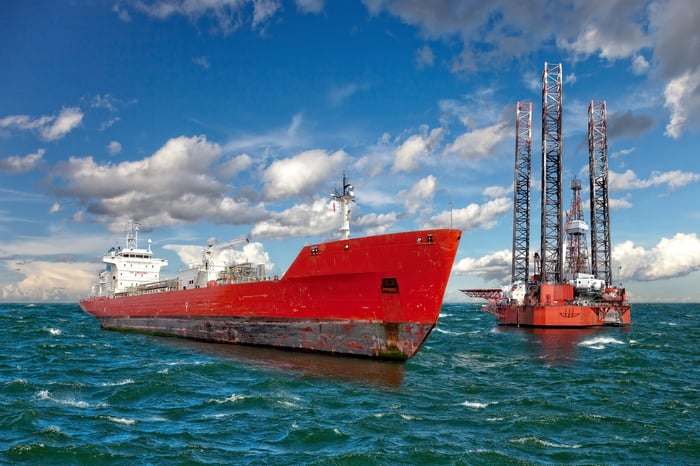
Image source: Getty Images.
Revenue has surged for the industry
DHT reported second-quarter revenue of $285.5 million, up 52.8% sequentially and 123% year over year. But that growth reflects a trend across the sector. The single most powerful driver of tanker revenue is ton-mile demand, which is the product of oil volume and distance traveled. Global sanctions following geopolitical conflicts have forced a structural rerouting of energy trades.
European nations replaced the short-haul Russian Baltic pipeline and Black Sea crude with long-haul imports from the U.S. Gulf Coast, Brazil, and West Africa. Simultaneously, Russian crude shifted away from Europe toward Asian buyers, primarily India and China, turning short multi-day voyages into long multi-week transits. The increased transit time effectively absorbs fleet capacity, reducing the number of available ships on the spot market and driving charter rates significantly higher.
That was before the war in Iran. Once that conflict began, many long-distance crude and product tankers rerouted around the Cape of Good Hope at the southern tip of Africa to avoid drone and missile attacks in the Red Sea. This adds 10 to 14 days to a typical voyage between the Middle East and Asia and Europe, drastically tightening global ship availability.
In addition, regional tensions and security risks surrounding Middle East transit routes have caused severe local vessel bottlenecks and forced shippers to pay elevated war-risk premiums and higher daily spot rates.
Most of its competitors have a high dividend yield
While DHT's high dividend yield is enticing, it is hardly unique among its competitors. That's because DHT, Frontline, International Seaways, and Okeanis Eco all deliver above-average dividends right now. They're able to do this because short-term spot-market charter rates for crude tankers have soared over the past year thanks to the Iran war.
That doesn't mean that these high yields are sustainable once spot-market rates come back down to Earth. DHT and its competitors have all raised and lowered their dividends over the past decade.
DHT's hybrid revenue model provides stability
Unlike many maritime shipping peers that carry heavy leverage, DHT maintains a low debt-to-equity ratio and strong liquidity metrics. Its low net debt -- which fell from $349.7 million in the second quarter of 2025 to $273.1 million in the second quarter of 2026 -- reduces cash break-even levels across the fleet, allowing the company to remain profitable and avoid financial distress even during cyclical downturns in charter rates.
The company does this by benefiting from short-term spot-market charter rates and long-term deals that, while they limit upside, provide stability, allowing it to maintain its ultra-high dividend even when spot-market charter rates plummet.
On Sept. 14, DHT announced a lucrative three-year time charter for the 2016-built VLCC DHT Panther at $100,000 per day, beginning this month. The deal, secured with an unnamed major global energy company, reinforces the company's fundamental drivers by locking in multi-year revenue, enhancing operating cash flow predictability, and strengthening balance sheet health to safeguard dividend coverage regardless of near-term spot market volatility.
It's a good time to be a tanker company
All of its competitors are healthy right now, but DHT combines an ultra-high dividend with greater financial stability, making it a better long-term risk for dividend investors. Yes, its dividend could easily drop, but the company is built to withstand short-term shocks better than its competitors.
James Halley has no position in any of the stocks mentioned. The Motley Fool has no position in any of the stocks mentioned. The Motley Fool has a disclosure policy.