
UnitedHealth Group (UNH) Stock Still Looks Undervalued After Medicare Reset
UnitedHealth Group has seen its share price move in different directions over recent periods, with a modest gain over the past year but a much weaker showing across three years. That mixed record, alongside fresh efforts to reshape the Medicare offering and overhaul senior leadership, raises a straightforward question for investors who focus on earnings: is the current valuation grounded in what the business is actually earning today?
- Over the past three years the stock has declined 24.8%, which puts the spotlight firmly on whether the current earnings base justifies where the share price now sits.
- New Medicare Advantage plan designs that emphasize affordability and a more connected care experience, together with a multi year margin recovery effort, may support different expectations for future profitability than the past share performance alone suggests.
- Your read on UnitedHealth Group is one view; the desks covering it have another. See what analysts think UnitedHealth Group's shares could be worth.
The issue now is whether UnitedHealth Group's current share price is adequately supported by its earnings when judged against the Fair Ratio benchmark.
If you want to test the same earnings-based valuation question beyond UnitedHealth Group, apply the rule to a wider field using 27 high quality undervalued stocks.
Is UnitedHealth Group a Bargain on Earnings?
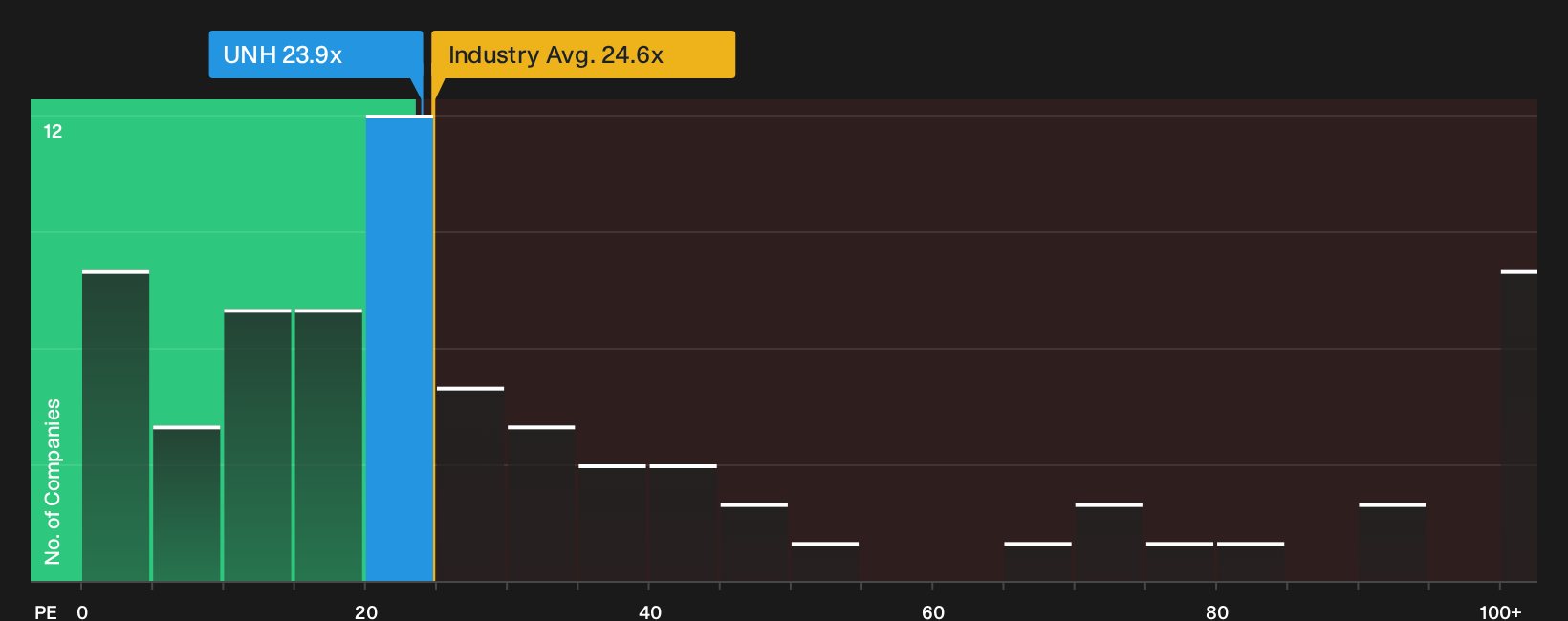
The P/E ratio is a useful starting point for UnitedHealth Group because earnings remain a central yardstick for how investors judge large healthcare insurers. UnitedHealth Group currently trades at about 23.6x earnings, which sits slightly below the Healthcare sector average of roughly 24.6x and below peers around 27.3x. That places the stock on a lower earnings tag than many comparable insurers, even as the business commits significant resources to Medicare plan redesign and digital upgrades.
Because the Fair Ratio framework looks at factors like profitability profile, risk and scale, it would point to a higher P/E than where UnitedHealth Group trades today, so the current multiple screens as undervalued on this yardstick. The recent Medicare plan refresh that leans into affordability and more connected care has lifted the focus on future economics, yet the stock still changes hands at a discount to what this earnings based model suggests might be justified. Investors weighing that gap against execution risks around the multi year margin recovery effort can use the detailed Fair Ratio output as a reference point for how much of a cushion the market is currently pricing in. Explore the numbers behind UnitedHealth Group's P/E valuation.
The UnitedHealth Group Narrative: What Would Justify Today's Price?
Narratives for UnitedHealth Group pick up where the valuation puzzle leaves off and spell out which combinations of future growth, profitability and earnings power would need to hold for the stock to be worth meaningfully more or less than today’s price on Simply Wall St's Community page. Rather than relying on a single P/E or one model, each scenario lays out the key assumptions behind its fair value view so you can compare those expectations with the actual results as they arrive over time.
The Simply Wall St community is split, with one camp seeing meaningful upside in UnitedHealth Group and another arguing the stock already prices in a lot of its strengths.
Bull case: 23% undervalued
"The company continues to invest in technology that improves physician workflows and digital engagement, and the current AI program that targets billions of dollars of G&A savings through automation of claims, call handling, clinical documentation and back-office functions is aimed at lifting net margins and operating earnings over time..."
Discover why this Narrative puts UnitedHealth Group at 23% undervalued.
Bear case: 20% overvalued
"The risk is not collapse, but compression, if regulatory pressure increases or if Optum’s growth slows, multiples could contract..."
Explore why this Narrative puts UnitedHealth Group at 20% overvalued.
One more UnitedHealth Group puzzle that current earnings do not answer
Valuation only shows where UnitedHealth Group trades today, while the projections that professional analysts publish sketch out where they think the business could be a few years from now. Explore where analysts expect UnitedHealth Group to be in a few years.
This article by Simply Wall St is general in nature. We provide commentary based on historical data and analyst forecasts only using an unbiased methodology and our articles are not intended to be financial advice. It does not constitute a recommendation to buy or sell any stock, and does not take account of your objectives, or your financial situation. We aim to bring you long-term focused analysis driven by fundamental data. Note that our analysis may not factor in the latest price-sensitive company announcements or qualitative material. Simply Wall St has no position in any stocks mentioned.
Have feedback on this article? Concerned about the content? Get in touch with us directly. Alternatively, email editorial-team@simplywallst.com