
Continued buybacks and acquisitions are beneficial and stimulating. Why is Xindai Healthcare (02291) recovering its stock price?
After the intraday stock price hit a phased high of HK$15.51 on August 21 this year, Baotong's failed Xintai Healthcare (02291) stock price went through a period of deep V adjustment.
In particular, in the first half of September, Xintai Healthcare's stock price retraced by more than 30% from the previous high. However, after losing liquidity support from the Hong Kong Stock Connect, its stock price has rebounded since the second half of September and has returned to the level of early September. Expectations for stock buybacks and acquisitions are undoubtedly an important factor supporting its stock price to move beyond technical restoration.
The “V-shaped” trend after disclosure in the interim report
At 8 p.m. on August 21, Xintai Medical revealed its 2026H1 financial report.
Investors paid a lot of attention to this financial report. Because of August 20 and 21, before the financial report was disclosed, there were significant changes in Xintai Healthcare's stock price.
The Zhitong Finance App observed that on August 20, the highest intraday increase in Xintai Healthcare's stock price was over 35%, but the final closing was only 6.75%, thus drawing a significant long-term picture; the next day, the company's stock price rose all the way up to a maximum of 26.44% while opening low and high, and eventually closed up 20.53%. This is also the second time since this year that Xintai Healthcare's single-day revenue rose by more than 20%.
However, the early trading of the market does not seem to be due to the company's performance. Financial reports show that the company's revenue for the first half of the year was 310 million yuan, a year-on-year decrease of 5.94%; net profit to mother was 147 million yuan, a year-on-year decrease of 19.49%. This performance clearly fell short of previous market expectations.
Compared to this 2026H1 financial report, a trading announcement revealed by Xintai Healthcare half an hour later was the protagonist of the market's pulse. According to the announcement, Xintai Medical plans to acquire 54.2384% of the shares of Shanghai Minwei Biotechnology Co., Ltd. (hereinafter referred to as “Minwei Biotech”) with 1.088 billion yuan in cash.
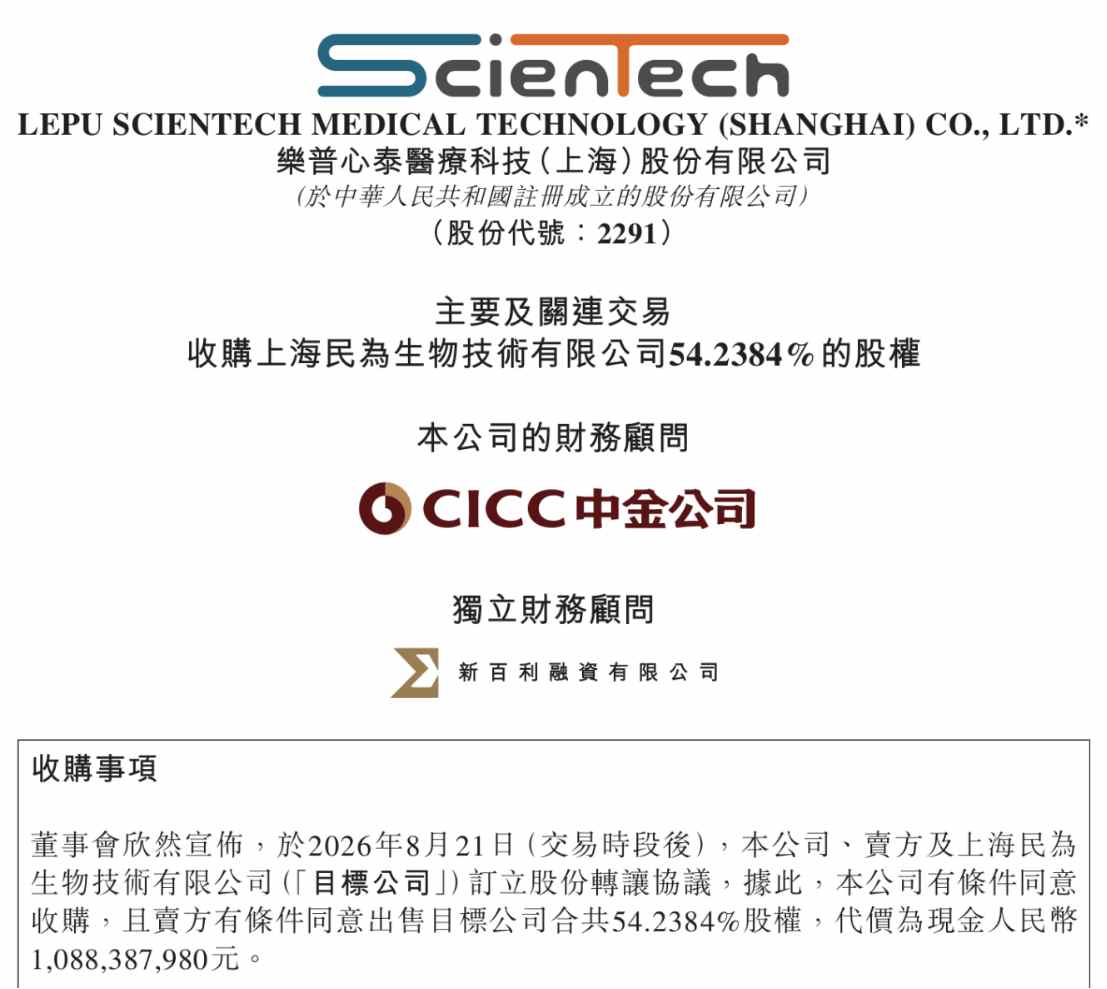
However, the announcement did not bring the main upward trend to Xintai Healthcare; on the contrary, it broke out of the technical structure of “contraction and decline after the incident pulse” on the market.
Judging from previous public information, Xintai Medical did not disclose the relevant acquisition matters, so the “extreme” long line on the August 20 market was more like an early game where the long and short sides of the market were favorable to the company's financial reporting points, and it was settled profitably before the official announcement the next day.
It is worth mentioning that in the market on August 20 and 21, Xintai Healthcare's stock price formed a “double top structure” at a high of HK$15.50, and the subsequent stock price failed to break through this area and fluctuated in the HK$13-14 range; at the same time, Xintai Medical's total stock trading volume on August 20 and 21 was about 18.17 million shares, with a turnover of HK$251 million, which is equivalent to nearly 50 times the previous average daily turnover. This also indicates that market differences widened further after the takeover announcement, rather than being unanimous.
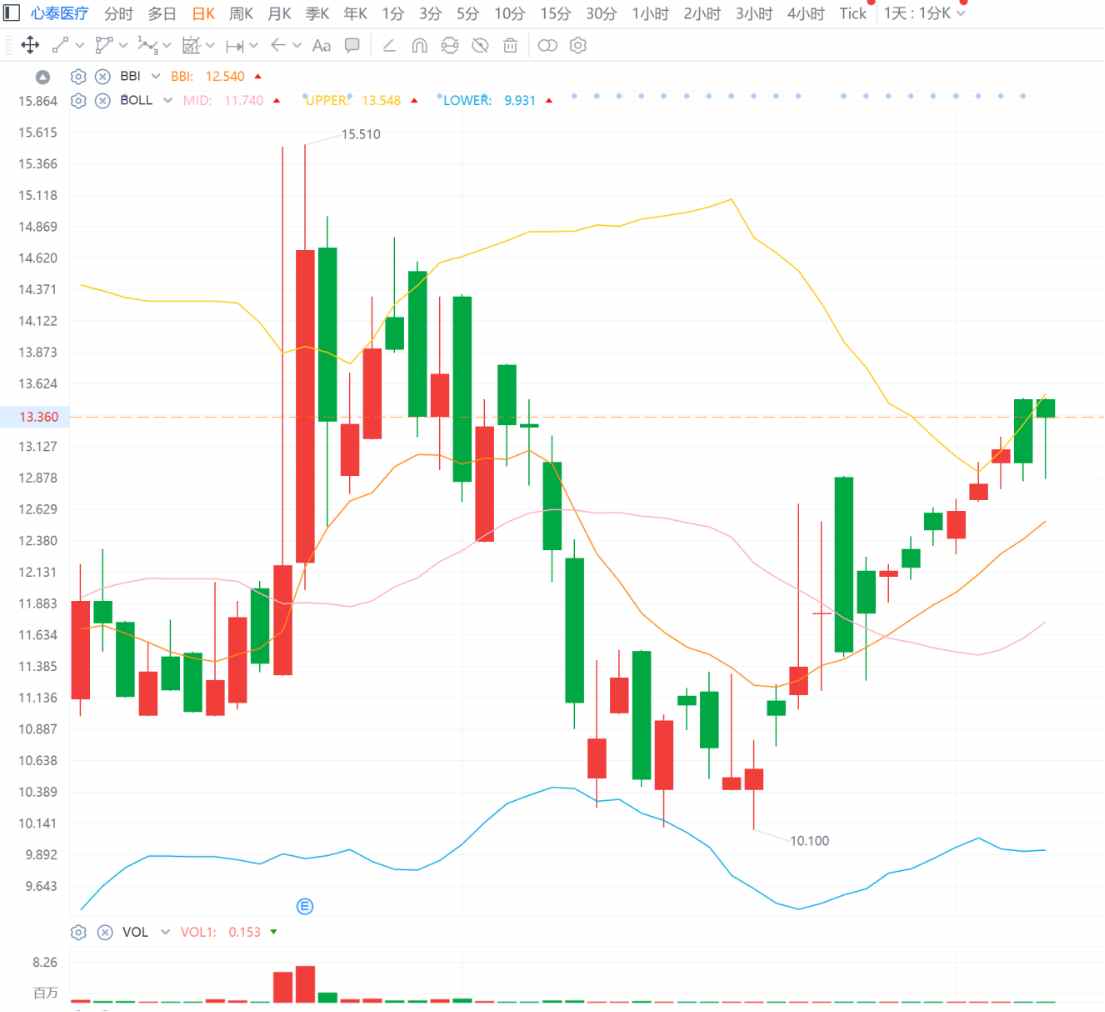
However, the widening market differences at a high level have relieved a wave of stress from this “pulsed rise” to a certain extent. Subsequent market conditions showed that under the influence of “withdrawal” and interim results, the company's stock price continued to fall after a high of HK$15.51 until closing at HK$10.57 on September 18. The share price range fell by about 13.2%, and retracted by about 31.9% from the previous high.
However, after a high level of disagreement, Xintai Healthcare's average daily turnover contracted markedly. On September 18, the single-day trading volume of 200,000 shares was only about 1/5 of the average of its range. However, this also shows, to a certain extent, that in the latter part of this decline range, Xintai Medical did not panic and crash the market, but rather a downturn in volume reduction caused by insufficient acceptance.
From a technical point of view, although in the above stages, both the moving average performance of short and medium term bears and the ADX indicator showed that Xintai Healthcare still had the upper hand until mid-late September, the marginal convergence of volatility also showed that some investors were also shifting from divergent trading to watching low transactions at this time.
This is probably a signal from a technical point of view that indicates a shift from weak bottom-finding to multiple repairs, and this signal has also continued to strengthen under the market's continued expectations of Xintai Medical's continued repurchase and acquisition of Minwei Biotech, which has ultimately contributed to the company's stock price repair market from late September to now.
Repurchase background+positive incentives. How far can this wave of markets go?
After September 18, Xintai Healthcare's stock price showed a clear pattern of strengthening. On September 18, the stock price of Xintai Medical once fell to HK$10.10, but then stopped falling and rebounded steadily. On October 7, the company's stock price closed at HK$13 and had returned to its level at the beginning of September.
The main driver of this round of market is undoubtedly the acquisition mentioned above.
The Zhitong Finance App learned that the acquisition of Minwei Biotech is not only an asset restructuring within Xintai Medical's parent company, but also a “device+drug” cross-border integration.
As far as Xintai Healthcare is concerned, the acquisition of Minwei Biotech is not an ordinary asset injection.
According to the acquisition announcement, Minwei Biotech has three major technology development platforms: GPCR agonist screening, RAF ultra-long-acting molecules, and dual-siRNA, and has thus developed 6 drug candidates at different clinical stages, and a GLP-1/GIP multi-target race track covering chronic diseases such as obesity, dyslipidemia, and high blood pressure. Among them, the fastest progressing was MWN109 injection (obesity indication), which has entered clinical phase III.
In addition, Minwei Biotech also authorized MWN105 (GLP-1/GIP/FGF21 three agonists) to Sidera in 2025. The total down payment and recent milestone payments of 35 million US dollars have already been paid, plus a milestone payment of up to 1.01 billion US dollars and sales share, and also obtained 9.99% of Sidera's shares. This license directly enabled it to turn a loss into a profit that year.
After the public injects biological assets, Xintai Medical is expected to change from a device stock that is suppressed by collection and procurement to a platform pharmaceutical stock holding major innovative drug assets such as GLP-1 and siRNA, as well as overseas licensing milestones. Simply put, the company will usher in a “valuation anchor switch.”
Furthermore, since this year, Xintai Medical has also continued to carry out small-step repurchases. Since the beginning of the year, it has repurchased 45 times, and the number of shares repurchased has reached 4.138 million shares, accounting for 1.19% of its total share capital, with a cumulative amount of HK$47,272,200.
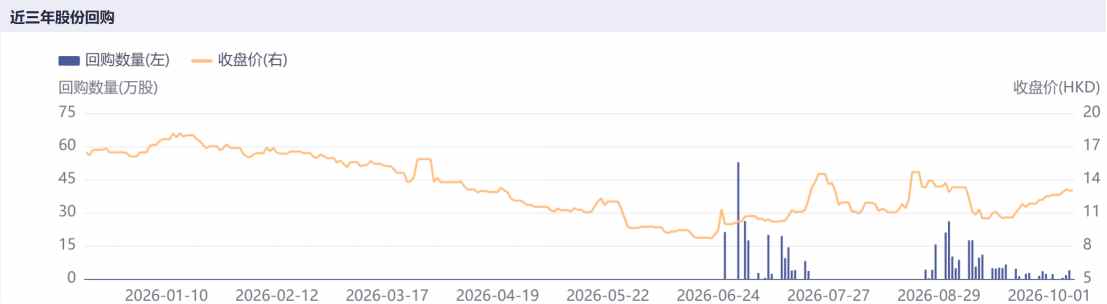
From September 18 to October 7, although the actual repurchase amount of Xintai Medical was only HK$894,700, which was not significant compared to its average daily turnover of HK$2.21 million, the “bottom acceptance signal” brought about by the repurchase combined with the favorable stimulus of the company's acquisition became the core reason why the market was willing to reprice it. Based on the closing price of the range, the cumulative increase in the company's stock price from September 18 to October 7 was about 22.99%, and the maximum retracement in the range was only 2.54%. This also shows that during this round of growth, Xintai Medical had a relatively stable OTC acceptance.
However, this round of rebound is not a volume-driven upward structure, because although its price structure has strengthened, the average daily turnover is significantly lower than the previous stage, and the company's stock price has not broken through the above HK$13.50 pressure level, so currently Xintai Healthcare is still in the “contraction and repair” stage.
According to the Zhitong Finance App's observation, although the acquisition was officially announced as early as August 21, the above acquisition transaction still requires procedures such as a circular and independent shareholder approval. Xintai Medical announced on September 21 that the circular was delayed until or before October 19, which also affected sentiment in the market.
The current stock price trend of Xintai Healthcare's “downsizing and repair” may be a figurative performance of the market's failure to “complete the acquisition” for its full price. This also means that the pace of implementation of the acquisition may become a key variable affecting the subsequent stock price trend of Xintai Healthcare.