
China Index Research Institute: The popularity of the national housing rental market declined in September, and rents in 50 cities fell month-on-month
The Zhitong Finance App learned that the China Index Research Institute published an article stating that in September, as the peak rental demand subsided during the graduation season, the popularity of the national housing rental market gradually fell back to a normalized level, and average residential rents in 50 cities rebounded slightly for three consecutive months. Residential rents in all tier cities fell simultaneously. Among them, first-tier cities ended six months of continuous month-on-month increases and then fell slightly. Notably, residential rents in Shanghai and Shenzhen continue to rise. Among them, Shanghai has ranked first among the 50 cities for 6 consecutive months in terms of month-on-month growth.
Residential rents in 50 cities fell month-on-month in September, and the year-on-year decline narrowed to the lowest level in nearly 25 months
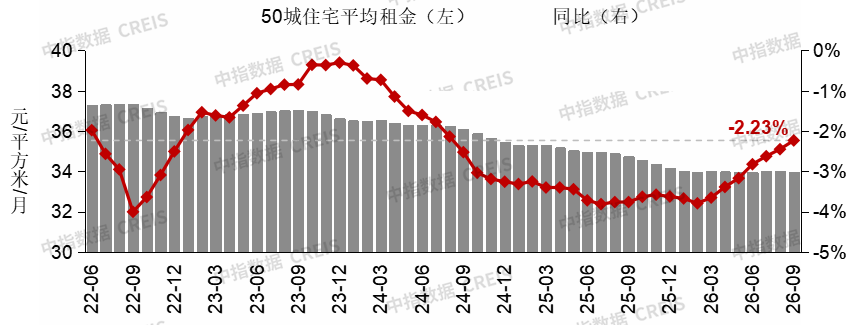
According to the CIDIC 50 City Residential Rental Price Index, in September, the average residential rent in the 50 cities was 33.97 yuan/square meter/month, down 0.17% month-on-month, ending the previous three-month continuous month-on-month increase; the year-on-year decline was 2.23%, which was 0.22 percentage points narrower than in August.
Although residential rents in 50 cities fell in September, the month-on-month decline was relatively small compared to the same period last year. The year-on-year decline continued to narrow. As of September, the year-on-year decline in residential rents in 50 cities had narrowed to the lowest level in nearly 25 months, and the signs that residential rents in key cities are stabilizing tend to be clear.
Figure: Average residential rents and year-on-year changes in 50 cities
Data source: Middle Index Data CREIS
Residential rents in first-tier cities ended six months of continuous month-on-month rise in September, and all tier cities fell month-on-month
In September, average residential rents in all tier cities fell month-on-month. According to monitoring by the Central Index Institute, in September, the average rent for ordinary housing in first-tier cities fell 0.03% month-on-month, ending the previous six-month continuous month-on-month increase. Among them, rents in Shanghai and Shenzhen continued to rise month-on-month, with increases of 0.52% and 0.09%, respectively. Rents in Beijing and Guangzhou both fell month-on-month. Average rents in second-tier cities fell 0.25% month-on-month, up 0.16 percentage points from August; average rents in third- and fourth-tier cities fell 0.15% month-on-month.
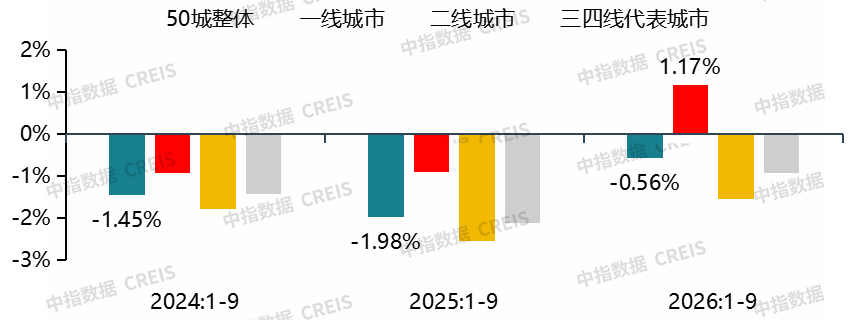
Figure: The cumulative rise and fall trend of average residential rents in each tier of cities during the year
Data source: Middle Index Data CREIS
Judging from the cumulative rise and fall rate during the year, the pattern of rent differentiation among various echelons continues. From January to September 2026, the average rent in first-tier cities increased by 1.17%, which is basically the same as the previous month; second-tier cities had a cumulative decline of 1.55%, and third-tier and fourth-tier representative cities had a cumulative decrease of 0.92%, all of which increased from August. Overall, the rent base for first-tier cities is relatively stable. Rents in second-tier, third-tier and fourth-tier representative cities are still in the adjustment channel, but the cumulative decline during the year is narrowing compared to the same period in 2024 and 2025.
The number of cities where rents rose in September was further reduced, and Shanghai continued to lead 50 cities
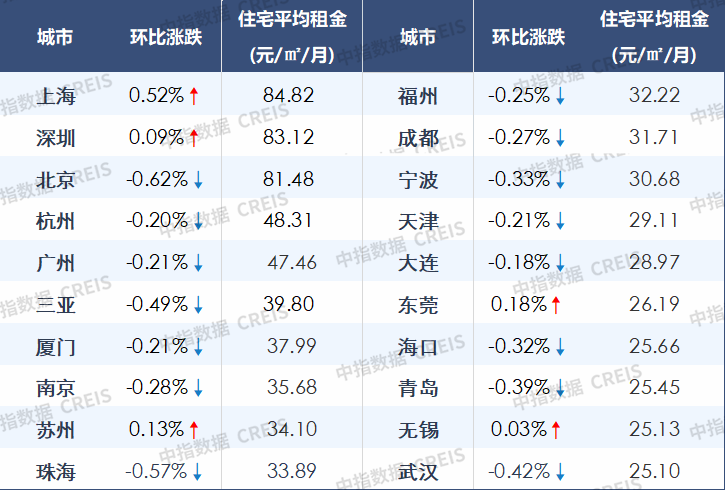
In September, as the graduation season effect subsided, market demand stabilized, and overall rents in key cities moved into an adjustment stage. According to monitoring by the Central Index Institute, residential rents in 50 cities rose and fell 2 square meters from 9 to 39 in September, and the number of cities where rents rose decreased by 6 compared to August. Among the top 20 cities with residential rents, a total of 5 cities increased month-on-month, down 1 from August.
Judging from the performance of specific cities, as of September, residential rents in Shanghai and Shenzhen had been rising for 7 consecutive months. Among them, Shanghai ranked first among the 50 cities for 6 consecutive months; Suzhou had been rising for 5 consecutive months; however, overall, the month-on-month increases in Shanghai, Shenzhen, and Suzhou all declined slightly in September. Furthermore, residential rents in Hangzhou ended 3 months of continuous month-on-month rise and fell in September; after rents in Beijing, Guangzhou, Tianjin, and Chengdu turned down in August, the month-on-month decline widened further in September, and residential rent support in key cities weakened after the peak rental season declined.
Table: Performance of 50 top 20 cities with residential rents in September 2026
Data source: Middle Index Data CREIS
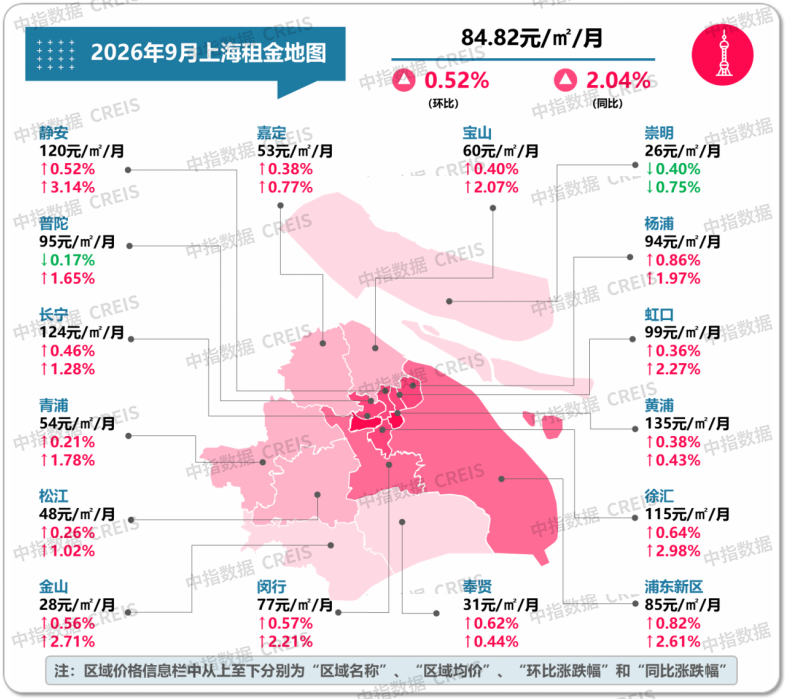
Looking at the city's internal rent performance, in September, residential rents in the Shanghai district continued to rise mainly from month to month. With the exception of Chongming and Putuo, rents in the remaining 14 municipal districts all rose month-on-month. Among them, Yangpu, Pudong, Xuhui, Fengxian, and Minhang all had the highest increases of more than 0.5%. Residential rents in Beijing have generally declined, while rents in Dongcheng, Haidian, Shijingshan, Xicheng, and Changping districts have dropped significantly. Residential rents in the Shenzhen district rose and fell by 5, while Yantian, Guangming, Nanshan, and Futian ranked higher in rent increases, while rents in Bao'an and Longgang declined slightly. Residential rents in the Guangzhou municipal district rose by 2 and 9, while rents in the Liwan and Baiyun districts rose slightly, while rents in the Conghua and Huangpu jurisdictions fell by about 0.5%.
Figure: Map of residential rents in Shanghai, Beijing, Shenzhen and Guangzhou in September 2026
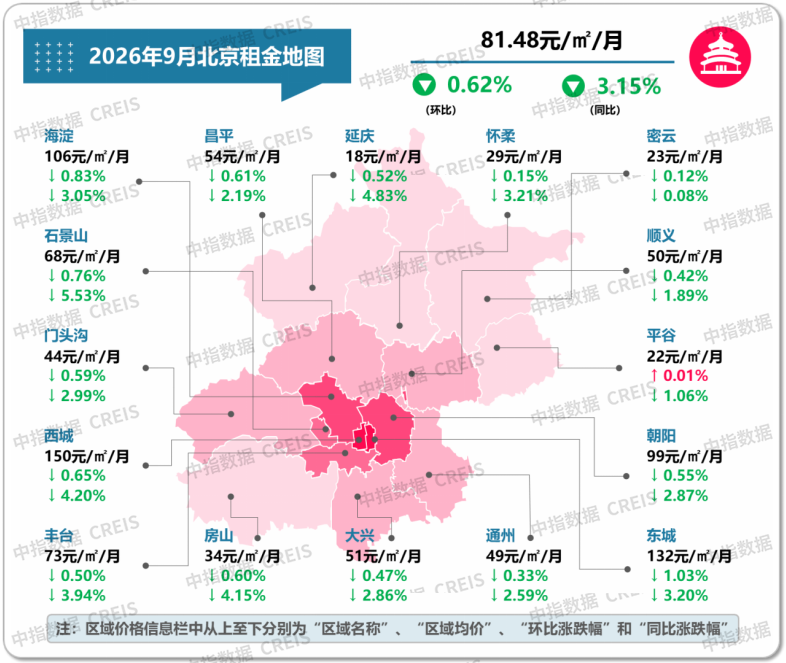
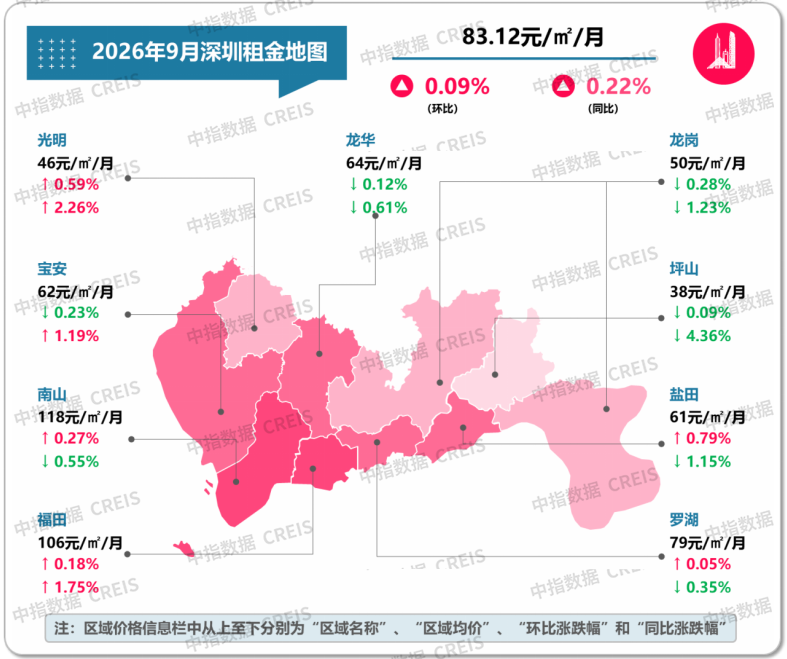
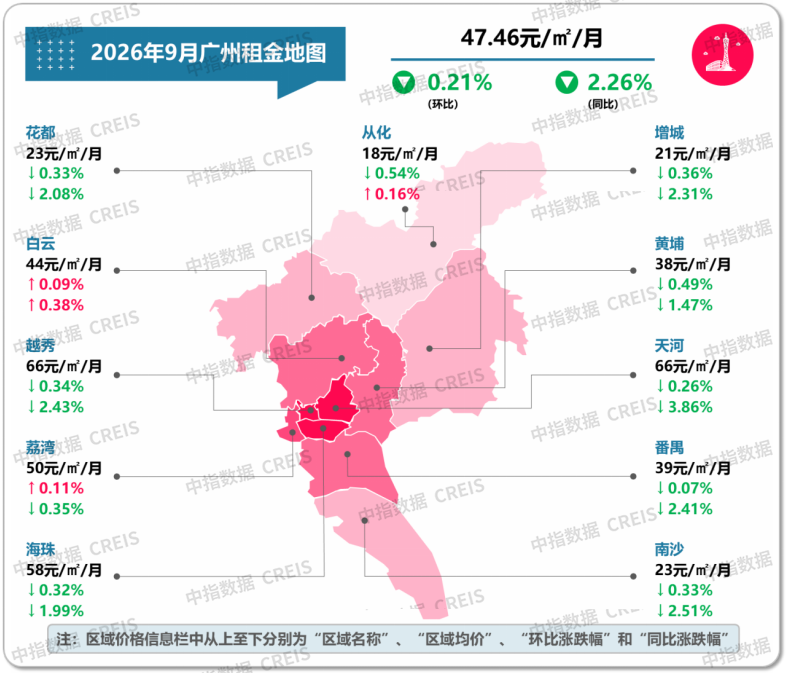
Data source: Middle Index Data CREIS
The fourth quarter is the traditional low season for the housing rental industry. Residential rents in 50 cities will continue to adjust in October
Entering the fourth quarter, as market demand returns to stability, the housing rental industry will enter the traditional low season. It is expected that in the short term, residential rents in 50 cities will continue to adjust the trend. However, considering the narrowing of the downward space in the market after continuous adjustments in recent years and the current signs of rent bottoming out in hot cities, rent adjustments in key cities in October will narrow compared to the same period last year.
Looking at each city, differentiation is still the main characteristic of the market. In cities where rents continue to rise, such as Shanghai and Shenzhen, residential rents are expected to remain relatively resilient, driven by the popularity of the real estate market and the continued influx of young people, while rents in Beijing and Guangzhou will continue to be adjusted; most ordinary second-tier and third-tier and fourth-tier cities are affected by abundant supply, and rents may continue to adjust slightly, but the extent of the adjustment is generally manageable.