
Under Armour (UAA) Could Be 22% Undervalued After Its Recent Rebound
Under Armour (UAA) has drawn fresh attention after recent share price moves, with the stock last closing at US$4.88. Investors are weighing this level against the company’s mixed track record and current fundamentals.
Recent trading hints at a tug-of-war between bargain hunters and cautious holders. Under Armour’s 1-day share price return of 1.24% and 7-day gain of 5.17% come after a 90-day slide of 28.13%. Meanwhile, the 1-year total shareholder return of 1.46% contrasts with a 5-year total shareholder loss of 76.21%, indicating that short-term momentum is picking up even as the longer record remains weak.
Scan how Under Armour’s rebound profile compares with other consumer names showing improving return trends through our curated 27 high quality undervalued stocks.
Bulls point to signs of improving returns and a discount to analyst targets. Bears focus on heavy longer term losses and the current net loss. Which case does the valuation math lean toward next?
Most Popular Narrative: 22% Undervalued
Under Armour’s most followed narrative puts fair value at $6.28 per share, above the recent $4.88 close. This frames the current rebound as a discount story rather than a momentum chase.
The ongoing transformation to a brand-first strategy, with a focus on premiumization, tighter SKU assortments, and greater brand storytelling, positions Under Armour to increase average selling prices, improve full-price sell-through, and reduce reliance on discounting, which should positively impact net margins and long-term earnings growth.
Expansion into high-growth categories such as women's athletic wear, team sports, and product launches in premium footwear and connected performance apparel leverages growing participation in sports and health and wellness activities, supporting future top-line revenue growth.
See why 30 investors see Under Armour as 22% undervalued.
Result: Fair Value of $6.28 (UNDERVALUED)
Still, tariff driven cost pressure and ongoing weakness in footwear could keep Under Armour’s margins under strain and challenge the brand reset that investors are watching.
Find out about the key risks to this Under Armour narrative.
Another View: Under Armour Through A Cash Flow Lens
The first lens on Under Armour leaned on analyst assumptions and implied multiples. A second cut, using the Simply Wall St DCF model, points in a different direction. On that approach, UAA’s recent price of $4.88 sits above an estimated future cash flow value of $4.30, which frames the shares as overvalued rather than discounted. That gap raises a simple question for you as an investor: Which story do you trust more, the cash flow math or the earnings narrative?
To understand how that cash flow estimate is built and what would need to change for the result to move closer to the narrative fair value, take a closer look at the full model in the Look into how the SWS DCF model arrives at its fair value..
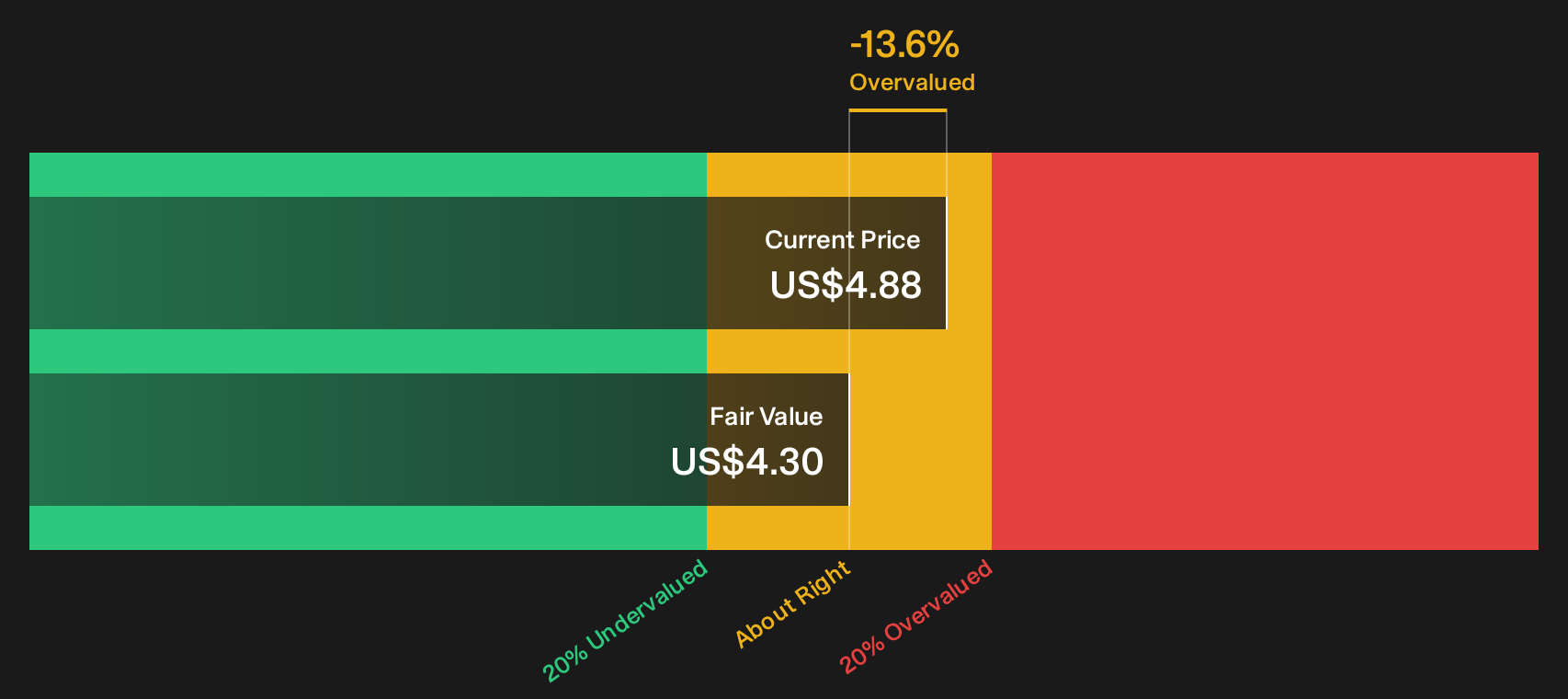
Simply Wall St performs a discounted cash flow (DCF) on every stock in the world every day (check out Under Armour for example). We show the entire calculation in full. You can track the result in your watchlist or portfolio and be alerted when this changes, or use our stock screener to discover 27 high quality undervalued stocks. If you save a screener we even alert you when new companies match - so you never miss a potential opportunity.
Next Steps
Skeptical or cautiously optimistic about Under Armour after all this
If you want to move fast and build your own view off the same numbers, start with the upside case in the 2 key rewards.
Looking for more investment ideas beyond Under Armour?
If Under Armour has sharpened your focus, do not stop here. Fresh ideas backed by the same data engine can help you build a stronger watchlist.
- Target resilient income by scanning companies with steady payouts and higher yields through the 8 dividend fortresses.
- Zero in on financially robust businesses by running a list of solid balance sheet and fundamentals (25 results) that filters for stronger balance sheets and fundamentals.
- Hunt for potential future leaders before the crowd by checking out a 20 high quality undiscovered gems that spotlights quality companies flying under most investors’ radars.
This article by Simply Wall St is general in nature. We provide commentary based on historical data and analyst forecasts only using an unbiased methodology and our articles are not intended to be financial advice. It does not constitute a recommendation to buy or sell any stock, and does not take account of your objectives, or your financial situation. We aim to bring you long-term focused analysis driven by fundamental data. Note that our analysis may not factor in the latest price-sensitive company announcements or qualitative material. Simply Wall St has no position in any stocks mentioned.
Have feedback on this article? Concerned about the content? Get in touch with us directly. Alternatively, email editorial-team@simplywallst.com