
Cardinal Health (CAH) Climbed, So What Is Behind The Fresh Attention?
Cardinal Health (CAH) drew fresh attention after announcing a binding Letter of Intent with CVS Health to extend their pharmaceutical distribution agreement through June 30, 2032, while keeping its current service scope intact.
Against that backdrop, Cardinal Health’s recent price action has been steady rather than explosive, with a 1-day share price return of 2.93% and a 7-day share price return of 3.85% helping offset a slightly weaker 30-day patch. Long-term total shareholder returns of 53.44% over 1 year, along with very large gains over 3 and 5 years, suggest that momentum has been building over several years rather than just around this latest CVS announcement.
Compare Cardinal Health’s steady distribution-driven story with other healthcare players by scanning 32 healthcare AI stocks that could see their own momentum build around long-term contracts and sticky customer relationships.
Cardinal Health has already delivered very large multi year gains, yet the recent CVS extension and solid 1 year run raise a sharper issue. Are investors still early in the upside, or mostly late to the party?
Most Popular Narrative: 12% Undervalued
Cardinal Health’s most followed narrative pegs fair value at $270.94 per share, above the latest close at $238.96. This puts the current CVS deal into a broader story about mix shift and cash generation rather than a one off catalyst.
The expansion of specialty pharma distribution, multi specialty MSO platforms in areas like oncology, urology and gastroenterology, and a rapidly scaling Biopharma Solutions business that is ahead of its prior growth plan points to a larger mix of higher value services that can influence segment profit and overall earnings.
See why 51 investors see Cardinal Health as 12% undervalued.
Result: Fair Value of $270.94 (UNDERVALUED)
Still, quality control issues such as the levothyroxine recalls and any renewed cost pressure inside Global Medical Products and Distribution could quickly challenge the Cardinal Health optimism story.
Find out about the key risks to this Cardinal Health narrative.
Another View: Cardinal Health On Earnings Multiples
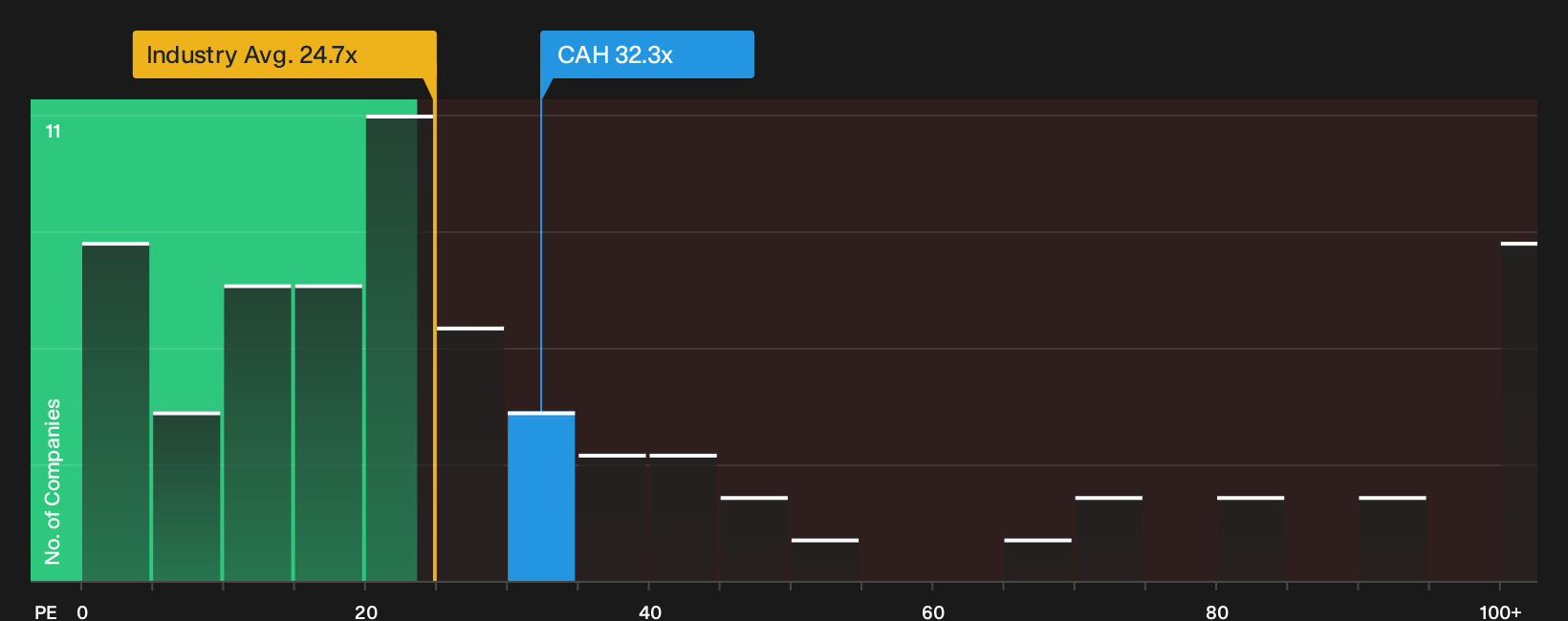
The earlier narrative leans on a fair value of $270.94 based on future earnings power and cash generation. A simple P/E lens tells a tougher story. Cardinal Health trades at 32.3x earnings, compared with a 31.2x fair ratio, 26.7x peer average and 24.7x for the wider US Healthcare group.
This gap suggests investors are already paying a premium for Cardinal Health relative to both its closest comparables and the broader industry, which can limit upside if expectations cool or execution wobbles. The question is whether this richer multiple reflects durable strengths or a crowded trade at a full price.
See what the numbers say about this price — find out in our valuation breakdown.
Next Steps
Mixed messages so far on Cardinal Health’s valuation and risks. Act on the data while it is fresh and build your own thesis by weighing the 3 key rewards and 3 important warning signs.
Looking for more investment ideas beyond Cardinal Health?
If Cardinal Health has sharpened your focus on quality opportunities, do not stop here. Fresh ideas come from comparing different business models, risk levels, and income profiles.
- Target high potential upside by scanning 20 high quality undiscovered gems that pair solid fundamentals with lower market attention.
- Strengthen capital preservation by reviewing 31 resilient stocks with low risk scores that score well on resilience and downside control.
- Build a portfolio with income at its core by using 8 dividend fortresses that aim to combine yield with business durability.
This article by Simply Wall St is general in nature. We provide commentary based on historical data and analyst forecasts only using an unbiased methodology and our articles are not intended to be financial advice. It does not constitute a recommendation to buy or sell any stock, and does not take account of your objectives, or your financial situation. We aim to bring you long-term focused analysis driven by fundamental data. Note that our analysis may not factor in the latest price-sensitive company announcements or qualitative material. Simply Wall St has no position in any stocks mentioned.
Have feedback on this article? Concerned about the content? Get in touch with us directly. Alternatively, email editorial-team@simplywallst.com