
Is it time for Asian assets to be revalued? Goldman Sachs: Demand for AI computing power sparks long-term technology hardware cycle, profit growth 34% over the next 3 years
The Zhitong Finance App learned that Goldman Sachs published a research report called “The 720: Investing in Differentiated Asia”. In this research report, Goldman Sachs points out that investing in Asia is not a homogenized investment decision. The investment environment is becoming increasingly differentiated across different markets, industries, and topics. In terms of market capitalization, the region is now the second-largest market in the world after the US, with a total market capitalization of 50 trillion US dollars. The market is more liquid and technology-driven characteristics are more obvious.
Goldman Sachs pointed out that after 15 years of growth below potential, profits in the Asian region are expected to grow by 34% between 2026 and 2028, mainly driven by the technology industry. The bank expects the IT industry's compound annual growth rate (CAGR) to reach 20% over the next 5 years. This expectation is mainly based on the extraordinary growth of the memory industry in 2026, as demand for AI-driven computing power is driving a strong and long-lasting technology hardware cycle.
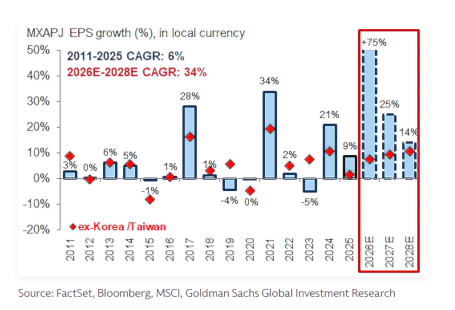
As a result, Goldman Sachs raised the MSCI Asia Ex-Japan Index (MXAPJ) annual profit growth forecast for the next 10 years to 10%, 1 percentage point higher than the previous forecast. The bank maintains a constructive view of the region. It expects a return on USD-denominated prices of 26% over the next 12 months and an average annual return of 14% in USD-denominated prices over the next 10 years.
Goldman Sachs is well positioned in the northern Asian market, which is dominated by technology stocks, including South Korea, Taiwan, Japan, and China A shares. To balance the risk of portfolio concentration, the bank suggests selectively allocating non-AI topics that have high profit visibility, such as electricity, defense, and areas where shareholder returns continue to improve.
Analysis and evaluation of investment targets
Samsung Electronics - 2026 Q3 operating profit is in line with expectations, raising HBM's average sales price forecast
Goldman Sachs raised Samsung Electronics' 12-month target price from 490,000 won to 500,000 won, and raised earnings per share (EPS) forecasts by 0.3%, 2.2%, and 0.1%, respectively, from 2026 to 2028. Previously, the company announced an initial operating profit of 10.74 trillion won for Q3, which was basically in line with expectations.
Its resilient operating profit mainly benefited from strong DRAM and NAND profit margins, and HBM bit shipments grew nearly 50% month-on-month, driven by HBM4 momentum. At the same time, due to the favorable performance of the high-end product portfolio, the smartphone business lost more than market concerns. Considering that the tight memory supply situation is expected to continue, Goldman Sachs drastically raised the HBM Comprehensive Average Selling Price (ASP) forecast for next year, and it is expected that HBM's revenue will increase 321% year over year, accounting for 20% of DRAM revenue.
Express sales - FY8/27 performance guidance is higher than expected
Goldman Sachs maintains a “buy” rating for rapid sales and a 12-month target price of 88,000 yen. The company announced FY8/26 operating profit of 718.4 billion yen, which was in line with expectations. At the same time, the FY8/27 operating profit and operating profit guidelines were better than expected, of which the operating profit guideline was 830 billion yen.
Goldman Sachs expects profit expansion to continue as the LifeWear concept continues to spread globally, mainly due to the strong sales performance of Uniqlo's international business and a further increase in management's confidence in Southeast Asia's expanding middle class consumer group.
Following the announcement of results and the company's announcement to raise the dividend payout ratio to 50%, Goldman Sachs maintained its operating profit forecast unchanged from FY8/27 to FY8/28. The estimated operating profit for FY8/27 is 870 billion yen, 7% higher than market consensus. This forecast is mainly supported by strong growth in overseas same-store sales, although the bank expects gross margin to remain flat or decline in markets other than China.
LG New Energy - 2026 Q3 initial operating profit was driven by energy storage system (ESS) volume, which greatly exceeded expectations
Goldman Sachs maintains a “buy” rating for LG New Energy and a 12-month target price of 520,000 won. The company announced preliminary Q3 results, and operating profit reached 756 billion won, significantly exceeding the market consensus of 267 billion won. After excluding the US Advanced Manufacturing Production Tax Credit (AMPC), the company's operating margin changed to 3.7%. Goldman Sachs believes this is mainly due to improved fixed cost absorption brought about by the faster release of the North American Energy Storage System (ESS), as well as potential “take-or-pay” (take-or-pay) compensation from OEMs. The bank believes that improved core profit margins and month-on-month revenue growth further support its investment logic, that is, the accelerated growth in ESS shipments will drive the recovery of capacity utilization and double EBITDA by 2028E.
Nippon Chemical Co., Ltd. - Profit forecast adjustments for three major chemical companies
Goldman Sachs adjusted profit forecasts for major Japanese chemical companies, raised the 12-month target price of Resonac with a “buy” rating to 27,560 yen, and raised the FY26 to FY28 core operating profit forecast by 1% to 8% after completing the divestiture of the petrochemical business and strong demand for semiconductor materials.
Goldman Sachs downgraded Asahi Kasei's rating to “neutral” and lowered its 12-month target price to 2,010 yen, while lowering the FY28 to FY29 operating profit forecast by 3% to 8% due to increased competition from its IgA nephropathy drug Tarpeyo and the upcoming expiration of the Envarsus XR patent.
Goldman Sachs also downgraded Mitsui Chemicals to “sell” and lowered its 12-month price target to 2,250 yen. Although affected by naphtha-driven inventory earnings, the bank raised its FY27 core operating profit forecast by 35%, but these earnings are expected to be reversed in FY28 as imports of petrochemical products from China will put price pressure on them.
The Xiaomi - Pengcheng product portfolio points to the upward space of ASP
Goldman Sachs said that although the 70,000 confirmed orders received by Xiaomi (01810) in the first month of its launch fell short of the market's most optimistic expectations, the bank believes that potential demand is still healthy and maintains the 12-month target price of HK$39 and the 2026 sales forecast of 450,000 vehicles unchanged.
Goldman Sachs pointed out that the initial product portfolio was significantly better than expected, with the high-end N90 version accounting for two-thirds of orders, which meant that the potential average vehicle selling price (ASP) was RMB 260,000, which is about 10% higher than expected. Furthermore, the high load rate of high-end options will also provide a driving force for vehicle profitability. Goldman Sachs believes that continued order momentum, upcoming model revisions, and overseas expansion in the second half of 2027 will drive the delivery growth trajectory from 2027 to 2028.
Hanwha Aerospace - Transforming into a Defense Technology Supplier
Given the strong long-term fundamentals and business transformation that the market is not fully aware of, Goldman Sachs sees the recent decline in Hanwha Aerospace's stock price as an attractive entry point. Following the successful launch of the private-sector-led Nuri rocket, Goldman Sachs focused on the company's strategic transformation to “Defense AI 3.0.” The strategy integrates space satellites, data centers, and advanced weapons to provide highly optimized end-to-end tactical solutions.
Although the stock price may fluctuate in the short term due to weak 3Q performance due to delivery delays, Goldman Sachs expects profit momentum to continue until 2030, driven by the accelerated growth of orders in the Middle East and increasingly clear potential project opportunities in the US market. Goldman Sachs rated Hanwha Aerospace as a “buy” with a target price of 1.81 million won for 12 months.
China Resources Brewery - Short-term sales prospects are cautious, but the resilience of consumption upgrades can cushion the impact
Management expressed a cautious view on short-term beer demand, pointing out that 3Q26 sales declined month-on-month due to weakening consumption through catering channels, which may lead to a slight decline in FY26 sales throughout the year (Goldman Sachs is expected to be -0.7%). However, consumption upgrades are still the driving force for long-term growth. Heineken's sales volume has continued to grow by more than 20% year to date, as well as the continued expansion of the product portfolio, which is supported by the continued expansion of the product portfolio. Although falling operating leverage and rising aluminum costs will put pressure on profit margins in 2H26, strict cost saving measures in channel and brand investment should partially offset this impact. Goldman Sachs maintained its 12-month target price of HK$26.8 for China Resources Breweries (00291).
No. 9 Company - 3Q26 performance outlook and profit forecast adjustments
Prior to the announcement of the 2026 Q3 results, Goldman Sachs lowered its earnings forecast for Company 9 (689009.SH) 2026E to 2028E by 4% to 6%, and lowered its 12-month target price from RMB 64 to RMB 58 to reflect a month-on-month slowdown in revenue growth and profit margins.
The bank expects 3Q revenue to still achieve a strong but slowing 18% year-on-year increase, mainly due to the decline in revenue contribution of high-margin mowing robots entering Europe's low season. In contrast, the year-on-year growth rate of domestic electric two-wheelers (E2W) revenue is expected to accelerate to 18%, driven by the seasonality of the peak season, easing of cost pressure, and continued increase in market share, while market demand is gradually recovering. Despite the recent correction in stock prices, the bank maintains a positive view because the company's structural growth logic is still intact, the potential for overseas expansion still exists, and the current risk-reward ratio is attractive.
Consumption in China
Goldman Sachs believes that demand for domestic travel in China was weak during Golden Week, but demand for outbound travel was stronger than expected. Due to rising ticket prices, tourists are moving more to short-haul destinations and neighboring Hong Kong and Macau, China. As tourist travel arrangements were adjusted around the previous Mid-Autumn Festival, the movement of people across regions increased by only 0.7% year-on-year; at the same time, cross-border outbound passenger flow increased by 6.7%, benefiting from the strengthening of the RMB.
Goldman Sachs said that China's spending performance during the National Day holiday was generally in line with cautious expectations, but was distorted by calendar changes — the extended holiday season and the early release of long-distance travel demand. Service consumption continues to outperform commodity consumption, but the performance of various sub-sectors is fragmenting: tourism and cultural activities have experienced strong growth, while movie box office revenue has reached its lowest level in ten years.
Consumption of commodities is still weak. Among them, liquor sales are weaker than expected, and sportswear retail trends are under pressure, all highlighting weak consumption. However, trade-in subsidies have driven strong growth in home appliance sales, while IP retailers such as Mingchuang Premium (09896) and Bubble Mart (09992) have maintained strong consumer participation.
Goldman Sachs remains wary of airlines because fuel costs have yet to fully recover. For China Free (01880,601888.SH), the bank maintained a “neutral” rating due to a decrease in the average amount spent on duty-free shopping. However, the bank favors Ctrip (09961, TCOM.US) because of its positive revenue prospects, and expects Huazhu (01179) and ATAT.US (ATAT.US) to announce solid third-quarter results.
Macau Gaming - Q3 Outlook
Goldman Sachs expects Macau's 3Q26 gaming industry EBITDA to rebound 5% month-on-month to reach US$1.95 billion, mainly driven by stronger seasonal non-gaming revenue, stabilizing promotions, and strict cost control, although total gaming revenue remains flat month-on-month.
With the return of leisure visitors and favorable gaming win rate factors, Goldman Sachs expects Sands China and Galaxy Entertainment to achieve the strongest month-on-month EBITDA growth and increase in market share; at the same time, due to declining operating leverage and loss of market share, the bank expects the trends of Macau International and Macau Expo Holdings (MLCO.US) and Australian Expo Holdings (00880) to be relatively weak.
Given that the current industry valuation is about 7 times corporate value/EBITDA (EV/EBITDA), while the mid-cycle average is 11 to 12 times, and the average dividend yield exceeds 6%, Goldman Sachs maintains a “buy” rating for Galaxy Entertainment (00027), Sands China (01928), Wynn Macau (01128), and Ho Chi Minh City.