
Is Texas Pacific Land (TPL) Below Fair Value On G7 Reserve Release News?
Texas Pacific Land (TPL) has been pulled into the crosscurrents of macro headlines, with the G7 planning major reserve releases even as Treasury yields climb and sector volatility picks up.
Recent trading shows that Texas Pacific Land has been whipsawed by macro forces yet still holding a strong multi‑year record. The share price climbed 3.47% over the last day and 6.34% over the past week, although it is down 6.32% over 30 days and 10.06% over 90 days. The year to date share price return of 20.07% and a 5 year total shareholder return of 181.32% point to momentum that has cooled in the short term but remains strong over a longer horizon.
Scan royalty and energy plays that could react in similar ways to Texas Pacific Land by running through our hand picked 27 high quality undervalued stocks that are aligned with strong cash generation and solid balance sheets.
Texas Pacific Land has snapped back in the last week but is still below its recent highs, which presents a straightforward decision. Is this the right time to enter, or is it better to remain patient?
Most Popular Narrative: 20% Undervalued
At a last close of $357.78 versus a widely followed fair value view of $445, Texas Pacific Land screens as materially cheaper than that narrative suggests. Analysts tie the gap to expectations around oil-linked royalties, water services and very high margins.
The analysts have a consensus price target of $445.0 for Texas Pacific Land based on their expectations of its future earnings growth, profit margins and other risk factors.
In order for you to agree with the analysts, you'd need to believe that by 2029, revenues will be $1.3 billion, earnings will come to $837.1 million, and it would be trading on a PE ratio of 45.1x, assuming you use a discount rate of 7.1%.
See why 26 investors see Texas Pacific Land as 20% undervalued.
Result: Fair Value of $445 (UNDERVALUED)
Still, the Texas Pacific Land narrative can be knocked off course if decarbonization efforts curb long run oil demand, or if stricter Texas water rules bite into segment profitability.
Find out about the key risks to this Texas Pacific Land narrative.
Another View On Texas Pacific Land’s Valuation
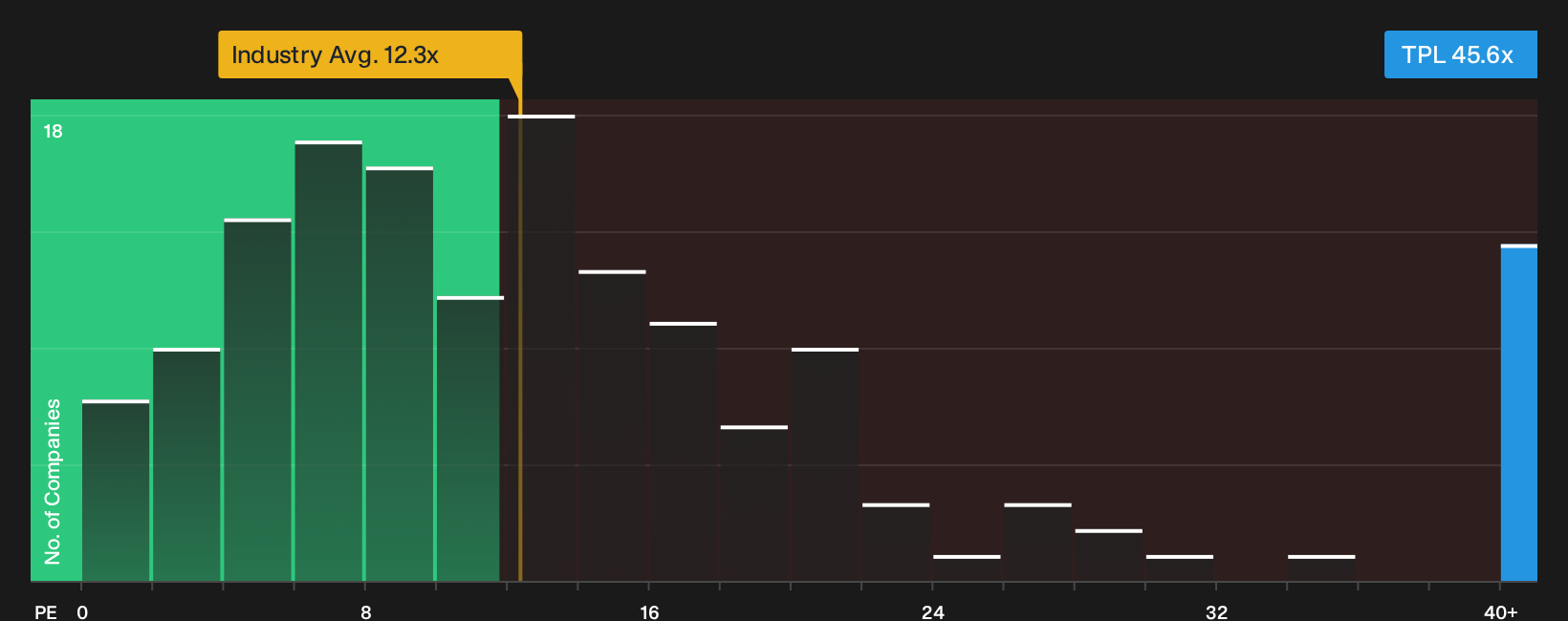
The story changes when you look at Texas Pacific Land through its P/E ratio rather than a fair value narrative. The stock trades on roughly 45.6x earnings, while the US Oil and Gas industry sits near 12.3x and the peer group around 11.3x. The fair ratio for TPL is estimated at 20.1x, so the current multiple is more than double that reference point, which raises a simple question for investors: Is the discount to fair value enough to offset the risk of such a rich earnings multiple?
To see how these earnings multiples compare in practice, including how the current level relates to the fair ratio and peers, See what the numbers say about this price — find out in our valuation breakdown..
Next Steps
Mixed messages around Texas Pacific Land’s valuation and risks do not need to leave you on the fence. Look through the same data, weigh both the concerns and the potential rewards, and then check the 3 key rewards and 1 important warning sign.
Looking for more investment ideas beyond Texas Pacific Land?
If Texas Pacific Land has caught your attention, do not stop there. Broader idea generation can sharpen your decisions and reveal opportunities you might overlook alone.
- Target potential mispricings by running through the 27 high quality undervalued stocks to find companies that combine strong fundamentals with prices that may not fully reflect their financial strength.
- Strengthen the income side of your portfolio and scan the 8 dividend fortresses to focus on payouts backed by resilient balance sheets.
- Calm portfolio swings by checking the 31 resilient stocks with low risk scores to identify resilient businesses with lower measured risk profiles.
This article by Simply Wall St is general in nature. We provide commentary based on historical data and analyst forecasts only using an unbiased methodology and our articles are not intended to be financial advice. It does not constitute a recommendation to buy or sell any stock, and does not take account of your objectives, or your financial situation. We aim to bring you long-term focused analysis driven by fundamental data. Note that our analysis may not factor in the latest price-sensitive company announcements or qualitative material. Simply Wall St has no position in any stocks mentioned.
Have feedback on this article? Concerned about the content? Get in touch with us directly. Alternatively, email editorial-team@simplywallst.com