
Amazon Stock Has Been Flat for the Past Month, But AMZN Put Credit Spreads Have Worked Out Well
Amazon Inc. (AMZN) stock has been treading water over the last month. I discussed doing an AMZN put credit spread on Sept. 14; it returned a 12% ROI in the same period. As a result, it's time to do a new AMZN put credit spread.
AMZN was at $259.92 on Oct. 7, but a month ago, when I wrote about it in a Sept. 14 Barchart article ("Amazon's Operating Cash Flow Could Push AMZN Over $314 - What's the Best AMZN Play?"), AMZN was at $256.78,
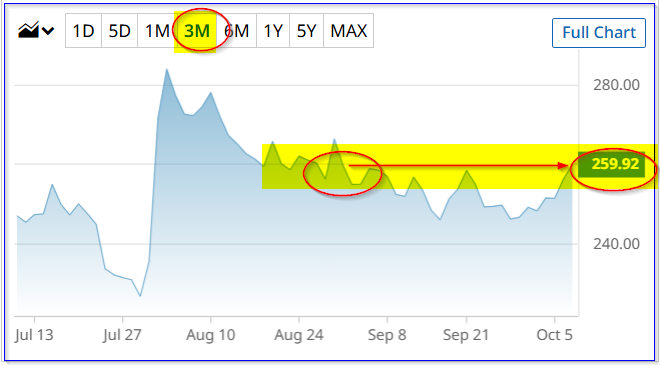
So, it hasn't moved much over the last month. But investors who shorted out-of-the-money puts made money, especially with a put credit spread.
However, since then, analysts have raised their forecasts and price targets.
For example, analysts now forecast that revenue for the year ending Dec. 2027, will reach $948.44 billion. That's up from $946.7 billion in my prior article a month ago.
Moreover, my article showed that, based on its operating cash flow margins, AMZN stock could be worth $314.56 per share (+21%). Yahoo! Finance's survey of 59 analysts has an average price target (PT) of $330.59 (+27%), up from $328.17 a month ago.
The bottom line is that AMZN could be worth between 21% and 27% more over the next year, i.e., about 25% more. That's despite the stock staying flat for the past several months.
As a result, one way to profit from AMZN is to short out-of-the-money (OTM) puts, using put credit spreads.
AMZN Put Credit Spread Has Worked Well
On Sept. 14, I had discussed shorting the $240 put strike expiring Oct. 16 for a $3.08 premium collected. At the same time, I pointed out that buying the lower $235 put strike for $2.14 (i.e., to protect any downside risk) would net:
$308 - $214 = $73.00 net put credit spread
However, the net collateral at risk was only $427 ($500-$73), so the net expected return (ER) was:
$73/$427 = 17% ER
Today, the net put credit spread is down to just $13 (i.e., $0.30 - $0.17) x 100 = $13. So the net profit is $73-$13, or $60 in the last three weeks and 4 days:
$60/$473 = 12.68% ROI
The investor can wait for the put credit spread to deteriorate to zero, thereby gaining the full 17% ROI possible. Or they can close it out and do a new put credit spread for one month out.
New AMZN Put Credit Spread Play
For example, look at the Nov. 6, 2026, AMZN put option expiration period. It shows that the same $240 and $235 put strikes have a net put credit spread of $108:
$4.00 x 100 ($240 short put) - $2.92 x 100 ($235 put buy) - $1.08 x100 = $108
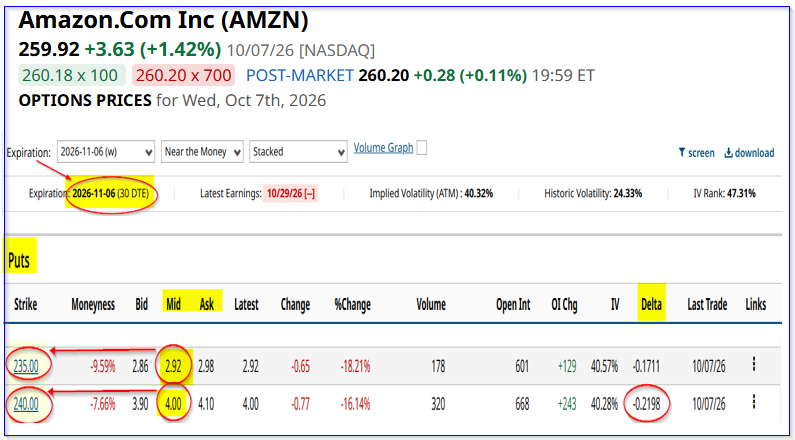
As a result, the expected return is:
$108/ ($500 -$108) = $108/$392 = 27.55% ER
That is higher than the prior 17% expected return with the same two strikes.
The bottom line is that this looks like an attractive play for value investors in AMZN stock who expect AMZN to rise 25% or so over the next year.
On the date of publication, Mark R. Hake, CFA did not have (either directly or indirectly) positions in any of the securities mentioned in this article. All information and data in this article is solely for informational purposes. For more information please view the Barchart Disclosure Policy here.