
Can Harley-Davidson (HOG) Justify Its Valuation On Citi’s Upgrade And Growth Plan?
Citigroup’s upgrade of Harley-Davidson (HOG) put fresh attention on the Back to the Bricks plan, as investors weigh lower-priced bikes, higher sales guidance, and the Q3 earnings call on November 3.
Harley-Davidson’s recent moves come after a mixed stretch for holders, with the share price up 29.6% year to date but the 1-year total shareholder return at 4.33% and the 5-year total shareholder return down 20.62%, which indicates stronger short-term performance while longer-term returns remain subdued.
Scan how Harley-Davidson stacks up against other potential turnaround plays by reviewing the hand-picked list of 20 high quality undiscovered gems that pair established brands with improving fundamentals.
Harley-Davidson has rallied hard this year, yet the 5-year record still shows a drag on investor wealth. After this upgrade and guidance reset, does the current valuation still skew the risk reward toward buyers or sellers?
Most Popular Narrative: 5% Undervalued
On the widely followed narrative view, Harley-Davidson’s fair value sits at $28.18 compared with the last close at $26.75. This puts fresh focus on whether the Back to the Bricks plan can justify that gap.
The Back to the Bricks cost program, which aims for at least US$150 million in run rate fixed cost savings and HDMC EBITDA of US$350 million or more by 2027 and is described as on track or slightly ahead after early headcount and cost of goods actions, provides Harley-Davidson with a clear path to support future operating margin and net income.
See why 13 investors see Harley-Davidson as 5% undervalued.
Result: Fair Value of $28.18 (UNDERVALUED)
Still, the bullish Harley-Davidson story runs into two obvious hurdles: rising tariff costs and the risk that a heavier tilt to cheaper bikes keeps squeezing margins.
Find out about the key risks to this Harley-Davidson narrative.
Another View: Harley-Davidson Through The Cash Flow Lens
The fair value story around Harley-Davidson looks very different when using the SWS DCF model. On that approach, the stock price of $26.75 sits well above an estimated future cash flow value of $4.84. This flags a wide gap and raises the risk that investors are paying up for earnings that may not fully convert into cash.
That kind of disconnect does not prove the DCF is right and the narrative fair value is wrong. However, it does put a hard question on the table for anyone leaning on the 5% undervalued view. Which set of assumptions about Harley-Davidson’s future cash generation do you trust more, and why?
Look into how the SWS DCF model arrives at its fair value.
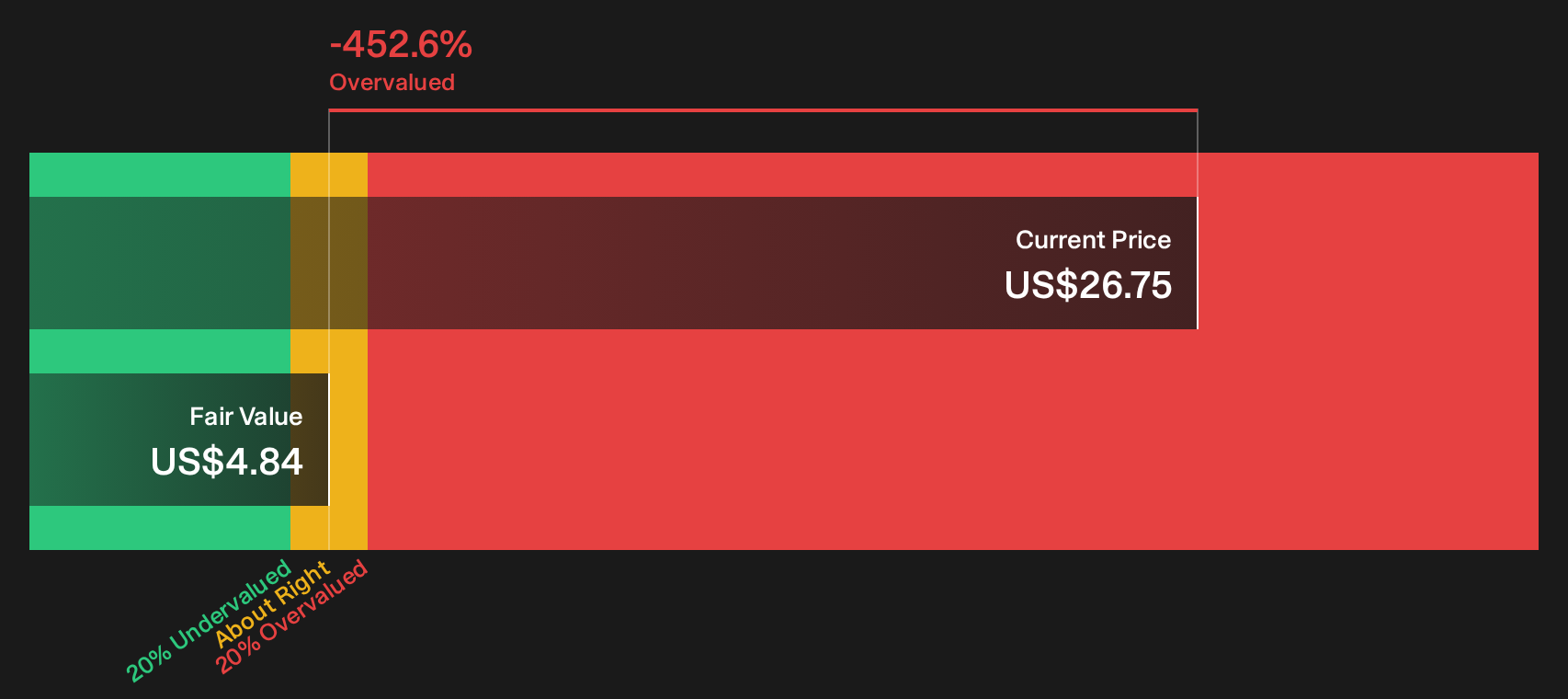
Simply Wall St performs a discounted cash flow (DCF) on every stock in the world every day (check out Harley-Davidson for example). We show the entire calculation in full. You can track the result in your watchlist or portfolio and be alerted when this changes, or use our stock screener to discover 27 high quality undervalued stocks. If you save a screener we even alert you when new companies match - so you never miss a potential opportunity.
Next Steps
Sentiment on Harley-Davidson is split, with both risks and rewards in focus. Move quickly to review the full picture and weigh the 3 key rewards and 1 important warning sign.
Looking for more investment ideas beyond Harley-Davidson?
Do not stop with Harley-Davidson. Broaden your watchlist by scanning focused stock ideas built from clear rules so you are not relying on headlines alone.
- Target resilient balance sheets and steady fundamentals by running a screen on a curated list of solid balance sheet and fundamentals (25 results). This can help anchor a more defensive corner of your portfolio.
- Hunt for mispriced opportunities by checking a focused 27 high quality undervalued stocks. It blends quality metrics with pricing signals to surface potential bargains early.
- Build a watchlist of potential outperformers by reviewing a 31 resilient stocks with low risk scores. It filters for businesses with more stable profiles and fewer red flags.
This article by Simply Wall St is general in nature. We provide commentary based on historical data and analyst forecasts only using an unbiased methodology and our articles are not intended to be financial advice. It does not constitute a recommendation to buy or sell any stock, and does not take account of your objectives, or your financial situation. We aim to bring you long-term focused analysis driven by fundamental data. Note that our analysis may not factor in the latest price-sensitive company announcements or qualitative material. Simply Wall St has no position in any stocks mentioned.
Have feedback on this article? Concerned about the content? Get in touch with us directly. Alternatively, email editorial-team@simplywallst.com