
Billionaires Are Piling Into Union Pacific. Here's What They See.
Key Points
Union Pacific reported a record second quarter.
Its merger with Norfolk Southern is facing resistance.
The railroad has increased its dividend for 20 straight years.
Union Pacific (NYSE: UNP) is on the precipice of a game-changing $85 billion merger with Norfolk Southern (NYSE: NSC). The deal would make Union Pacific the first transcontinental railroad in the U.S., with more than 52,000 miles of track.
The merger is not a slam dunk. It has to pass muster with the Surface Transportation Board, with a decision expected sometime next year. A coalition of labor, competitors, and farm groups opposes the merger. The concern is that the merger would create a de facto monopoly and eliminate competition. On the positive side, it could also lead to lower freight costs for shippers and reduced pollution by reducing the need for interstate trucking with single-line coast-to-coast rail service.
Missed Nvidia in 2009? This Rare Signal Is Flashing Again. In 2009, a "Double Down" signal flashed for a little-known chipmaker called Nvidia. For the first time in years, that same "Total Conviction" signal is flashing for a company 1/100th the size of Nvidia. Continue »
The stock is up more than 19% so far this year, and billionaires Chris Hohn, Ken Griffin, and Bill Gates are all among the major owners of Union Pacific through the investment firms they control. Griffin, who owns Citadel, is Union Pacific's leading shareholder, with 2,675,693 shares. Hohn, who owns TCI Fund Management, owns 4,032 shares of the railroad, and Gates, through Cascades, owns 3,435 shares of Union Pacific.
Like most railroads, Union Pacific isn't a high-profile growth stock, but it has a huge economic moat, and the merger would supercharge its potential while trimming transit times by 24 to 48 hours for more than 1 million intermodal loads annually and eliminating roughly 2.1 million truck trips per year, the company said.
Here are three reasons why the stock may make sense for retail investors, not just billionaires.
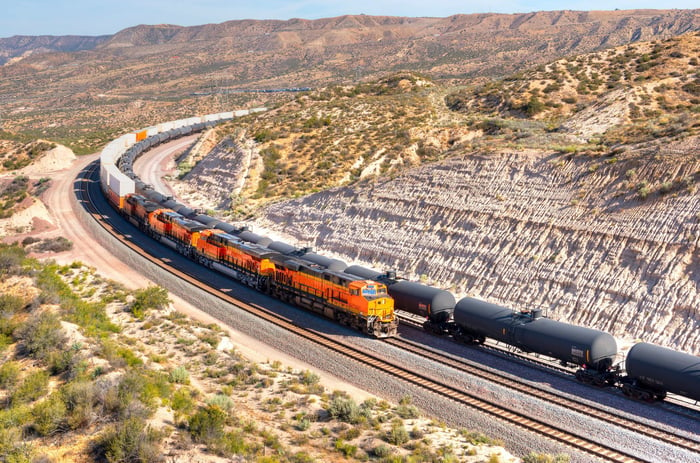
Image source: Getty Images.
1. Steady growth, solid balance sheet
In the second quarter, Union Pacific reported record numbers, including operating revenue of $6.86 billion, up 12% over the same period a year ago; net income of $2 billion, up 6% year over year; and adjusted earnings per share (EPS) of $3.41, up 13% over the same period last year.
The company raised guidance for reported EPS growth to the high single digits this year, consistent with its goals of single- to low-double-digit compound annual growth through 2027.
Because rail remains the most cost-effective way to move bulk commodities, grain, and industrial products over long distances, Union Pacific retains strong pricing power that consistently outpaces inflation.
2. An above-average dividend that is safe
The industrial company raised its quarterly dividend by 2.8% this year, the 20th consecutive year it has increased it. The yield on that dividend is 2.01%, and the payout ratio is a safe 50.1%.
The dividend is well protected. Union Pacific reported six-month cash from operations of $5.5 billion, up 21%, year over year. The company has made its dividend even safer by trimming its debt-to-earnings before interest, taxes, depreciation, and amortization (EBITDA) ratio over the past three years.
3. The company already has a huge moat
Its merger with Norfolk Southern would mean Union Pacific would operate in 43 states, across more than 52,000 miles of track and serving more than 100 ports. Despite the pushback against the deal, it is likely to be approved because of its benefits to U.S. supply lines, a weakness that emerged during the COVID-19 pandemic. It could also cut costs and improve delivery speeds for essential items, including food.
Even if the deal doesn't go through, Union Pacific is the nation's largest freight railroad, and there's no Class I competitor in sight because of the expense and complications involved in matching its 32,000 miles of track.
The company's network connects Gulf Coast ports to the West Coast and to six leading Mexican routes. That makes it a prime beneficiary of long-term nearshoring trends and North American freight traffic. The company's strong cash flow from operations gives it ample leverage to grow, including pursuing a multibillion-dollar merger.
James Halley has positions in Union Pacific. The Motley Fool recommends Union Pacific. The Motley Fool has a disclosure policy.