
This Stock Could Be a Winner From the U.S.-China AI Race
The artificial intelligence (AI) race is about much more than who has the fastest chips. As companies pour billions of dollars into AI infrastructure, the need for faster networks, better data center connectivity, and advanced optical technologies is growing just as quickly. After all, processing massive amounts of data is one thing, but moving it efficiently between chips and across data centers is another. That is where optical connectivity comes into play, and it could open up some interesting opportunities for semiconductor materials companies.
Interestingly, China could be an important part of this story. As the U.S.-China AI race intensifies and U.S. export restrictions constrain China’s access to advanced semiconductor technology, the country is investigating how to overcome chip-performance limitations and build faster networks. According to Wedbush Securities analyst Matt Bryson, China requires optics and faster networks more urgently than Western solutions can fully accommodate. This growing demand for optical solutions could give China an incentive to explore alternatives and potentially position U.S.-related companies such as AXT (AXTI) to capture a larger share of the expanding market.
The California-based materials science company manufactures specialized semiconductor substrates, including indium phosphide (InP), a critical material used in high-speed optical communications. As AI data centers require faster connections to move increasing volumes of information, demand for these substrates could rise. And with China looking to expand its optical infrastructure, AXT could find itself in a favorable position to capitalize on this growing market.
But here is what makes the opportunity particularly interesting. AXT’s potential upside is not limited to China’s AI ambitions. Its customer relationships and long-term supply agreements also connect it to the broader global demand for optical connectivity. That gives investors another reason to watch the stock as AI infrastructure spending continues.
So, could AXT emerge as an unexpected winner in the U.S.-China AI race as the Wedbush analyst anticipates? Let’s take a closer look at the company and the factors behind analysts’ bullish view to see what could drive its next phase of growth.
About AXT Stock
Incorporated in 1986, AXT is a materials science company that develops and manufactures high-performance compound and single-element semiconductor substrate wafers, including indium phosphide, gallium arsenide (GaAs), and germanium (Ge). These specialized substrates are used in semiconductor and optoelectronic devices when conventional silicon wafers cannot meet performance requirements.
AXT serves diverse end markets, including 5G infrastructure, data center connectivity, passive optical networks, LED lighting, lasers, sensors, wireless power amplifiers, and satellite solar cells. The company maintains its global headquarters in Fremont and its Asia headquarters in Beijing, China, alongside three manufacturing facilities in China. It also holds partial ownership stakes in ten Chinese companies supplying raw materials for its manufacturing operations. Its market capitalization currently stands at around $5.2 billion.
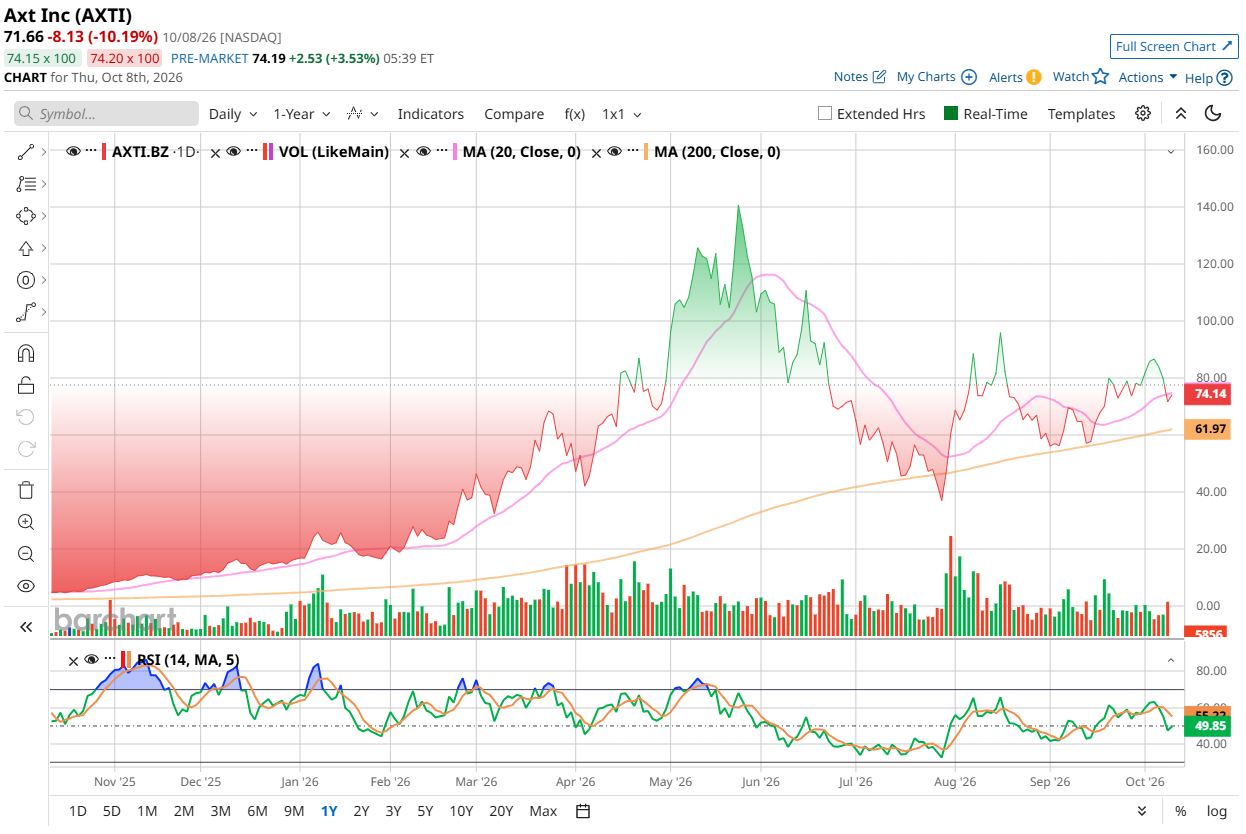
AXTI stock has had quite the run on Wall Street, and if there is one thing this semiconductor materials stock has made clear, it is that AI fever can send a relatively small company into the market spotlight in a hurry. AXTI stock soared to an all-time high of $143.16 in May 2026. While the stock has since surrendered roughly half its value, it remains up a staggering 1,249.5% over the past 52 weeks and 338.3% year to date (YTD). Clearly, the AI trade has been doing some heavy lifting.
So, what is fueling all this excitement? Hyperscalers like Amazon (AMZN), Alphabet's (GOOG) (GOOGL) Google, Microsoft (MSFT), and Meta (META) are connecting thousands of GPUs to train and run increasingly demanding AI models. Traditional copper connections face limitations around power consumption, heat, and data transmission speeds, pushing the industry toward optical technologies, including silicon photonics and high-speed 800G and 1.6T transceivers. That is where AXT comes in. Its indium phosphide and other compound semiconductor substrates are essential materials for high-performance optical components, giving the company a potentially lucrative role in the AI data center buildout.
The excitement became even more tangible after AXT reported strong second-quarter 2026 results in July. Shares jumped nearly 30% following the report and gained another 14% over the subsequent trading sessions, as record InP revenue and improving profitability reinforced optimism about the company’s growth prospects. Its growing backlog, long-term customer agreements, and aggressive capacity expansion plans added further fuel to the rally.
However, AXTI’s rally has not been smooth. Over the past six months, AXTI gained 34.8%, while its three-month advance came in at 19.2%. Yet the latest pullback has been brutal. As of Oct. 8, shares closed at $71.66, down 10.2% for the session, extending their losing streak to three trading days. The stock also fell 12.4% over the past five sessions, leaving it roughly 50% below its May peak.
After such an extraordinary run, valuation concerns are becoming harder to ignore. Insider share sales have added to the caution, while China’s export-permit requirements present a practical hurdle – strong demand means little if AXT cannot ship its substrates to customers on time. Broader volatility across semiconductor stocks has added another layer of uncertainty.
AXTI stock currently trades below its 20-day moving average but above its 200-day moving average, suggesting that the broader trend remains steady despite the recent pullback. Meanwhile, its 14-day RSI sits at 49, indicating relatively neutral momentum, with neither strong buying pressure nor oversold conditions dominating the picture.
Valuation is where things get a little tricky for AXTI. The stock trades at 23.5 times sales, well above both its sector average and historical norm. That premium suggests investors are betting on substantial revenue growth and further market expansion, particularly as demand for optical semiconductor materials accelerates alongside the AI infrastructure boom.
Q2 Earnings Snapshot
In July, AXT reported a standout second quarter for 2026, marking a key turning point for the business. As demand for data center optical connectivity picks up and manufacturing capacity expands faster than expected, the company is beginning to see the financial benefits of its investments.
For the quarter, AXT generated revenue of $47.6 million, up 164.8% year-over-year (YoY), while its non-GAAP gross margin, excluding stock-based compensation charges, surged to 45% from 8.2% in the year-ago period. Non-GAAP net income reached $11.9 million, or $0.19 per share, compared with a net loss of -$6.4 million, or -$0.15 per share, in the second quarter of 2025. Both revenue and earnings also exceeded Wall Street’s expectations.
At the heart of this growth is indium phosphide, a semiconductor material increasingly important for high-speed optical communications. CEO Morris Young said AXT had entered an critical growth phase as customers expanded their deployment of faster optical technologies to support data center connectivity. The company generated a record $30.7 million in InP revenue during the quarter, with demand continuing to outpace available supply.
Encouraged by faster-than-expected manufacturing progress, AXT has stepped up its capacity expansion efforts and is ahead of schedule on its 2026 plans. Management expects InP revenue opportunities to more than triple by year-end, with further expansion planned for 2027. Progress toward producing six-inch InP substrates could also open the door to higher-value products and improved margins.
Meanwhile, AXT is strengthening its customer relationships through long-term supply agreements with Casela, Coherent, and Lumentum. The company received prepayments of $22.3 million and $25.4 million under agreements with Casela and Coherent, respectively, providing additional visibility as products are delivered. Its backlog remains above $100 million and extends into 2027 when combined with long-term supply agreements.
AXT is all set to release its Q3 2026 earnings results following the market close on Thursday, Oct. 29, 2026. Management expects approximately $66 million in third-quarter revenue that can be recognized from substrate products and raw materials for which the necessary permits are available or not required. Non-GAAP EPS is expected to be between $0.30 and $0.32.
As AXT enters the second half of 2026, its focus remains on scaling production, improving productivity, fulfilling customer commitments, and developing larger-diameter substrates. With AI infrastructure and optical connectivity driving demand, the company is working to turn its expanding manufacturing capabilities into sustained growth.
Analysts tracking AXT anticipate its Q3 revenue to be $66 million, with EPS rising 850% YoY to $0.30. For fiscal 2026, AXT’s EPS is projected to surge 263.3% annually to $0.80 and then rise by another 168.8% YoY to $2.15 in fiscal 2027.
What Do Analysts Expect for AXTI Stock?
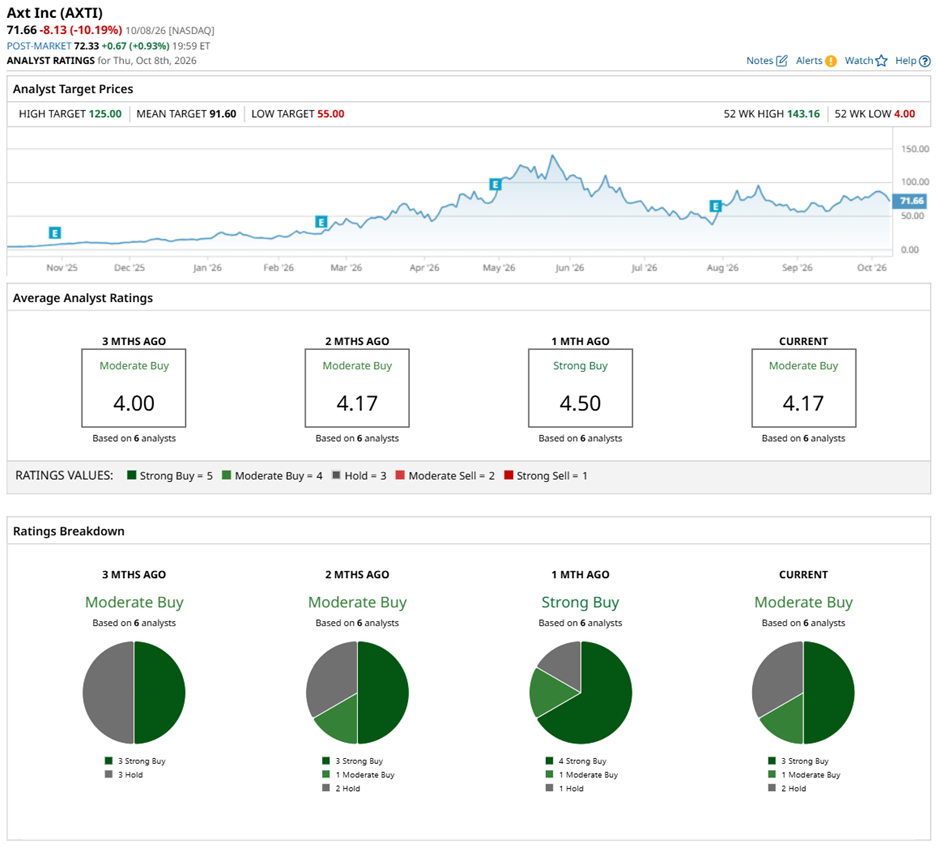
Wall Street remains cautiously optimistic about AXTI stock, although sentiment has cooled a bit. The stock currently carries a “Moderate Buy” consensus rating, down from “Strong Buy” a month ago. Of the six analysts covering the stock, three recommend a “Strong Buy,” one has a “Moderate Buy” rating, and the remaining two advise investors to “Hold.”
Meanwhile, the average price target of $91.60 points to potential upside of 27.8% from current levels. The most bullish analyst on the Street has set a $125 target, suggesting AXTI could climb as much as 74.4% if that optimistic outlook plays out.
Final Thoughts on AXTI Stock
AXT has an interesting opportunity on its hands as China looks to build faster networks and strengthen its AI capabilities. Wedbush believes this demand could work in the company’s favor, while its InP substrates and expanding production capacity give it a way to capitalize on the optical connectivity boom. Still, investors shouldn’t get carried away just yet. Export hurdles, rich valuation, and recent share-price swings remain concerns. Whether AXTI can turn this opportunity into lasting growth is the real question.
On the date of publication, Sristi Suman Jayaswal did not have (either directly or indirectly) positions in any of the securities mentioned in this article. All information and data in this article is solely for informational purposes. For more information please view the Barchart Disclosure Policy here.