
Two-car race gets hotter
FOR years, Perusahaan Otomobil Kedua Sdn Bhd (Perodua) had little reason to look at the rearview mirror.
It was streets ahead of fellow national carmaker Perusahaan Otomobil Nasional Sdn Bhd (Proton) in terms of market share and the question was rarely whether Perodua would remain Malaysia’s No 1 carmaker, but how far ahead it would finish.
That cushion, however, is beginning to shrink.
Proton is steadily clawing back market share, narrowing the gap with Perodua and turning what had become a largely one-sided national-car race into a more competitive two-player market (see Chart A).
An analyst tells StarBiz 7 that the shift was becoming “quite significant”, with the market-share gap between the two national brands narrowing to about 17 percentage points in the first seven months of 2026 from 28 percentage points a year earlier.
Citing Malaysian Automotive Association passenger-vehicle data, the analyst says Proton’s average market share rose to around 27% in the first seven months of 2026 from about 20% in the same period last year.
Over the same period, Perodua’s share eased to around 44% from 48%.
“Proton is clearly becoming a stronger competitor and is taking meaningful market share,” the analyst says.
“Having said that, I would not say Perodua’s No. 1 position is under immediate threat.”
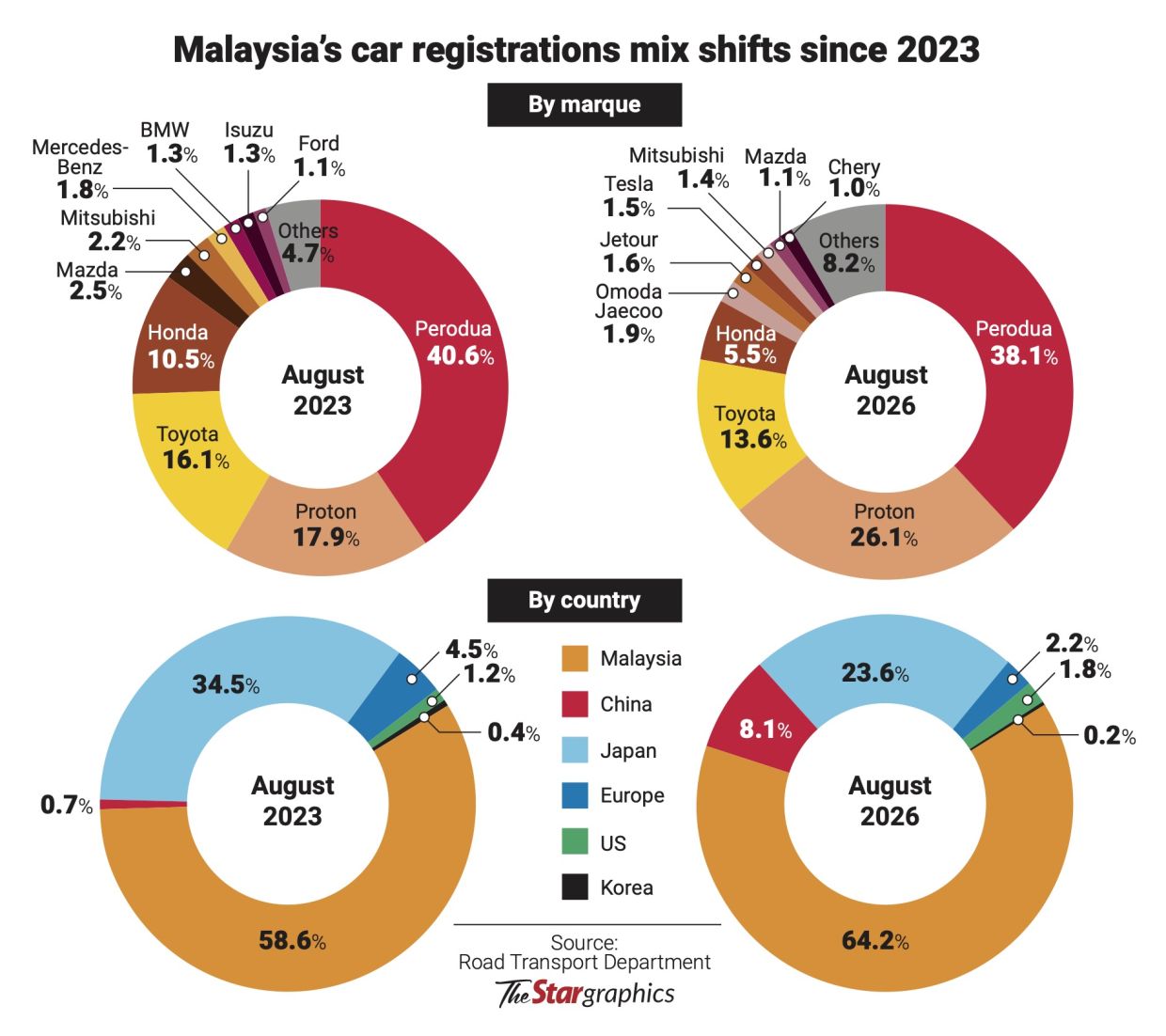
But the change is that Proton is once again a credible challenger.
“It is a much more competitive two-player market now, rather than an imminent change in market leadership,” the analyst adds.
“Perodua probably cannot take its dominant position for granted anymore.”
That matters in a market where the two national brands together account for close to two-thirds of vehicle sales.
Perodua still has an enormous lead but if Proton continues gaining ground, the analyst expects Perodua’s market share to gradually come down from the high-40% levels seen in recent years.
A price war, however, is unlikely to be Perodua’s preferred response, the analyst says.
“Its cars are already priced quite competitively, especially in the mass-market segment, so I think it is more likely to defend its position through new launches, better specs, more features, attractive financing packages and selective promotions,” the analyst says.
The pressure is also coming from beyond Proton.
Chinese brands are becoming more aggressive in Malaysia, particularly by offering more technology and features at similar price points, the analyst adds.
That competition comes as the overall Malaysian automotive market continues to grow, although at a more measured pace.
A bigger market, but tougher fight
BMI, a market research and data analysis firm, expects total vehicle sales to rise 1.7% year-on-year in 2026 to around 835,000 units, from a record 820,752 units in 2025.
It expects national models such as the Perodua Bezza and Alza, along with key Proton nameplates, to continue underpinning demand.
“Festive promotional activity, new model launches and intensifying competition from Chinese marques and other new-energy vehicle entrants should sustain showroom traffic and force wider discounting across the market,” it notes.
Overall, the analyst says the intensifying competition should benefit consumers through better value for money.
“But for carmakers, competition will definitely get tougher and they will have to work harder to defend market share,” the analyst notes.
Perodua has already made some moves on pricing.
It cut prices for the Axia by up to 12%, citing “operational efficiency” and its intention to pass the savings on to customers.
Its QV-E has also seen its price reduced substantially since its launch, alongside lower battery-as-a-service charges and promotional rebates.
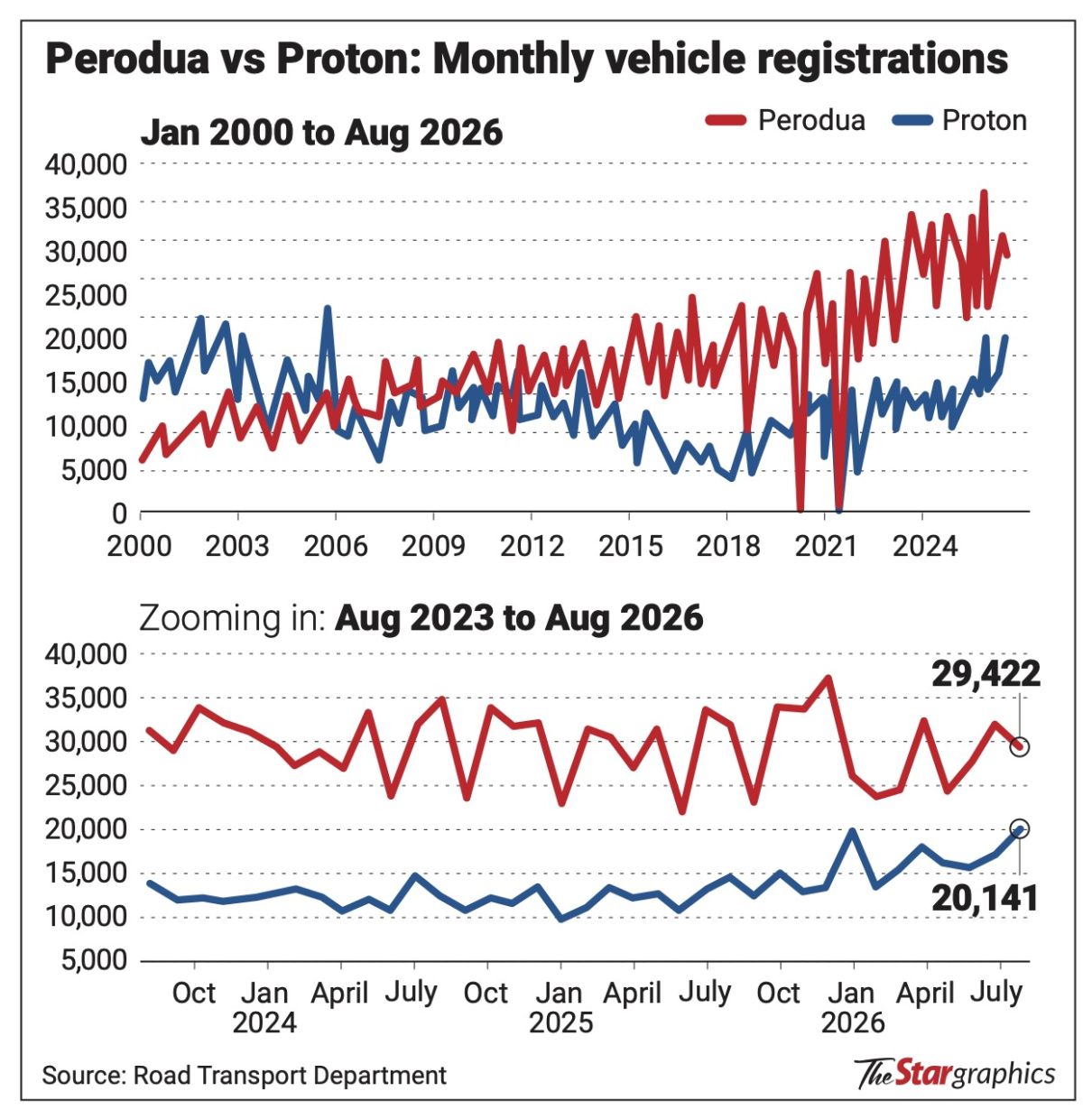
Proton was not always the weaker of Malaysia’s two national carmakers.
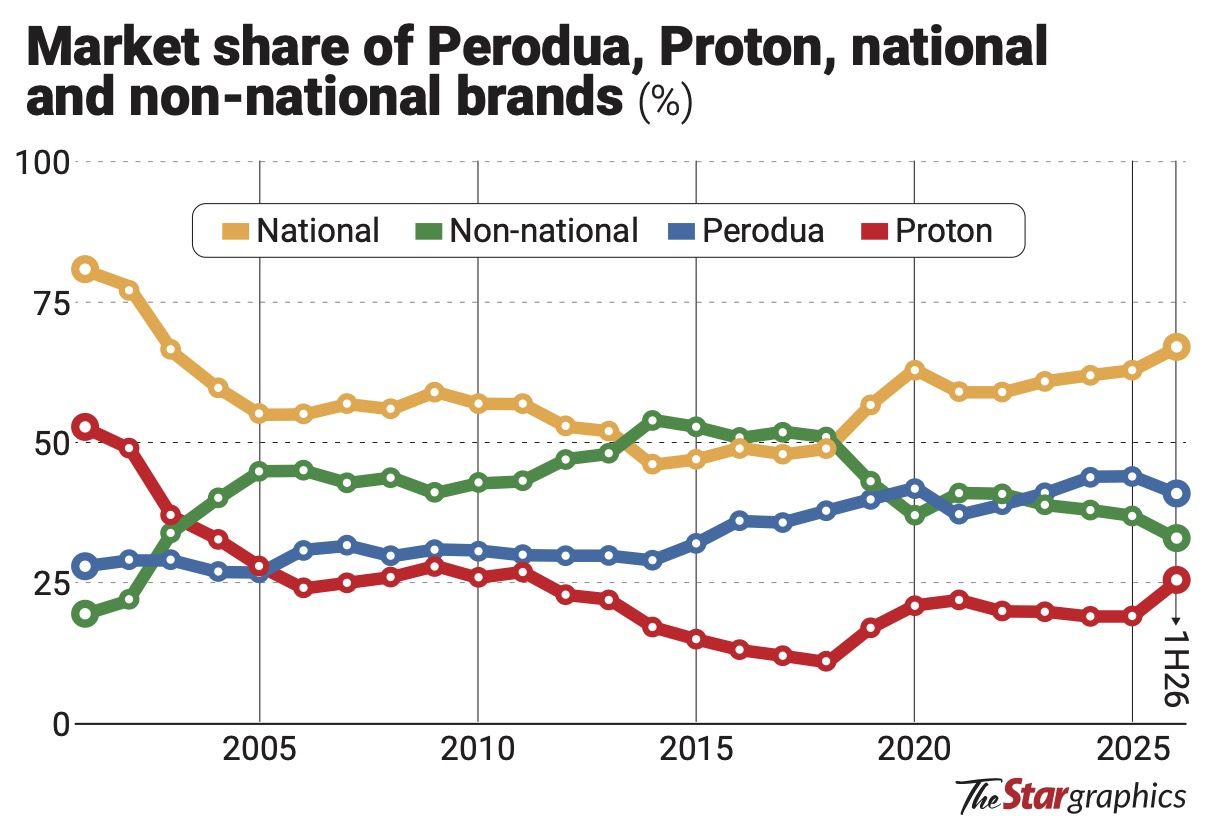
Established in 1983 under Malaysia’s National Car Project, Proton once dominated the domestic automotive market, commanding more than 60% of sales in the 1990s.
Its first car, the Saga, was launched in 1985, followed by models such as the Wira and Perdana, with Mitsubishi providing much of the technology and engineering expertise behind its early models.
But then, the market changed.
Vehicle sales expanded, foreign marques gained ground and Perodua, which began operations in 1993, started growing quickly.
Mitsubishi also exited its stake in Proton in 2004, and by 2006, Perodua had overtaken Proton in sales (see Charts B and C).
Even Toyota and Honda outsold Proton in parts of the decade, highlighting how far the first national carmaker had fallen from its earlier dominance.
Today, however, Proton appears to have found a formula for regaining relevance.
The Geely effect
A major turning point came with its partnership with Chinese automaker Geely Automobile Holdings Ltd.
Geely acquired a 49.9% stake in Proton in 2017, with DRB-Hicom Bhd retaining 50.1%.
The partnership gave Proton access to vehicle platforms, powertrains and technology that, an industry observer says, would otherwise have required substantial investment and years of development.
It also allowed Proton to refresh its product range much faster.
More importantly, Proton’s revival also marks a significant change from the days when the national carmaker depended heavily on government support.
An industry observer said the partnership was crucial in preventing Proton from continuing to accumulate losses.
“If Geely had not come inside there, I can tell you, every year they would be bleeding billions,” the observer says.
A 2016 parliamentary reply showed that the government had provided about RM13.9bil in grants, tax incentives and other assistance to Proton since its establishment in 1985.
Another analyst, however, cautions against viewing Proton as simply a Chinese-controlled carmaker.
“Yes, Geely has played a big role in Proton’s turnaround, giving it access to better platforms, technology and powertrains, while also speeding up product development,” the analyst says.
However, the analyst also points to Proton’s efforts to rebuild its own engineering and product-development capabilities.
The latest Saga, for example, was largely developed by Proton’s Malaysian team, with technical support from Geely, while Proton owns the intellectual property for its new advanced modular architecture platform.
“I would still consider Proton a Malaysian carmaker, but one with a strong global technology partner,” the analyst says.
“As long as Proton continues to increase localisation and build its own engineering capabilities, I think the Geely partnership strengthens rather than weakens its Malaysian identity.”
Proton sold 19,465 vehicles in September, bringing year-to-date sales to 160,886 units, up 40.8% from a year earlier.
The Saga remained its bread-and-butter model, with sales of 68,237 units, up 34.5%.
The S70 recorded 20,709 units, while the X50 posted 20,163 units.
Proton estimates its market share at 26.9% year-to-date.
In a reply to StarBiz 7, Proton says it remained focused on its medium- and long-term growth plans and was on track to achieve its target of 200,000 vehicle sales in 2026.
“We forecast there is further room to grow Proton’s market share,” it says when asked if there was still room for growth.
Proton declines to reveal its order volumes and production schedules, noting that these were dynamic, according to market demand.
“We therefore believe the confirmed sales and deliveries, which we report on regularly, provide a more meaningful indication of our market performance,” it says.
“Our immediate focus is to fulfil customer orders while managing delivery expectations and we work closely with our dealers to keep customers informed of estimated delivery timelines for their selected model and variant.”
Proton says it is “enhancing” its plant and vendor ecosystem capacity and capability to meet demand, while thanking the government for its industry policies and customers for their support.
Its electrified vehicle arm, Proton New Energy Technology Sdn Bhd or Pro-Net, has delivered 40,000 electric vehicle (EV) and plug-in hybrid electric vehicle e.MAS models since launching 20 months ago, with its market share now above 60%, Proton says.
To meet rising demand, Proton announced a RM37mil expansion of its EV assembly plant in Tanjung Malim last May, on top of the RM82mil initial investment in the facility, which was launched in September 2025.
Furthermore, the plant sits on a 5.57-acre site within Proton’s complex and will see annual production capacity increase from 20,000 to 42,000 units.
Perodua was contacted for comment and requested more time to respond.