
When a Seasonal Commodity Spread Stops Following the Pattern
Dual Edge Research publishes two powerful newsletters that work great individually — and even better together. The Bull Strangle Newsletter focuses on stocks and options, combining stock ownership with premium-selling strategies to generate consistent income and market-beating returns. The Smart Spreads Newsletter specializes in seasonal commodity futures spreads, offering a diversified approach with low correlation to equities. Together, they deliver a complete investment perspective — one focused on income, the other on diversification — all under one simple subscription.
Introduction
A seasonal tendency can help identify a commodity spread opportunity. But once the trade is open, the market may deviate from the historical pattern. The practical question becomes: Does the position still fit the trading plan, or is it time to exit?
For the Smart Spreads strategy, historical research provides a framework for selecting trades. Managing those trades requires comparing that framework with current price behavior, the remaining seasonal window, and the position's risk.
History Provides a Framework
A commodity futures spread involves buying one futures contract and selling another. The position’s result depends on the change in the price relationship between the two contracts.
Seasonal research examines how that relationship behaved during comparable periods in previous years. Average profits, win rates, historical drawdowns, and holding periods help us evaluate a potential opportunity.
Those statistics describe a range of past outcomes. They do not establish the path a spread must follow this year. Even a trade with favorable historical results can move adversely or finish with a loss. That distinction matters when the current trade diverges from its seasonal tendency.
A Hypothetical Trade Changes Direction
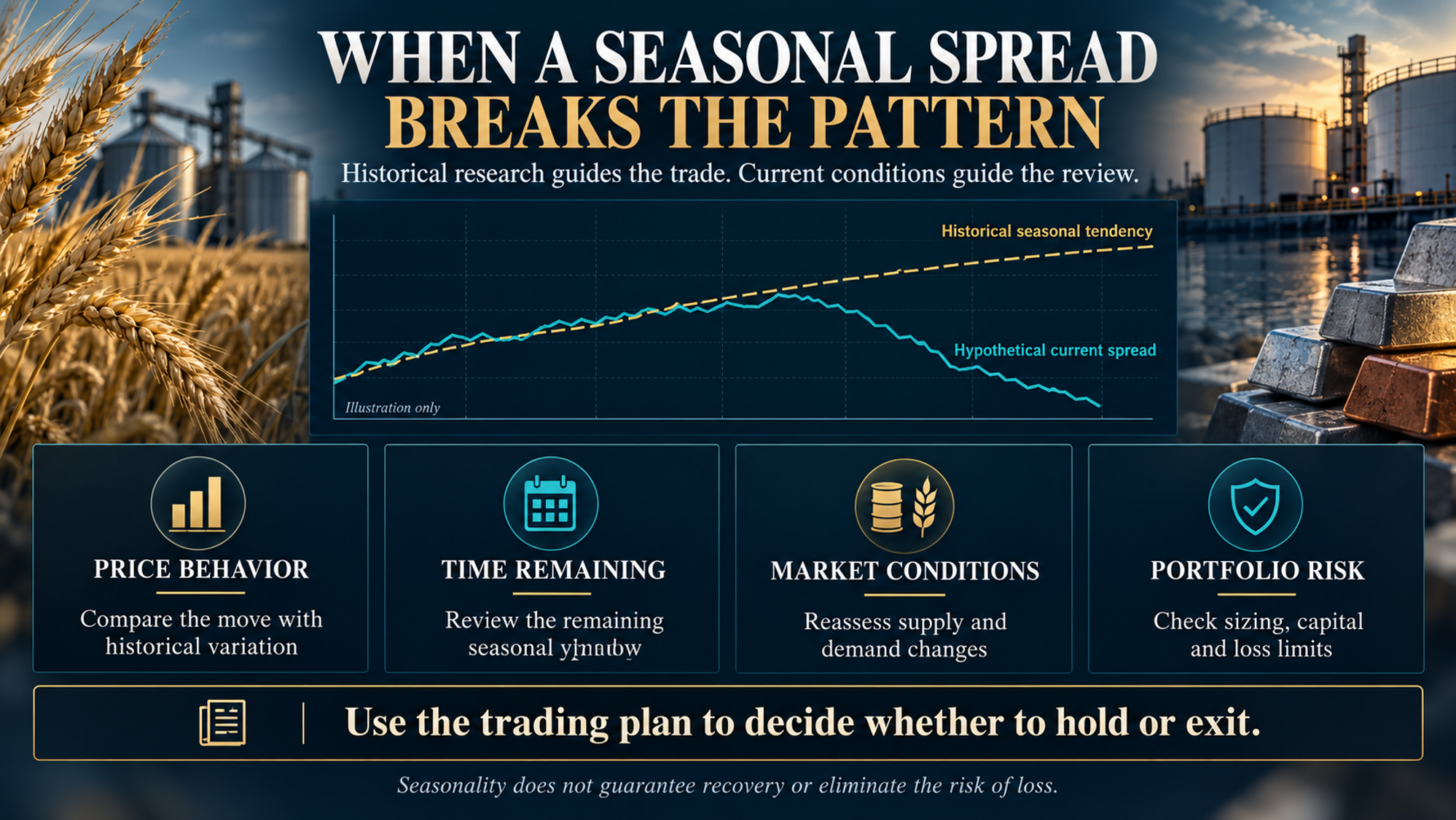
Suppose we enter a calendar spread with a historically favorable six-week seasonal window. The spread initially moves in the expected direction, then reverses and gives back its early gain. At that point, neither the reversal nor the historical win rate answers the management question on its own.
Exiting on every unfavorable move could cut short trades experiencing ordinary fluctuations. Holding simply because the spread has usually recovered could turn a manageable loss into a much larger one. We need to assess the current position against the expectations and limits established before entry.
Put the Adverse Move in Context
The first question is how the current move compares with the spread’s historical behavior. Did previous profitable years experience similar setbacks? Is the adverse move occurring at a point in the seasonal window when the spread has often fluctuated? Or is this year’s behavior materially different?
An average seasonal chart can smooth out considerable variation between individual years. Reviewing those individual paths helps distinguish a relatively steady tendency from one that has produced similar final results through very different routes. Historical drawdown provides additional context. However, the largest loss observed in the research is not a ceiling on what can happen next. A current trade can exceed every adverse move in the historical sample. The purpose of this review is to understand the deviation—not to find a reason to dismiss it.
Consider the Time Remaining
A seasonal trade has a time component as well as a price component. An adverse move early in a six-week window calls for a different decision than the same move with only a few days remaining. Early in the trade, more of the research period remains. Near the planned exit, there may be little time left for the expected relationship to develop.
More time does not guarantee recovery. But the remaining window helps us assess whether the original trade opportunity is still present. Extending a position beyond its planned seasonal exit also changes the trade. The decision should rest on a clear reason and an acceptable risk commitment, rather than a desire to avoid closing a losing position.
Review What May Have Changed
Next, consider whether current market conditions help explain the spread’s behavior. Commodity relationships can respond to changes in supply, demand, inventories, weather, transportation, and production. A development may affect the two contracts differently, changing the relationship we are trading.
The useful question is whether a change affects the reasoning behind the position. A news headline matters more when it helps explain why the expected seasonal relationship may be weaker, delayed, or absent this year. We may not always be able to identify a clear cause. Uncertainty about the explanation does not remove the need to manage the exposure.
Bring the Decision Back to Risk
The trade must also be evaluated within the portfolio. How much capital is committed? How much additional loss can the account absorb within its rules? Are other positions exposed to related commodity markets or the same underlying development?
Several spreads can look different while responding to a common market force. An adverse move across those positions may create more concentrated risk than the individual trade analysis suggests. The current position should remain within the account’s sizing, capital, and loss limits. Favorable historical statistics do not justify exceeding those limits.
Use the Plan to Decide Whether to Hold or Exit
Before entering a seasonal spread, we should know the intended holding period, the risk commitment, and the conditions that would prompt an exit. Those decisions provide a reference when the market becomes uncomfortable. Holding may remain consistent with the plan when fluctuations stay within expectations, the seasonal window remains relevant, and the position stays within its risk limits.
Exiting may be appropriate when a risk limit is reached, the planned window ends, or current conditions no longer support the trade’s original reasoning. The decision should reflect the evidence available now. The entry price and the desire to recover a loss do not determine whether the remaining opportunity is attractive.
Learn From the Deviation
After closing the trade, record how it behaved relative to the research. Note the timing and size of the adverse move, the reason for the exit, and whether the management decision followed the plan.
A losing trade does not, by itself, invalidate a seasonal tendency. A profitable trade does not prove the process was sound. Reviewing both helps separate decision quality from outcome.
Seasonality helps us identify opportunities worth investigating. When a spread stops following the pattern, a defined management process helps us decide whether it still deserves capital. Historical research informs that decision, but it does not eliminate the risk of loss.
Additional Details
The Bull Strangle Newsletter focuses on stocks and options, combining stock ownership with disciplined option-selling techniques designed to generate consistent income while managing risk.
The Smart Spreads Newsletter focuses on seasonal commodity spreads, a historically proven approach that seeks opportunities across agricultural, energy, metal, and financial futures markets.
Each strategy is designed to stand on its own, but together they provide a diversified approach that can perform across a wide range of market environments. For traders looking to deepen their education, The Bull Strangle Strategy and Trading Commodity Spreads are both available on Amazon.
Visit BullStrangle.com to subscribe for just $1 for the first month.
For a video overview of the Bull Strangle Newsletter
For a video overview of the Smart Spreads Newsletter
Darren Carlat
Dual Edge Research
(214) 636-3133
DualEdgeResearch@gmail.com
Disclaimer
This information is for informational purposes only and should not be considered investment advice. Past performance is not indicative of future results, and all investments carry inherent risk. Consult with a financial advisor before making any investment decisions.