
3 US Staffing Stocks Investors Are Screening As Tech Visa Rules Tighten
U.S. visa rules suddenly sit front and center after Washington put Microsoft, Adobe and several IT contractors under fresh scrutiny, and that ripple matters for hiring, payroll and compliance specialists that live in tech’s shadow. When immigration pipes narrow, employers often scramble. That scramble can create fresh demand for certain services. This piece breaks down three U.S. listed staffing and compliance stocks exposed to this policy shock and what that could mean for your portfolio.
The stocks covered below are just a starter pack, and the full screen surfaced 11 more U.S. staffing, recruitment, payroll and compliance companies with equally compelling narratives that do not fit into a single article. To identify which ones best fit your thesis, head straight into the U.S. Domestic Staffing and Compliance Beneficiaries of Tighter Tech Visa Enforcement screener and analyze, filter and rank the names that match your highest conviction view.
TrueBlue (TBI)
TrueBlue is one of the clearest pure plays in this theme, with clients leaning on its U.S. focused staffing and compliance services when visa routes tighten and domestic hiring or outsourced workforce management picks up.
TrueBlue runs contingent staffing and outsourced recruitment across industrial and skilled roles tied closely to U.S. hiring, with PeopleReady generating about US$969 million of revenue, PeopleManagement around US$536 million, and PeopleSolutions roughly US$186 million, and the stock valued at about US$270 million in market cap.
"Persistent structural labor shortages in skilled trades and commercial drivers, combined with TrueBlue’s reported fifth consecutive quarter of double digit driver growth, may position the company to gain share and potentially lift consolidated revenue and operating margins if transportation volumes recover."
What happens to earnings if that demand meets even a modest shift in pricing power is the unresolved question investors will focus on.
If that pricing power materialises, full narrative for TrueBlue examines how TrueBlue’s staffing mix, cyclicality and policy exposure could be quietly reshaping the risk reward profile.

Insperity (NSP)
Insperity fits into this visa tightening theme as the full service HR partner that U.S. small and mid sized employers rely on when staffing, payroll and compliance risk suddenly feel too big to run in house.
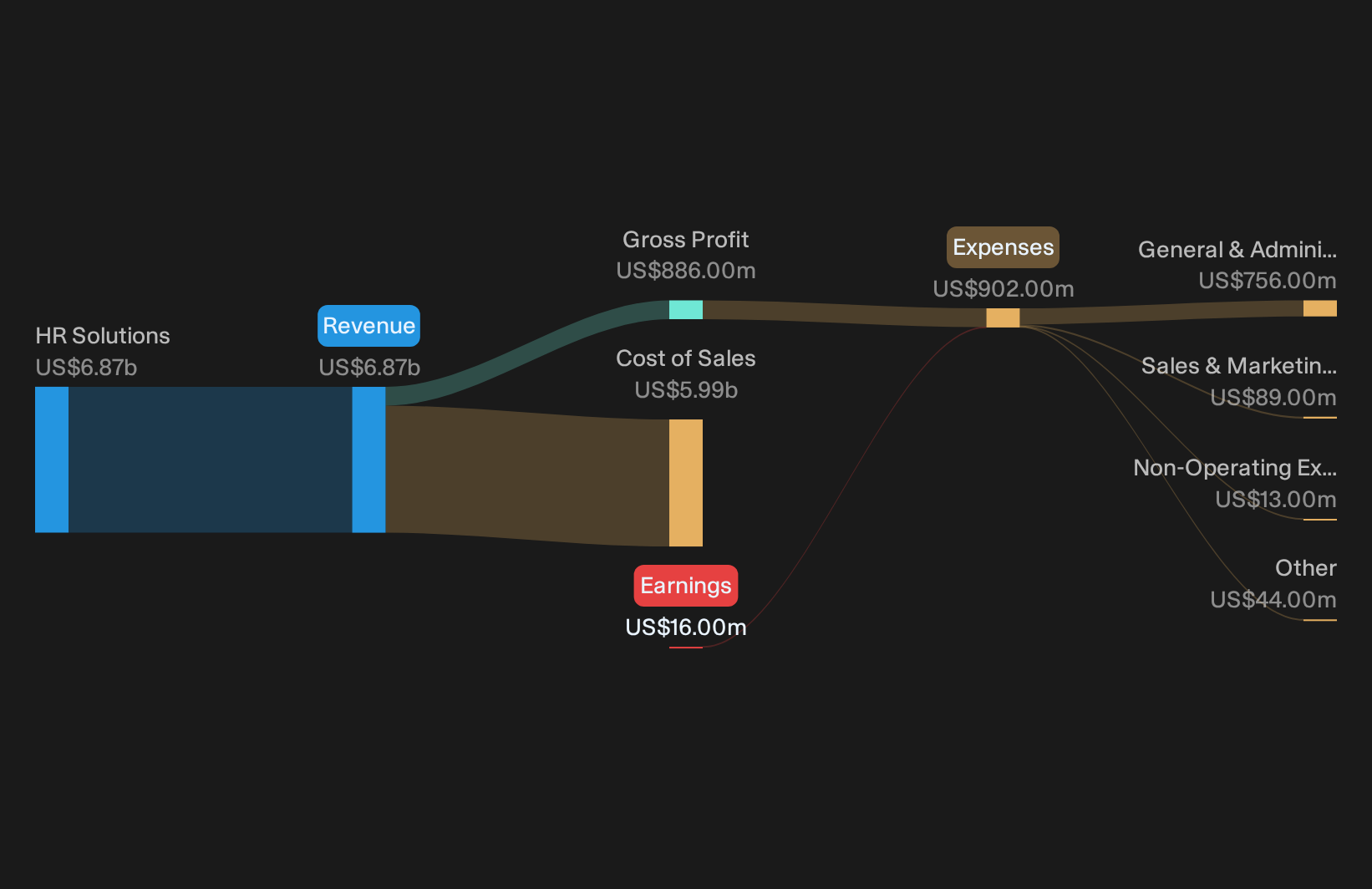
Insperity runs bundled HR and payroll services for small and midsize U.S. employers through its HR Solutions segment, which generated about US$6.9b, and the group is valued at roughly US$1.9b in market cap.
"The rollout of Insperity HRScale with Workday to mid-sized clients between 150 and 5,000 employees, now with about 8,000 worksite employees sold and a shift of spending from development to revenue-producing operations, points to a new revenue stream that management expects to carry profitability at or above HR360 levels and support earnings growth."
The key variable is how one pressure point in this model reshapes what investors can reasonably expect from future margins and cash generation.
That margin puzzle is exactly what the full narrative for Insperity unpacks, mapping how HRScale, pricing power and compliance demand could be quietly re-rating Insperity’s earnings story.
Barrett Business Services (BBSI)
Barrett Business Services plugs directly into this screener theme as a U.S. focused PEO and staffing specialist, handling payroll, workers compensation and recruiting for smaller employers that may lean harder on domestic hiring and outsourced HR as visa rules tighten.
Barrett Business Services generates about US$1.27b from staffing and outsourcing services in the U.S., using a co employment and recruiting model across industries, and the stock carries a market value of roughly US$769 million.
Investors scanning for U.S. staffing and compliance plays tied to tighter PERM and H 1B enforcement will see Barrett Business Services sitting right in the flow of that shift, with its model already wired into domestic payroll, workers compensation and HR administration for smaller employers.
"A turning workers compensation pricing environment in California, with advisory and approved rate hikes in 2025 and 2026 and eight consecutive months of company level pricing increases by Q2 2026 while SG&A growth stays below gross billings growth, presents a scenario in which higher earned pricing could flow through to improved gross margins and earnings once the 2026 transition year is behind the business."
The real swing factor is how one developing trend in Barrett Business Services’ client mix ultimately feeds through to the margins investors care about.
That client mix question is exactly what the full narrative for Barrett Business Services tackles, mapping how accelerating pricing, risk controls and capital discipline could be decoupling Barrett Business Services’ earnings power from old cycle patterns.

Seeking Fresh Alternatives Before They Fly
Market narratives move fast. The next breakout themes can gain momentum while you are still caught on yesterday’s headlines. Scan these fresh stock ideas that are under the radar for now and consider them while they remain in the early stages.
- Spot overlooked quality before momentum traders arrive by running your filters through the 20 high quality undiscovered gems while conviction is still forming and entry prices remain in play.
- Pressure test your income plan against a curated 8 dividend fortresses so potential yield workhorses do not slip away as prices move and spreads start dropping.
- Monitor structural tech demand with a targeted sweep of 92 AI infrastructure stocks before institutional money changes the trading dynamics and the earliest pricing gaps close.
This article by Simply Wall St is general in nature. We provide commentary based on historical data and analyst forecasts only using an unbiased methodology and our articles are not intended to be financial advice. It does not constitute a recommendation to buy or sell any stock, and does not take account of your objectives, or your financial situation. We aim to bring you long-term focused analysis driven by fundamental data. Note that our analysis may not factor in the latest price-sensitive company announcements or qualitative material. Simply Wall St has no position in any stocks mentioned.
Have feedback on this article? Concerned about the content? Get in touch with us directly. Alternatively, email editorial-team@simplywallst.com