
Is Stronger Earnings Altering The Investment Case For Carnival (CCL)?
- Carnival Corporation reported third quarter 2026 results with sales of US$2,906 million, revenue of US$8,435 million and net income of US$1,920 million, alongside nine month figures that also showed higher sales, revenue and earnings compared with the prior year period.
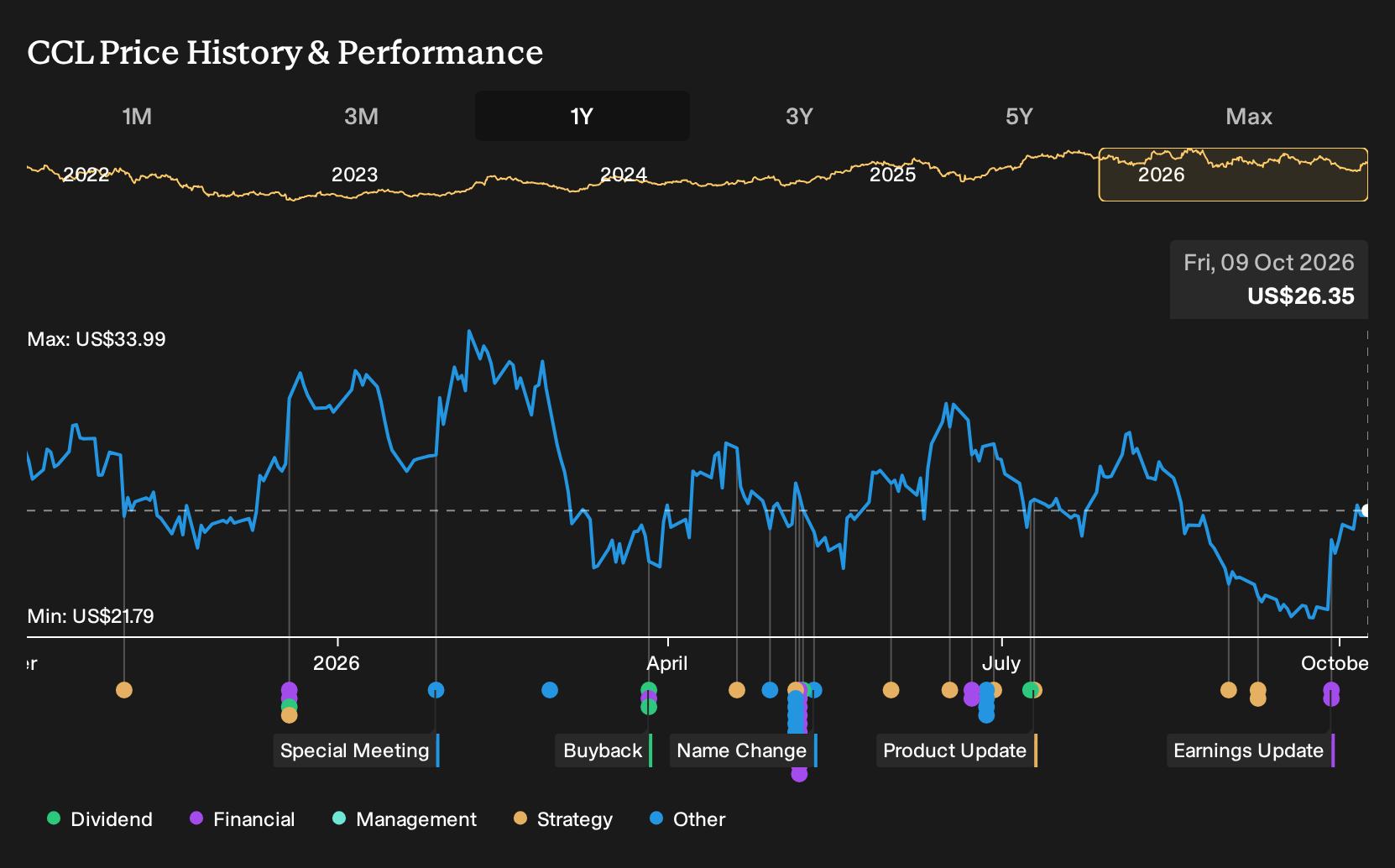
- Alongside these results, Carnival completed a US$1,200 million share repurchase covering 3.27% of its stock and filed a broad shelf registration for multiple securities. This filing gives management additional flexibility around capital structure and future funding choices.
- The focus now turns to how Carnival's higher net income and completed buyback could reshape the existing investment narrative around capacity, debt and cash generation.
Carnival Investment Narrative Recap
Carnival investors need to believe the cruise operator can keep filling ships at healthy pricing while steadily turning current profitability into consistent free cash generation. The latest quarter showed higher sales, revenue and net income versus last year, which supports that view, but the real test is whether this carries through peak seasons without discounting eroding yields.
The biggest short term swing factor remains how consumer demand holds up against geopolitical shocks and ongoing travel cost sensitivity. The main risk still sits on the balance sheet. Carnival carries a meaningful debt load from the pandemic era, so any wobble in cash flow or refinancing costs matters more than a single solid quarter.
The completed US$1,200 million buyback, covering 3.27% of the stock, is the announcement that matters most in this context. It signals that Carnival is using current earnings and liquidity to reduce the share count rather than only sitting on cash, which directly affects per share metrics and how quickly existing holders feel the benefit of current profitability.
For catalysts, that repurchase interacts with debt and capex demands. If operating performance remains in line with the recent quarter, the finished buyback may modestly amplify earnings per share as the new loyalty program ramps and private destinations scale. If cash generation tightens or geopolitical disruptions hit bookings, the prior choice to allocate US$1.2b to equity instead of further balance sheet repair could amplify risk rather than support the story.
Carnival's narrative projects US$30.6b revenue and US$4.0b earnings by 2029. That profile assumes 3.5% yearly revenue growth and an earnings increase of about US$0.9b from US$3.1b today.
Uncover why Carnival's fair value indicates a 29% potential upside to its current price that could narrow quickly.
Exploring Other Perspectives
Some of the most optimistic analysts frame Carnival’s aggressive deleveraging as the real catalyst. Before this earnings release, the bullish camp was mapping out revenue of about US$31.0b and earnings of roughly US$4.4b by 2029. That is a much richer story than consensus, and it may shift again once this latest report and buyback are fully digested.
Explore 6 other Carnival fair value estimates, including one that suggests as much as 109% upside from the current price!
Form Your Own Verdict
Don't just follow the ticker; dig into the data and build a conviction that's truly your own.
- A great starting point for your Carnival research is our analysis highlighting 5 key rewards and 2 important warning signs that could impact your investment decision.
- See our latest analysis for Carnival. The report includes a comprehensive fundamental analysis summarized in a single visual, the Snowflake, making it easy to evaluate Carnival's overall financial health at a glance.
Looking For More Investment Ideas Beyond Carnival?
Once you have a view on Carnival, it can help to compare that thesis with other opportunities that match your goals on value, quality and risk. The Simply Wall St Screener lets you quickly filter for different profiles so you are not relying on a single story or sector.
- If you want potential mispricing with support from fundamentals, start by scanning a curated set of 29 high quality undervalued stocks that pair solid cash flows with balance sheets that can handle shocks.
- If resilience and capital strength matter most to you, narrow the field to a list of solid balance sheet and fundamentals (25 results) and compare how those businesses manage debt, liquidity and reinvestment versus Carnival.
- If you are hunting for opportunities that may not be widely followed yet, cast a wider net across a 20 high quality undiscovered gems and see which stories deserve a place on your watchlist next.
This article by Simply Wall St is general in nature. We provide commentary based on historical data and analyst forecasts only using an unbiased methodology and our articles are not intended to be financial advice. It does not constitute a recommendation to buy or sell any stock, and does not take account of your objectives, or your financial situation. We aim to bring you long-term focused analysis driven by fundamental data. Note that our analysis may not factor in the latest price-sensitive company announcements or qualitative material. Simply Wall St has no position in any stocks mentioned.
Have feedback on this article? Concerned about the content? Get in touch with us directly. Alternatively, email editorial-team@simplywallst.com