
AMD’s $8.2 Billion World Labs Deal Could Strengthen Its AI Growth Story
Advanced Micro Devices (AMD) is making an $8.2 billion bet on the next chapter of artificial intelligence. In fact, in late September, AMD announced it would acquire World Labs, the AI startup founded by researcher Fei-Fei Li, in an all-stock transaction. Once the deal closes, Li will become AMD’s executive vice president and chief scientist.
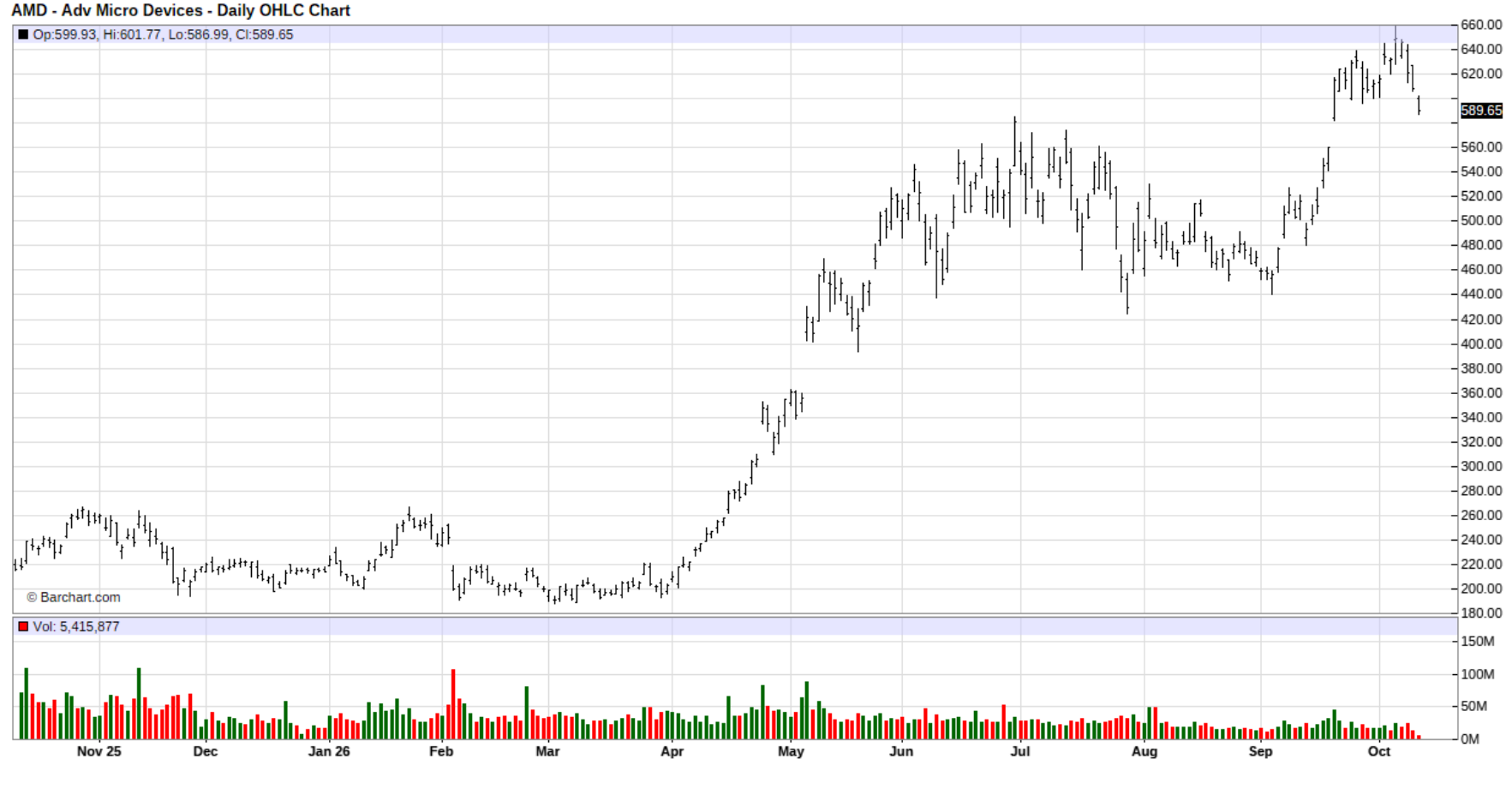
With the acquisition, World Labs could help AMD better understand world models that understand 3D spaces, physics, geometry, and movement. It will also allow AMD to challenge competitors, such as Nvidia (NVDA) when it comes to robotics, simulation, digital twins, and autonomous machines, with new chips, software, and systems.
AMD Is Taking AI Beyond Chat
Much of the excitement around AI has focused on systems that answer questions, write software, and generate content. World Labs is working on another challenge. That is to help AI understand and create three-dimensional environments. Its Marble product allows users to generate 3D worlds from inputs including images, video, and text. According to WorldLabs.ai, “Our first product, Marble, is powered by our generative 3D world models and enables anyone to create spatially coherent, high-fidelity, persistent 3D worlds from images, video, text, and 3D layouts.”
In fact, here’s an example of what it can create.
Beyond that, AMD could push into physical AI, including robotics and simulation. For example, a robot navigating a warehouse needs to understand space, objects, and movement. Better, if these applications become widely adopted, they could create another substantial source of demand for computing power from companies like AMD. Think about that for a moment. Exposure to 3D worlds could offer AMD exposure to a potential $9.24 billion AI-generated 3D asset market by 2032. The current market value is $1.63 billion. Robotics, another potential $194.36 billion market over the next decade, says SNS Insider. And with simulation, yet another potential $172.33 billion market by 2032, as noted by Astute Analytica.
Earnings Have Been Strong
In its most recent quarter, the company’s EPS of $1.66 beat by five cents. Revenue of $11.54 billion, up 50.1% year-over-year (YoY), beat by $230 million. Data Center segment revenue was up 107% YoY at $6.7 billion. “We delivered an excellent quarter, with record revenue and profitability as Data Center revenue more than doubled year-over-year,” Dr. Su said in a company earnings press release. “We enter the second half with strong momentum as EPYC demand accelerates, Instinct deployments scale, and Helios begins to ramp. More broadly, AI is driving a significant expansion in demand for compute across all of our markets, and our leadership portfolio and growing customer visibility position us exceptionally well to capture this expanding opportunity and deliver substantial revenue and earnings growth in the years ahead.” Looking ahead, AMD said it expects third-quarter revenue to be between $12.7 billion and $13.3 billion, with the midpoint of $13 billion 41% above consensus. Adjusted gross margin is expected to be 56%.
What Do Analysts Say About AMD Stock?
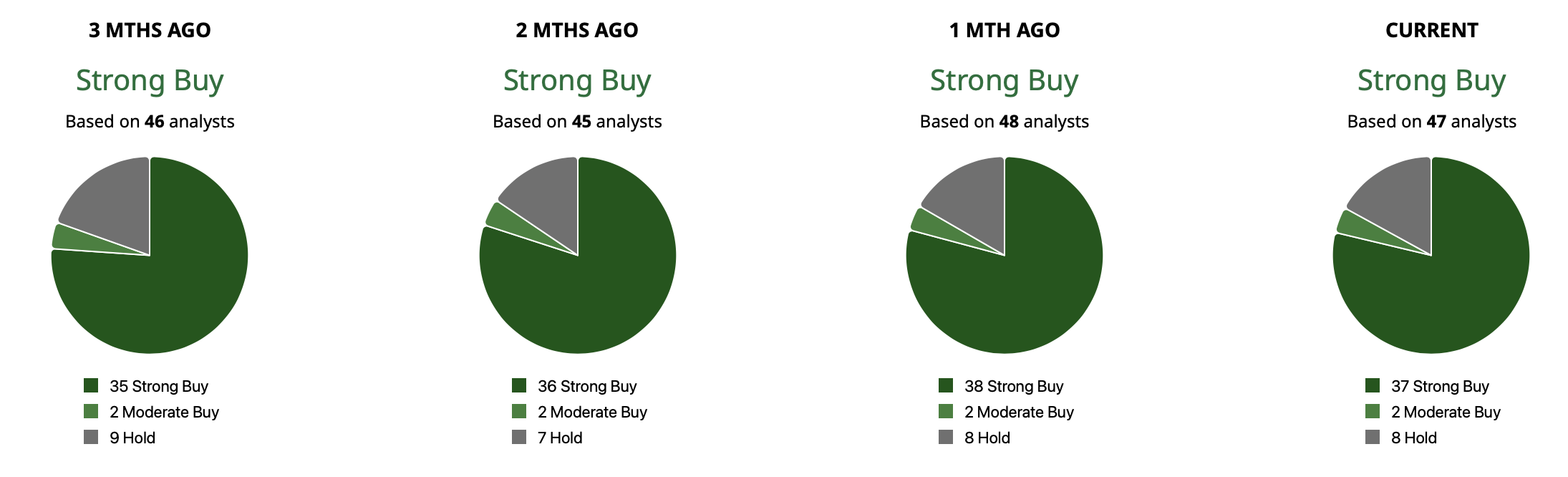
Overall, Advanced Micro Devices has a consensus “Moderate Buy” rating on Wall Street. Of the 47 analysts covering AMD stock, 37 have a “Strong Buy” rating, two have a “Moderate Buy” rating, and eight have a “Hold” rating. The mean target price of $653.74 implies a potential upside of 17% from current levels. Meanwhile, its high-end price target of $1,250 implies a potential upside of 123% moving forward. In addition, analysts at Mizuho raised its price target on AMD to $705 from $580, arguing that agentic AI use is leading to a surge in CPU demand. Analysts at Citi raised its target price on AMD to $800 from $575, arguing that the CPU market could hit $300 billion by 2030. BNP Paribas raised its price target on AMD to $960, similarly arguing for strength in CPUs thanks to AI.
On the date of publication, Ian Cooper did not have (either directly or indirectly) positions in any of the securities mentioned in this article. All information and data in this article is solely for informational purposes. For more information please view the Barchart Disclosure Policy here.