
Duolingo (DUOL) Stock Looks Expensive Based On Current Earnings
Duolingo shares have fallen hard over the past year, yet the stock still commands a clear earnings story that investors are trying to price. With the price at about US$149.92, the key issue is whether that market value lines up with what the business is currently earning.
- The share price has dropped about 54.6% over the past 12 months, which puts the focus squarely on whether the earnings profile now supports even this lower level.
- Multiple class action lawsuits filed since early 2025 over alleged misstatements on user growth and monetization may affect how investors think about the durability and quality of Duolingo's earnings stream.
- There is a second opinion on Duolingo worth weighing. See what analysts think Duolingo's shares could be worth.
For investors, the debate is whether Duolingo's current price is justified by the earnings it produces today and the profitability the business can realistically sustain.
If you are reassessing Duolingo after a 54.6% share price fall over the past year, it can help to compare it with a focused list of other 29 high quality undervalued stocks.
Is Duolingo Getting Expensive on Earnings?
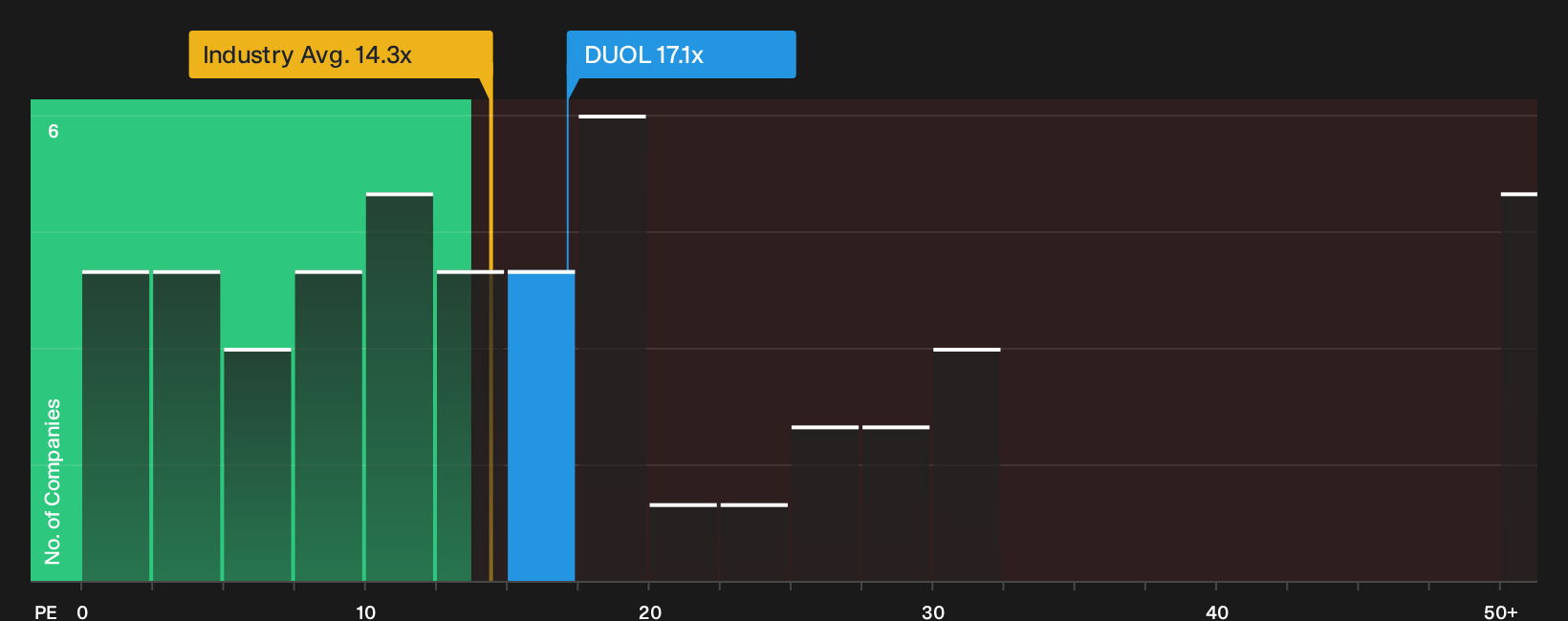
The P/E ratio is a useful yardstick for Duolingo because the business already reports positive earnings. On that metric, Duolingo trades on a P/E of 17.1x, which is above both the Consumer Services industry average of 14.3x and the peer group average of 13.3x. That means each dollar of Duolingo earnings is currently valued more highly than many similar businesses.
The fair multiple implied by the valuation model, which weighs the firm’s growth profile, margins, scale and risk, sits below today’s P/E, so the stock screens as overvalued on this framework. Because the recent class action lawsuits focus on alleged misstatements around user growth and monetization, the premium P/E also has to be judged against the extra uncertainty around how repeatable those earnings are. If you hold Duolingo after the drawdown, the key question is whether the higher earnings tag is justified by the quality and durability of its profit stream. Explore the numbers behind Duolingo's P/E valuation.
The Duolingo Narrative: What Would Justify Today's Price?
Simply Wall St Narratives for Duolingo pick up where this valuation question leaves off and outline which earnings, margin and growth paths would need to occur for the stock to appear meaningfully cheap or expensive relative to today. Each one connects its figure to a clear view on how Duolingo's growth, profitability and risks might evolve, giving you a reference point you can revisit as new information on the business becomes available.
Community views on Duolingo are now split between those who see a reset opportunity and those who think recent weakness already reflects richer expectations.
Bull case: 44% undervalued
"We often look for 'dislocations', moments where market sentiment diverges from business fundamentals…"
Discover why this Narrative puts Duolingo at 44% undervalued.
Bear case: 12% overvalued
"The numbers and current valuation imply that Duolingo is fairly valued with a bearish skew, with recent stock price weakness already reflecting concerns…"
Explore why this Narrative puts Duolingo at 12% overvalued.
Duolingo's price is only one side of the decision
Market multiples tell you what Duolingo is worth today, but analyst projections for the next few years offer a separate lens on where expectations sit and how bold they really are. Explore where analysts expect Duolingo to be in a few years.
This article by Simply Wall St is general in nature. We provide commentary based on historical data and analyst forecasts only using an unbiased methodology and our articles are not intended to be financial advice. It does not constitute a recommendation to buy or sell any stock, and does not take account of your objectives, or your financial situation. We aim to bring you long-term focused analysis driven by fundamental data. Note that our analysis may not factor in the latest price-sensitive company announcements or qualitative material. Simply Wall St has no position in any stocks mentioned.
Have feedback on this article? Concerned about the content? Get in touch with us directly. Alternatively, email editorial-team@simplywallst.com