
Did Prader Willi Therapy Progress Just Shift Rhythm Pharmaceuticals' (RYTM) Investment Narrative?
- Rhythm Pharmaceuticals has seen sentiment improve after recent developments in Prader-Willi syndrome care, including clinical and regulatory progress around its targeted therapy setmelanotide and broader investment into this treatment area.
- The key shift is that Prader-Willi syndrome is receiving more focused drug development and funding, which directly supports Rhythm Pharmaceuticals' core rare disease franchise and its effort to reach more genetically defined obesity patients.
- Attention now turns to how this momentum in Prader-Willi syndrome therapies, centered on setmelanotide, may reshape Rhythm Pharmaceuticals' investment narrative.
Rhythm Pharmaceuticals Investment Narrative Recap
To own Rhythm Pharmaceuticals, you need to be comfortable with a rare disease model that is still heavily dependent on setmelanotide and is not yet profitable. The investment case leans on expanding use across genetically defined obesity and related conditions. Recent momentum in Prader Willi syndrome interest supports that theme, but it does not remove near term execution risk.
The most important short term catalyst remains clinical and regulatory progress for new setmelanotide indications, especially in hypothalamic and Prader Willi related obesity. The biggest risk is that high R&D and SG&A keep losses elevated while payer access or competitive therapies limit how fully Rhythm can convert growing interest into prescription volume.
Recent commentary that the Prader Willi syndrome market is expected to grow, helped by greater awareness, better diagnosis, and multiple targeted therapies in development, matters directly for Rhythm Pharmaceuticals. Setmelanotide already anchors its rare disease focus, so rising attention on this condition can support patient identification and referral into genetic obesity treatment pathways.
At the same time, that same expansion in drug development introduces more future competition around Prader Willi care. For Rhythm, the operational task is clear: advance setmelanotide studies in this population, secure and maintain approvals where possible, and work country by country on reimbursement, while managing spending so that any broader opportunity can eventually feed through to the bottom line.
Rhythm Pharmaceuticals Forecast Setup
Consensus expectations around Rhythm Pharmaceuticals put hard numbers behind the rare disease story investors are tracking.
Rhythm Pharmaceuticals' narrative projects US$971.3 million revenue and US$263.4 million earnings by 2029. This implies revenue growth of 64.8% per year and an earnings swing of about US$471.2 million from current earnings of a US$207.8 million loss.
Analysts are building in forecast revenue growth of 64.8% annually over the next three years. That pace assumes the rare disease obesity franchise scales well beyond the current patient base and that setmelanotide and follow on assets reach a broader pool of genetically defined obesity and Prader Willi syndrome cases.
Earnings expectations today sit at a loss of US$207.8 million. The same forecasts point to consensus earnings of US$263.4 million by 2029, which would be a roughly US$471 million swing into positive territory if delivered. That change also embeds a shift in profit margins from a loss of 95.7% to a positive 27.1% over the coming three years. This reflects both operating leverage and tighter spending alongside revenue growth.
Those targets carry a wide range. The most optimistic analysts model US$636.4 million of earnings in 2029 while the most cautious only pencil in US$13.8 million. For readers, that spread highlights how much uncertainty still sits around adoption rates, pricing, reimbursement depth, and any future competitive therapies for the same patient populations.
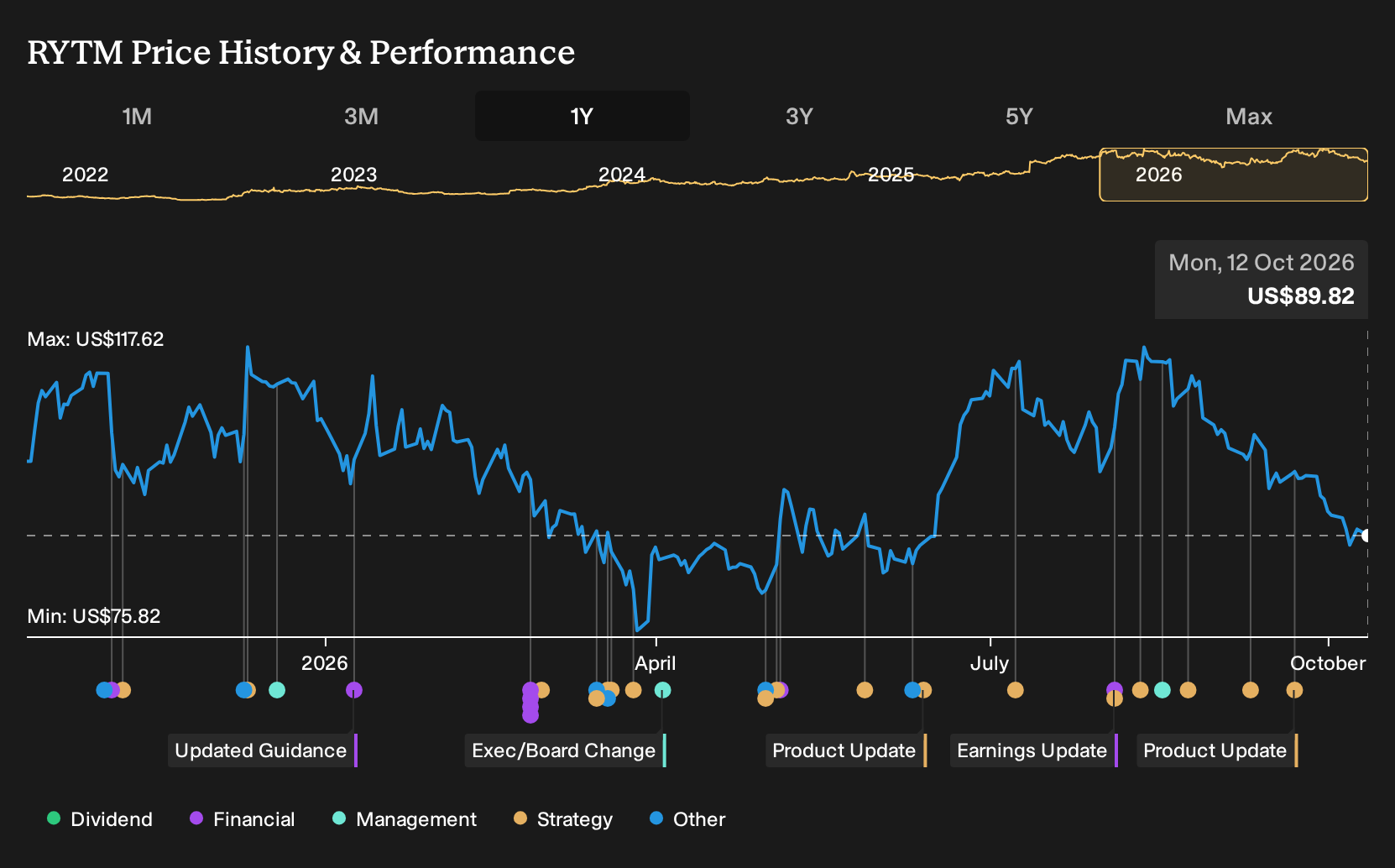
Uncover why Rhythm Pharmaceuticals' fair value indicates a 55% potential upside to its current price, which could narrow quickly.
Exploring Other Perspectives
Three fair value estimates from the Simply Wall St Community span roughly US$134 to about US$471 per share, so retail views on Rhythm Pharmaceuticals are all over the map. Those opinions do not yet reflect recent Prader Willi developments, so you are weighing them against fresh regulatory risk, pipeline catalysts, and shifting rare disease economics.
Explore 2 other Rhythm Pharmaceuticals fair value estimates, including one that suggests potential upside of up to 424% from the current price.
Decide For Yourself
Disagree with existing narratives? Extraordinary investment returns rarely come from following the herd, so go with your instincts.
- A great starting point for your Rhythm Pharmaceuticals research is our analysis highlighting 3 key rewards that could impact your investment decision.
- See our latest analysis for Rhythm Pharmaceuticals. The report includes a comprehensive fundamental analysis summarized in a single visual, the Snowflake, making it easy to evaluate Rhythm Pharmaceuticals' overall financial health at a glance.
Looking for more investment ideas beyond Rhythm Pharmaceuticals?
Once you have formed a view on Rhythm Pharmaceuticals, it can help to compare that thesis against other opportunities with different risk and return profiles using the Simply Wall St Screener.
- If income is a priority, you could scan for established payers that combine yield and resilience through our hand picked 8 dividend fortresses that already clear a 5% threshold.
- If capital preservation matters more to you, focus on stability first by filtering for 32 resilient stocks with low risk scores that score well on balance sheet strength and risk metrics.
- If you like to spot potential outliers early, broaden your watchlist with a curated mix of 20 high quality undiscovered gems that pair solid fundamentals with lower market attention.
This article by Simply Wall St is general in nature. We provide commentary based on historical data and analyst forecasts only using an unbiased methodology and our articles are not intended to be financial advice. It does not constitute a recommendation to buy or sell any stock, and does not take account of your objectives, or your financial situation. We aim to bring you long-term focused analysis driven by fundamental data. Note that our analysis may not factor in the latest price-sensitive company announcements or qualitative material. Simply Wall St has no position in any stocks mentioned.
Have feedback on this article? Concerned about the content? Get in touch with us directly. Alternatively, email editorial-team@simplywallst.com