
Refining profits are booming! Can Citi's sharp increase in the target price of Marathon Crude Oil (MPC.US) cracking the price spread support the next round of “refining mad cow”
The Zhitong Finance App learned that since this year, stock prices have repeatedly reached new highs against the backdrop of serious shortages in the supply of refined oil products, and the US refining giant Marathon Crude Oil Company (MPC.US) has received a sharp increase in the target price from Wall Street financial giants to officially invest in research reports based on optimism for further upward space in the refining giant. Citigroup analysts drastically raised the target price of Marathon Crude Oil for the next 12 months from 318 to 518 US dollars, an increase of 62.9%. Compared with the closing price of 458.81 US dollars, there is still 12.9% room. The total return including dividends is about 13.8%, but it maintains a “neutral” rating.
High crude oil fluctuations, shortages of refined oil products, and high long-term interest rates are pushing global refining stocks into a financial reporting window where “profit explosions and valuation constraints coexist.” On October 12, the futures prices of Brent crude oil and WTI crude oil closed at 106.65 and 93.74 US dollars respectively, and rebounded slightly to 105.47 and 92.57 US dollars during the noon session Beijing time on the 13th. Based on the closing price on February 27, the last trading day before the US-Iran war broke out on February 28, 2026, Brent crude oil rose sharply by 45% compared to before the war, while the price of WTI crude oil rose sharply by about 40%.
In terms of the cracking price spread that the market focused on, up to the close of the US stock market on October 9, the cracking price difference between NYMEX's ultra-low sulphur diesel and WTI fell 6.45 US dollars to 96.80 US dollars/barrel in a single day, and is still high. The futures cracking price difference between US diesel of the same type and WTI reached a record high of 102.20 US dollars/barrel on August 17, far exceeding the current 96.80 US dollars. Therefore, although the cracking price difference between NYMEX's ultra-low sulphur diesel and WTI has cooled down in recent months, it is still in a historically high range, indicating that the tight supply of diesel compared to crude oil has not been fundamentally eased.
Citi's core bullish judgment on the company was that the cracking price spread raised the profit center sharply, while changes in maintenance, product structure, and strategic oil reserve (SPR) earnings limited implementation; midstream assets provided cash flow support, and repurchases were bound by working capital and performance obligations. EPS for the third quarter is expected to be $25.64, which is still 2.2% lower than the Visible Alpha consensus of $26.21. The November 3 earnings report will directly test whether the strong boom in the refining sector can be fully translated into strong shareholder returns for the company.
Cracking spreads ignite profits: refining giants make money from mismatched supply
“The main business of American refining giant Marathon Crude Oil (MPC.US) focuses on refining, sales of refined oil products and midstream energy infrastructure: procurement of crude oil and processing into products such as gasoline, diesel, aviation coal, etc.; it operates pipeline transportation, warehousing, natural gas processing, and natural gas liquid (NGL) fractionation through MPLX, which it also lays out renewable diesel.
Compared to ExxonMobil and Chevron, two integrated energy giants that cover oil and gas exploration, extraction, transportation, refining and sales, Marathon Crude Oil focuses on refining as the core, combined with midstream logistics, and is generally classified as an independent refiner. The company's core profit variables are not Brent crude oil price trends, but price differences between refined oil products and crude oil, raw material discounts, refinery operating rates, processing costs, and midstream business cash flow. However, crude oil is also a procurement cost; if crude oil rises faster than refined oil products, refining profits may be under pressure. Compared with ExxonMobil and Chevron's upstream crude oil and natural gas production chains, which usually directly benefit, the group's overall performance also depends on downstream and other businesses.
The current geographical situation cannot yet be characterized as substantial easing — the US and Iran still disagree over the reopening of Hormuz and the order of negotiations on the nuclear issue. The Houthis attacked Saudi airports and oil tankers around the strait, while Russia and Ukraine accuse the Russian military of continuing to attack energy facilities after the “energy cease-fire” was announced.
The increase in Russian diesel supply is expected to bring about marginal cooling, but restrictions on facilities and transportation have not yet been lifted. According to EIA data, the average price difference of gasoline cracking in New York Port in the third quarter was more than double that of the previous year, and was close to three times that of diesel and aviation coal; the price spread of distillate oil continued to widen in September, and is expected to fall later but still high. The value of the company's MPC refining energy of about 2.9 million b/day from its flagship refinery is to process discounted raw materials into scarce refined oil products: the difference between product sales price and raw material cost, product yield, and plant efficiency determine profit.
However, strong indicators do not automatically equal the same amount of profit realized. Citi set a profit capture rate of 93% for the third quarter, lower than the 96% average for the same period in the past three years, reflecting a drag on by-products, weakening SPR revenue, discounted aviation coal compared to diesel, maintenance of conversion equipment in the Gulf of Mexico and central Mexico, and pressure on profits from refined oil products on the West Coast. The central reference cracking price spread widened to 47.01 US dollars/barrel due to competitor downtime, but MPC's actual product portfolio did not fully match the target; the increased premium of diesel compared to gasoline was beneficial to its higher diesel yield. The improved market structure brought about a gain of about US$350 million per annum, which is included in the indicators. The historical capture rate for the fourth quarter has averaged 116% since 2019, indicating that actual profit can exceed the reference target. This is not a forecast for this quarter.
The profit revisions mainly bet on subsequent spreads: From 2026 to 2028, EPS rose from $42.11, 24.08, and 22.94 US dollars to 73.66, 63.10, and 30.97 US dollars, up about 75%, 162%, and 35%; EPS rose from 2.54 to 29.81 US dollars in the fourth quarter. At the same time, the profit in 2028 was significantly lower than in 2026, indicating that the model is still taking into account cyclical regression. Although renewable diesel profit margins are strong, delayed confirmation of raw material costs may drag down the quarter's performance; Citigroup analysts estimated MPLX's adjusted EBITDA of US$1.85 billion for the third quarter, which is slightly lower than the consensus of US$1.86 billion. MPLX is also “neutral,” with a target of $55, representing a decline of about 3.2% compared to $56.83; its net present value valuation corresponds to about 10.25 times the 2027 EV/EBITDA.
After rising yields — energy companies' high profits must cross cash flow and valuation thresholds
The anchor for global asset pricing can be described as a direct sharp rise in the past — 10-year and 30-year US bond yields rose 50 and 37 basis points respectively in September, and were still 5.24% and 5.60% on October 9. Since then, they were close to their highest levels in history; the 10-year Asian market fell back to 5.193% on the 13th. Energy inflation pushes up policy interest rate expectations, fiscal debt pressure increases term compensation, and AI financing and productivity expectations reinforce upward pressure on real interest rates. These trends will be transmitted to global asset and refining companies through dollar financing costs, discount rates, and terminal demand.
Every time MPC experiences a change in crude oil price of 10 US dollars/barrel, the working capital changes about 550 million US dollars. At the end of June, cash was 6.7 billion US dollars, and the minimum cash target was 1 billion US dollars, but it is still necessary to cover inventory and SPR obligations from 2027; 12 million barrels have already been received in the second quarter, and another 10 million barrels are yet to be received. Citi expects repurchases of about 3 billion US dollars per quarter. The repurchase volume is still significantly below the 25% average daily turnover threshold for the past four weeks listed in the research report, and there is still room for execution.
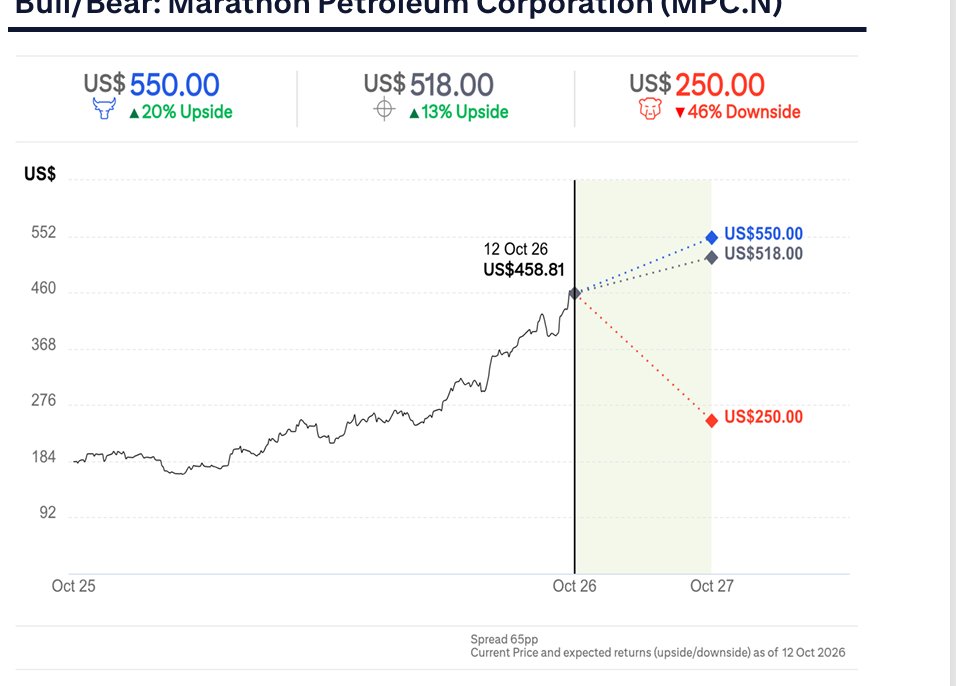
Citi said that the target price increase is due to an increase in profit assumptions, which does not mean that the valuation can expand indefinitely. Citigroup combined the 2027-2028 forecast and used the three methods of average valuation of 6 times EV/EBITDA, 11 times P/E, and DCF. DCF assumed a weighted average capital cost of 6.5% and sustainable growth of 1%. It believes that buybacks, business execution, and dividend increases are more fully reflected in stock prices. The bull market scenario was $550, up about 19.9%, and relied on additional supply disruptions to further drive up the spread; the bear market scenario was $250, down about 45.5%, in response to a faster resumption of production by Russian refineries or weakening demand. The widening price gap between low-price crude oil and light and heavy oil in central China is beneficial to complex refineries, while narrowing the price gap and adding new refining energy around the world weakens excess profits. The core of earnings trading is to determine how long a high cracking spread can last and how much cash can be redeemed.