
Levi Strauss (LEVI) Raised Its Dividend Following Earnings, Is The Stock Above Fair Value?
Levi Strauss (LEVI) just packed several signals into one update. Third quarter earnings, a higher dividend, updated revenue guidance and an US$80 million tariff refund all landed together on October 7.
Levi Strauss now trades at US$19.24, with a 1-day share price return of 2.89% following the earnings and dividend news. However, the 90-day share price return is down 19.13% and the 1-year total shareholder return has declined 6.69%, so recent momentum has cooled despite a stronger 3-year total shareholder return of 46.45%.
Spot opportunities with a similar mix of income, brand strength and recent share price pressure by scanning our curated 29 high quality undervalued stocks, which meets tighter quality and fundamentals filters.Levi Strauss now trades at a discount to analyst targets even after the post earnings bounce. Is the market simply overreacting to softer recent returns, or correctly pricing in the updated guidance and mixed profit picture?
Most Popular Narrative: 3% Overvalued
Levi Strauss closed at $19.24, while the most followed narrative on the stock pegs fair value at $18.72. That gap is small in dollar terms, but the reasoning behind it leans heavily on how management talks about growth projects when results are mixed.
The framing shift on the U.S. distribution network transition is the most consequential piece of this call, and it is worth focusing on the actual commitment before assessing how management now talks about it.
The plan had been specific: close the Hebron distribution center, consolidate into Groveport, and do it with urgency because “the fact that we have given the intent, given notice, is indicative that we’re serious about it.” A Bank of America analyst cites the number management itself had set: “an immediate $5 million in cost savings per quarter as soon as you shut these parallel DCs down.” Management confirms the Hebron closure happened, on schedule, at quarter’s end. The $5 million in quarterly savings that closure was supposed to trigger has been pushed to 2027, with no month specified.
See why 1 investors see Levi Strauss as 3% overvalued.
Result: Fair Value of $18.72 (OVERVALUED)
Still, the delayed U.S. distribution savings and softer direct to consumer progress at Levi Strauss could flip sentiment quickly if execution drifts further.
Find out about the key risks to this Levi Strauss narrative.
Another View On Levi Strauss Valuation
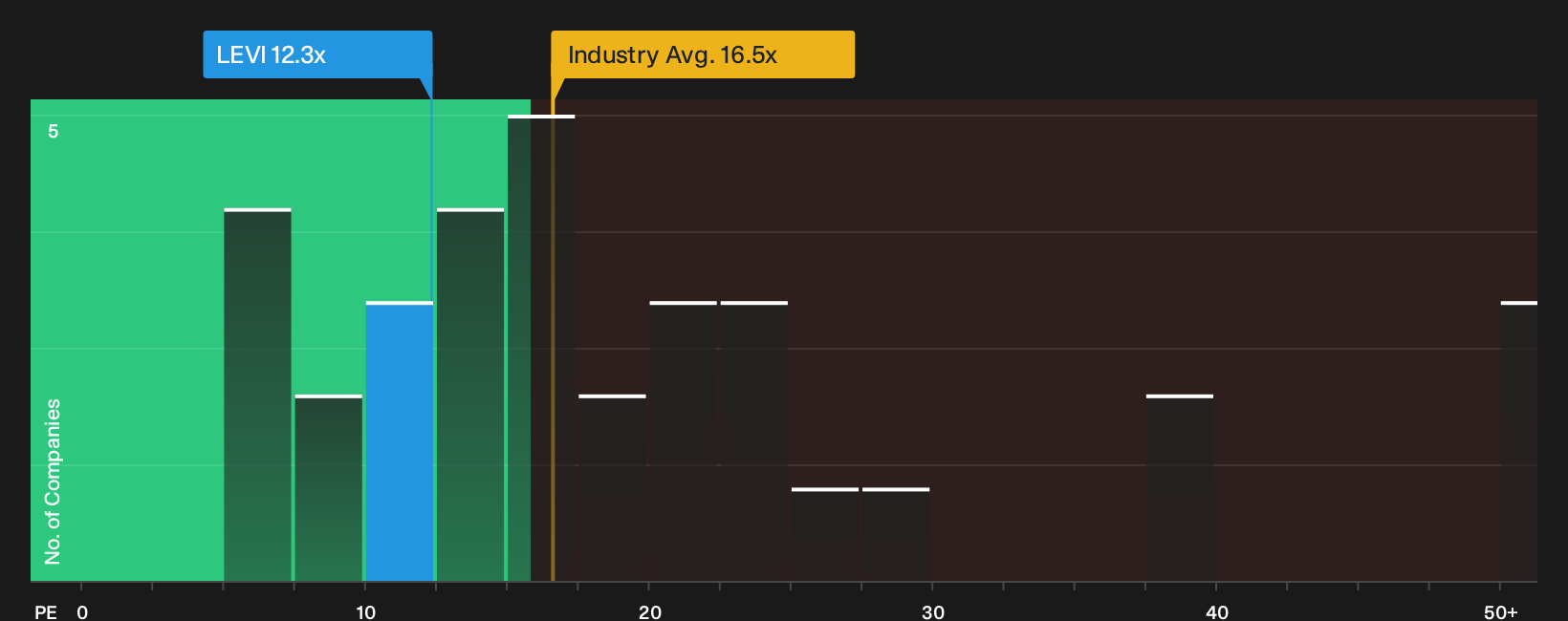
The first narrative pegs Levi Strauss as slightly overvalued on a fair value of $18.72 versus a $19.24 share price. The plain P/E picture tells a different story. At 12.3x earnings, LEVI trades well below the US Luxury sector on 16.5x, the peer group on 20.4x, and below its own fair ratio of 17.4x.
That spread points to investors paying less for each dollar of Levi Strauss earnings than both rivals and the level suggested by the fair ratio. This reduces valuation risk for some and raises the question of whether sentiment has shifted after recent share price weakness.
See what the numbers say about this price — find out in our valuation breakdown.
Next Steps
Mixed signals on Levi Strauss valuation, or a clear message investors are missing? Act quickly and stress test the story against the data yourself by weighing the 3 key rewards and 1 important warning sign.
Looking for more investment ideas beyond Levi Strauss?
If Levi Strauss has you rethinking your watchlist, consider widening your net. Exploring a broader range of ideas may help you refine your strategy.
- Evaluate companies with income potential by scanning for reliable cash generators through the 8 dividend fortresses.
- Review candidates for financial resilience using the curated list of solid balance sheet and fundamentals (25 results) that emphasizes strength over hype.
- Look for potential emerging leaders by examining the focused group of 20 high quality undiscovered gems before they become widely followed.
This article by Simply Wall St is general in nature. We provide commentary based on historical data and analyst forecasts only using an unbiased methodology and our articles are not intended to be financial advice. It does not constitute a recommendation to buy or sell any stock, and does not take account of your objectives, or your financial situation. We aim to bring you long-term focused analysis driven by fundamental data. Note that our analysis may not factor in the latest price-sensitive company announcements or qualitative material. Simply Wall St has no position in any stocks mentioned.
Have feedback on this article? Concerned about the content? Get in touch with us directly. Alternatively, email editorial-team@simplywallst.com