
Gold Lost Its Glitter This Year, But You Should Load Up on the Precious Metal Before 2027
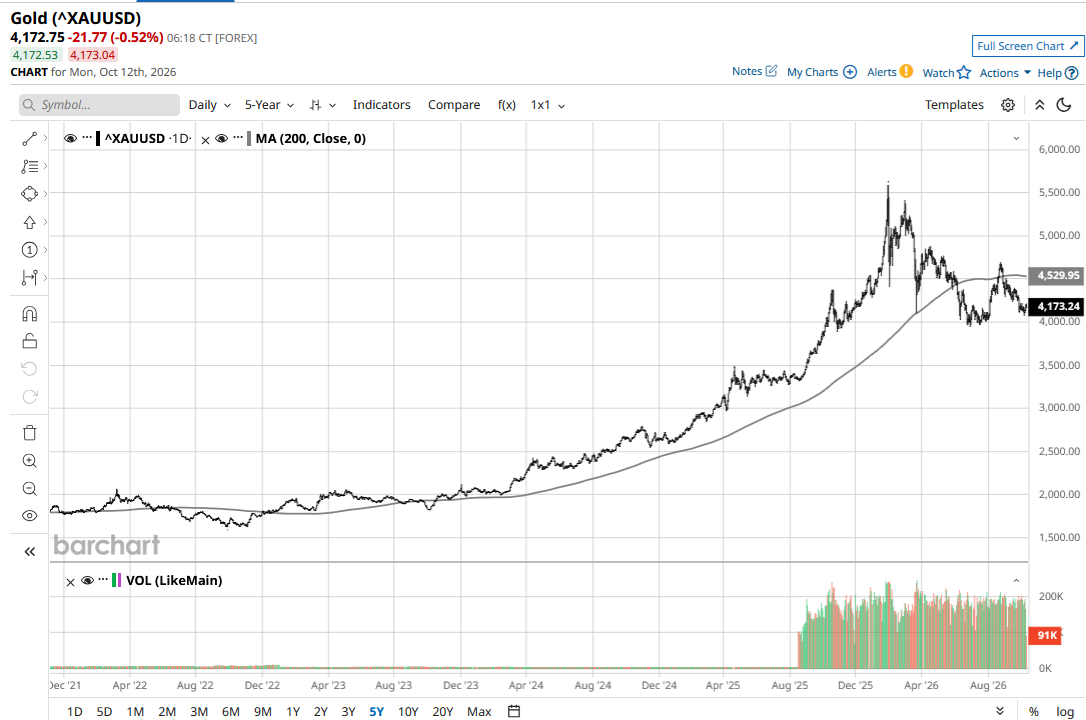
Precious metals, which were the best-performing asset class in 2025, have looked weak in 2026. Specifically, gold is down around 3.5% for the year. The yellow metal started the year strong and continued its rally from the previous year, hitting an all-time high in January. However, it failed to hold those levels and has lost more than a quarter of its value from its peak.
Why Has Gold Fallen in 2026?
The over 5% yield on the U.S. 10-year Treasury ($TNX) is not hitting stocks alone, and gold is also in the line of fire. Being a non-yielding asset, gold tends to underperform in periods of high interest rates, and here we are talking about yields not seen in decades. Higher yields not only raise the opportunity cost of holding gold but also lower its appeal as an investment compared to debt instruments. With U.S. inflation stubbornly high and persistently above the Fed’s 2% target, the Fed has embarked on a tightening cycle and more hikes are expected over the next year.
Central bank gold buying — a key driver of prices in recent years — is running below the levels we saw last year, even though the pace is still higher than historical averages.
The strengthening of the U.S. dollar ($DXY) against major currencies has also dampened gold demand, as a strong greenback increases gold prices in domestic currencies, pulling down demand. Moreover, India, which is the second-largest gold consumer thanks to the country’s appetite for jewelry, has clamped down on imports and urged citizens to limit or pause gold and jewelry purchases.
Long-Term Structural Drivers for Gold
The macro environment hasn’t been conducive to gold in 2026, but the structural drivers remain in place. While there could be aberrations, central bank gold buying should continue at a robust pace amid the de-dollarization drive as countries diversify reserves beyond the greenback. The continued increase in U.S. debt and the unsustainable fiscal deficit cost the world’s biggest economy its top credit rating last year, and there looks to be no path towards a sane fiscal environment. While I don’t yet buy the doomsday story about the U.S. economy, gold has emerged as a good hedge amid U.S. fiscal largesse. Retail and institutional investors should also keep piling into gold through different instruments as a hedging tool.
Higher geopolitical tensions also look like a consistent theme, and contrary to what Indian Prime Minister Narendra Modi famously told his Russian counterpart Vladimir Putin in 2022 that now “is not an era of war,” the reverse only seems to be happening, and we have perhaps entered into a new era of long wars.
Would Gold Rally in 2027?
I would put my $0.02 on a gold price rally in 2027. First, I expect U.S. markets to take a breather next year following stellar gains in the preceding few years. The S&P 500 Index ($SPX) is on track to post double-digit returns for the fourth consecutive year, a rarity in markets. The last time the world’s most popular index delivered this feat was during the dot-com boom of the 1990s, which was then succeeded by the 2000 crash.
While it is too early to call a meltdown like the 2000 crash, valuations of some artificial intelligence (AI) plays — particularly those in the private space — are concerning. Some of these private AI giants are eyeing a listing over the next year, which would not only squeeze tons of money from markets but also increase the risk profile of public markets by making them even more exposed to the AI trade. Such a scenario, if it were to happen, would be positive for gold given its safe-haven status. Gold’s investment demand could improve next year after having been hit by the sharp rise in Treasury yields this year, which particularly led to liquidations in gold ETFs in the U.S.
Overall, I believe it could be time to load up on gold — or, if you are an aggressive investor, gold mining stocks — amid the recent weakness. While gold prices might continue to whipsaw in the near term amid all the debate over Treasury yields, the yellow metal looks set to outperform next year.
On the date of publication, Mohit Oberoi did not have (either directly or indirectly) positions in any of the securities mentioned in this article. All information and data in this article is solely for informational purposes. For more information please view the Barchart Disclosure Policy here.