
Dear Apple Stock Fans, Mark Your Calendars for October 16
Apple (AAPL) is getting ready to turn a new page in its iPhone playbook, and Oct. 16 could be a big day for the tech giant. After years of refining its familiar smartphone design, Apple is finally stepping into the foldable phone market with the iPhone Duo, a book-style device that opens up into a larger display. But with a starting price of $1,999, this is hardly an impulse purchase.
Unveiled last month, the iPhone Duo marks Apple's latest attempt to shake up its smartphone lineup and take on the growing foldable market. Now, the countdown is on. Pre-orders open on Friday, Oct. 16 at 5 a.m. Pacific Time (8 a.m. Eastern Time), ahead of the official Oct. 23 launch. Apple is also opening its “Get Ready” process on Monday, Oct. 12, allowing prospective buyers to select their preferred configuration, arrange payment and trade-in details, and prepare their orders in advance. With reports of production issues raising the possibility of limited initial supplies, getting everything ready beforehand could give buyers a head start.
The launch comes at an interesting time for Apple shareholders. While excitement around the foldable iPhone helped lift AAPL stock in September, recent reports of reduced component orders for the iPhone 18 Pro models have raised fresh demand concerns. With the iPhone Duo about to make its debut, can Apple’s latest hardware gamble reignite investor enthusiasm?
About Apple Stock
Based in Cupertino, California, Apple has grown from a computer maker into one of the biggest names in global technology. Its products, including the iPhone, Mac, and iPad, have become part of everyday life for millions of people.
Beyond devices, Apple has built a thriving Services business covering the App Store, iCloud, Apple Music, and Apple Pay. These offerings keep customers connected to its ecosystem while generating recurring revenue. Backed by its strong brand, loyal customer base, and broad product lineup, Apple commands a staggering market capitalization of $4.9 trillion.
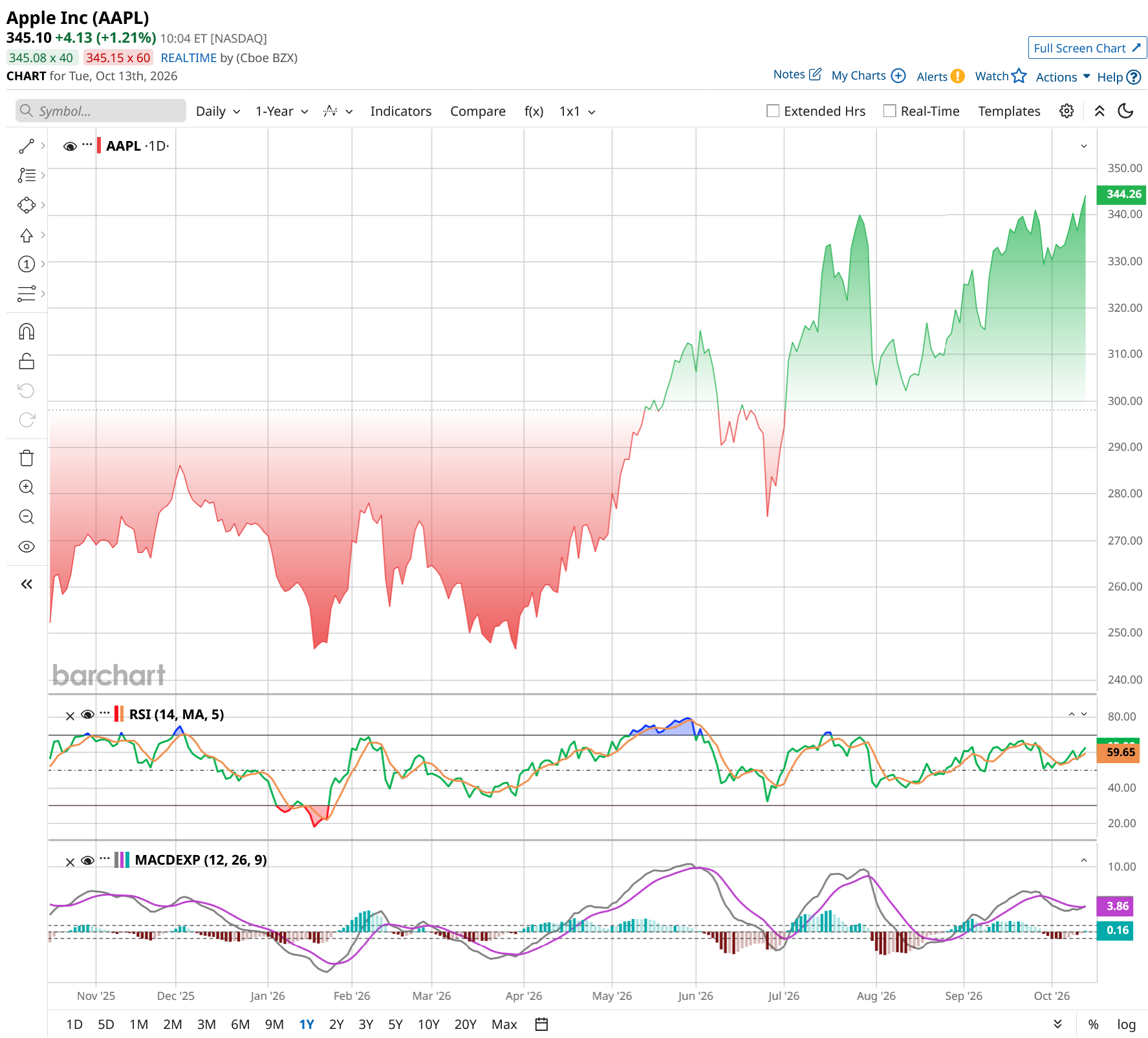
AAPL stock has had a few bumps along the way in 2026, but the ride has turned out pretty well for investors who stayed patient. The year began with uncertainty around interest rates, geopolitical tensions, and the market's obsession with artificial intelligence (AI) weighing on big tech. Apple shares struggled to find their footing early on, before gradually picking up momentum as resilient iPhone demand, steady Services growth, and renewed interest in the company's AI ambitions helped shift sentiment.
This morning, Oct. 13, AAPL stock was hitting a new all-time high of $347.93. So far it has gained roughly 27% year-to-date (YTD) and 40% over the past 52 weeks. Part of the appeal is Apple's relatively measured approach to AI spending. Unlike some rivals pouring enormous sums into data center infrastructure, Apple has taken a more restrained route, potentially giving it room to monetize AI across its massive installed base without shouldering the same level of infrastructure costs.
This year's rise hasn't been without some bumps, though. Shares recently slipped after a report indicated that Apple had asked suppliers to cut October component orders for the iPhone 18 Pro and Pro Max by roughly 15% to 20% versus initial estimates. Higher prices may be cooling demand, with Apple reportedly raising the starting prices of the iPhone 18 Pro and Pro Max by $100 to $1,199 and $1,299, respectively.
The broader memory and storage chip shortage, fueled by booming AI data center demand, has added to the pressure, pushing up costs across consumer electronics. Still, the demand picture is not entirely gloomy. Deepwater Asset Management’s Gene Munster noted that delivery lead times for the iPhone 18 Pro had fallen 31%, while those for the Pro Max increased 1%. Combined, lead times were roughly in line with last year’s iPhone 17 Pro lineup. For investors, the question now is whether Apple’s latest rally can hold up if premium iPhone demand starts losing some of its shine.
Technically, Apple stock is showing mixed signals. Its 14-day RSI sits around 60, suggesting moderately positive momentum without entering overbought territory. However, the MACD line has slipped below its signal line, accompanied by a negative histogram, hinting that bullish momentum may be losing steam. Although the chart looks encouraging, a little caution would not hurt.
Apple stock is not exactly being sold at a bargain-bin price, and Wall Street knows it. Trading at roughly 38.1 times forward adjusted earnings and 10.28 times sales, AAPL commands a premium to its historical averages and several mega-cap tech peers. Investors are clearly willing to pay up for its sticky ecosystem, loyal customers, and impressive cash-generating machine.
But there’s a little something extra for shareholders, too. Apple has raised its dividend for 13 consecutive years, while its roughly 12% payout ratio leaves plenty of room for future increases. With billions of dollars in stock buybacks, Apple continues to reward investors.
What You Should Know About the iPhone Duo Before Launch
Apple's first foldable iPhone brings a fresh twist to its familiar smartphone lineup. The iPhone Duo features a 5.4-inch cover screen for everyday use and a 7.6-inch folding display that opens up more room for watching videos, gaming, working, and multitasking. It is also Apple's thinnest iPhone yet when unfolded, with an interface that adapts to the phone's orientation. For instance, users can watch a video on one half of the screen while keeping playback controls on the other.
Apple has also paid particular attention to the engineering behind the foldable design. Rather than simply adding a hinge to a conventional smartphone, the company has developed a reinforced structure intended to make the device feel sturdy in everyday use. Its hinge and frame incorporate support ribs and ceramic-fiber inserts at key points, with Apple claiming that the fibers are three times stronger than Grade 5 titanium. The display itself uses a thin screen layer, a custom nano-texture finish, and multilayer lamination to help reduce the visibility of the crease where the screen folds while supporting durability.
Under the hood, Apple’s A20 Pro processor works alongside a new cooling system to deliver 35% higher sustained performance than the iPhone 17 Pro. The device pairs the A20 Pro chip with 12 GB of RAM, 256 GB of base storage, and Apple’s new iOS 27 operating system.
For photography, it features a dual rear-camera system with two 48-megapixel sensors. Battery life is another key consideration, particularly with two displays in the mix. Apple rates the iPhone Duo for up to 44 hours of video playback using the external screen and up to 31 hours on the larger folding display, although actual results will vary with usage and settings. Starting at $1,999, the iPhone Duo sits firmly in the premium smartphone category.
A Snapshot of Apple’s Q3 Results
In July, the tech giant reported fiscal Q3 2026 results, generating revenue of $109.4 billion, up 16.4% year-over-year (YoY) and ahead of Wall Street’s expectations. Adjusted earnings came in at $1.91 per share, while reported EPS climbed 28.7% to $2.02. The company also set June-quarter revenue records for the iPhone, Mac, and Services, while its installed base surpassed 2.5 billion active devices for the first time.
As usual, the iPhone did much of the heavy lifting, and its revenue jumped 22% YoY to $54.3 billion, with the iPhone 17 lineup driving record June-quarter sales across every geographic segment. Macs were another bright spot, with revenue surging 28.7% to $10.4 billion as the MacBook Neo and MacBook Pro attracted both first-time buyers and customers upgrading older devices. Supply constraints did limit some sales, but demand remained encouraging.
Meanwhile, Services revenue rose 12% to a record $30.7 billion, while paid subscriptions crossed 1.5 billion. From the App Store and AppleCare to cloud services, payments, and entertainment, the business is becoming an increasingly important contributor to Apple’s growth. Not every product category shared the same momentum, however. iPad revenue slipped 6% to $6.2 billion, while Wearables, Home, and Accessories revenue increased 6.5% to $7.9 billion.
Apple's financial strength adds another layer to the picture. The company ended the quarter with $147 billion in cash and marketable securities against $84 billion in debt. Record operating cash flow of $34.4 billion helped fund $33 billion in shareholder returns, including substantial stock buybacks and dividends.
Looking ahead, Apple is scheduled to report its fiscal Q4 results on Monday, Nov. 2, 2026. The company expects revenue to grow 9% to 11% YoY, with iPhone sales rising in the mid-teens and Services maintaining a similar growth pace to Q3. However, currency headwinds could shave 2.5 percentage points off growth, while tighter supply and higher memory costs may pressure margins. Existing inventory, lower costs elsewhere, and a favorable product mix could help cushion the impact.
Analysts monitoring the company remain pretty confident about Apple, predicting Q4 revenue around $113.6 billion, while EPS is anticipated to rise by 7% YoY to $1.98. Looking further ahead to fiscal 2026, profit is expected to be around $8.75 per share, up 17.3% YOY, before surging another 8.8% annually to $9.52 per share in fiscal 2027.
What Do Analysts Expect for AAPL Stock?
Jim Cramer thinks Wall Street may be sleeping on Apple's biggest upcoming opportunity: the iPhone Duo. In October, the CNBC host urged investors who don't own Apple shares to consider buying on further dips before the foldable phone launches. He believes investors are underestimating how much the Duo could move the stock.
Cramer pushed back against Morgan Stanley's more cautious outlook, arguing that near-term supply concerns shouldn't overshadow the device's long-term potential. He also noted that new CEO John Ternus sounded confident about having enough units available to meet demand. For Cramer, the Duo could be a bigger deal than Wall Street expects.
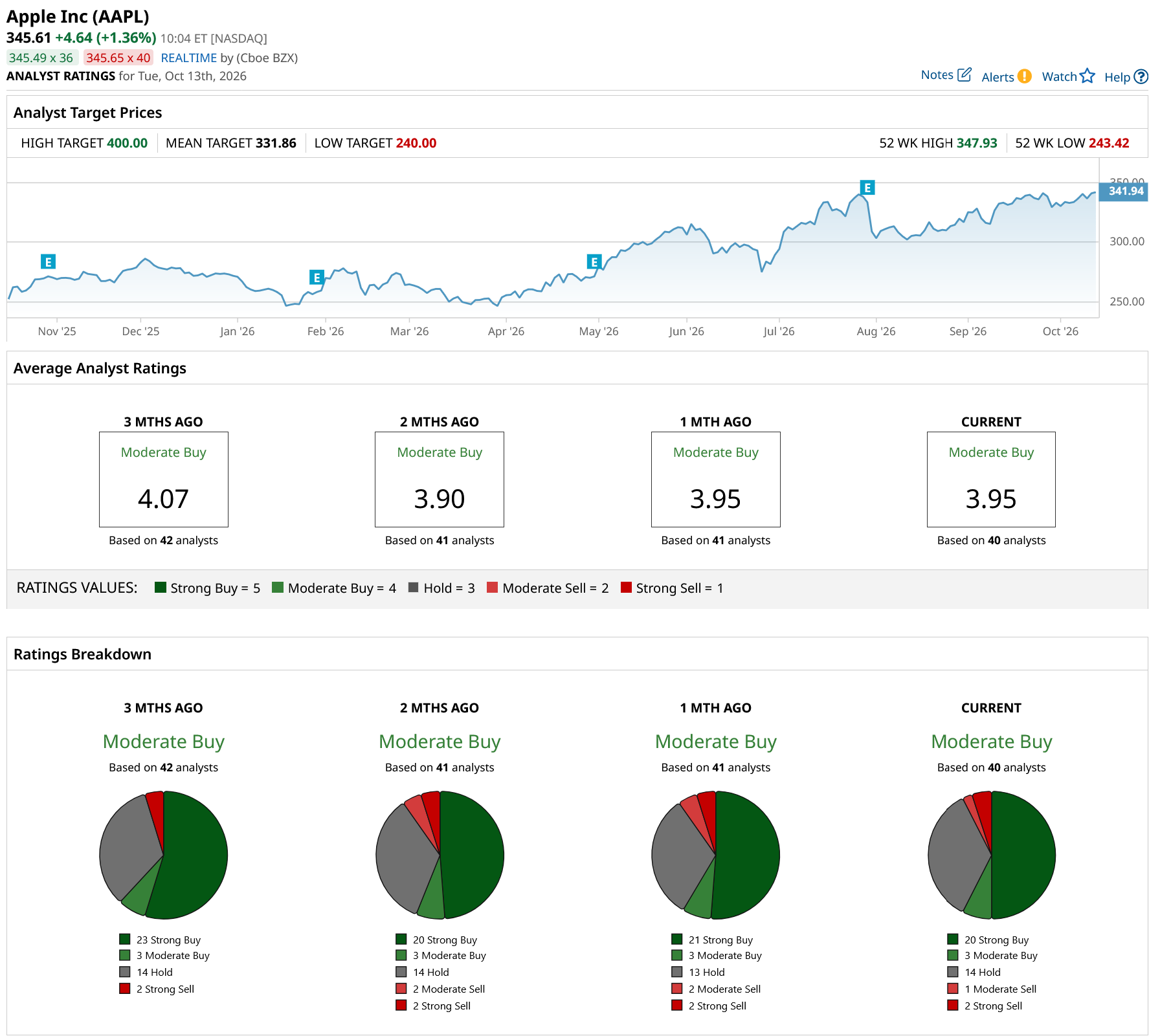
AAPL stock carries a consensus “Moderate Buy” rating, reflecting a mix of optimism and caution on Wall Street. Among the 40 analysts covering the stock, 20 have issued a “Strong Buy” recommendation, while three rate it a “Moderate Buy.” Meanwhile, 14 analysts have a more neutral “Hold” stance. On the bearish side, one analyst recommends a “Moderate Sell,” while the remaining two are outright skeptical, advising a “Strong Sell” rating.
AAPL stock is currently trading above its average analyst price target of $331.58, but the Street-high target price of $400 suggests that the stock could rally as much as 14%.
On the date of publication, Sristi Suman Jayaswal did not have (either directly or indirectly) positions in any of the securities mentioned in this article. All information and data in this article is solely for informational purposes. For more information please view the Barchart Disclosure Policy here.