
Microsoft’s New AI Model Is 35 Times Faster Than OpenAI’s GPT-6 Sol. Wait Until You See the Price Tag.
On Oct. 9, CEO Satya Nadella announced that Microsoft (MSFT) has released a new AI model called Microsoft-Decision-1. Most AI models, like ChatGPT, write text and work through problems step by step. This one does something narrower. It makes quick choices, such as picking a category, sorting requests, or deciding an AI agent’s next move. Microsoft says it runs about 35 times faster than OpenAI’s GPT-6 Sol on these tasks. It’s available through Microsoft Foundry and OpenRouter.
Why Cheap Decisions Matter
Then there’s the price, which is almost too low to believe. Decision-1 costs $0.042 per million input tokens, and output is free. OpenAI’s own decision model charges more than twice that. Price matters here because AI agents make dozens of small choices before finishing a single task. Running a large model for each one quickly gets slow and expensive. Microsoft’s Xbox research team saw this firsthand. It used Decision-1 to sort over 10,000 pieces of player feedback. The model matched GPT-6 Sol in quality while running more than 14 times faster at about 1/200th of the cost.
There’s also a strategic angle many investors may overlook. Microsoft built Decision-1 on an open-source model from Alibaba’s (BABA) Qwen family and plans to rebuild it later on with its own models and OpenAI’s. That flexibility shows that Microsoft can build useful AI tools without depending on a single partner. If agents spread across businesses as Microsoft expects, cheap decision models like this could make them far more affordable to run.
About Microsoft Stock
Microsoft Corporation is a global technology company that develops and sells a wide range of software, cloud services, devices, and business solutions, serving both individual users and enterprise customers worldwide. Its flagship products include Windows, Microsoft 365, Azure, LinkedIn, and Xbox. The company was founded in 1975 and is headquartered in Redmond, Washington.
Over the last 12 months, MSFT shares have gained 5%, underperforming the S&P 500’s ($SPX) 17% rise during the same period. The stock hit its 52-week high in October 2025 but started falling after that. However, this year the stock is up 14% year-to-date (YTD), slightly outperforming the S&P 500’s 13% gain over the same period.
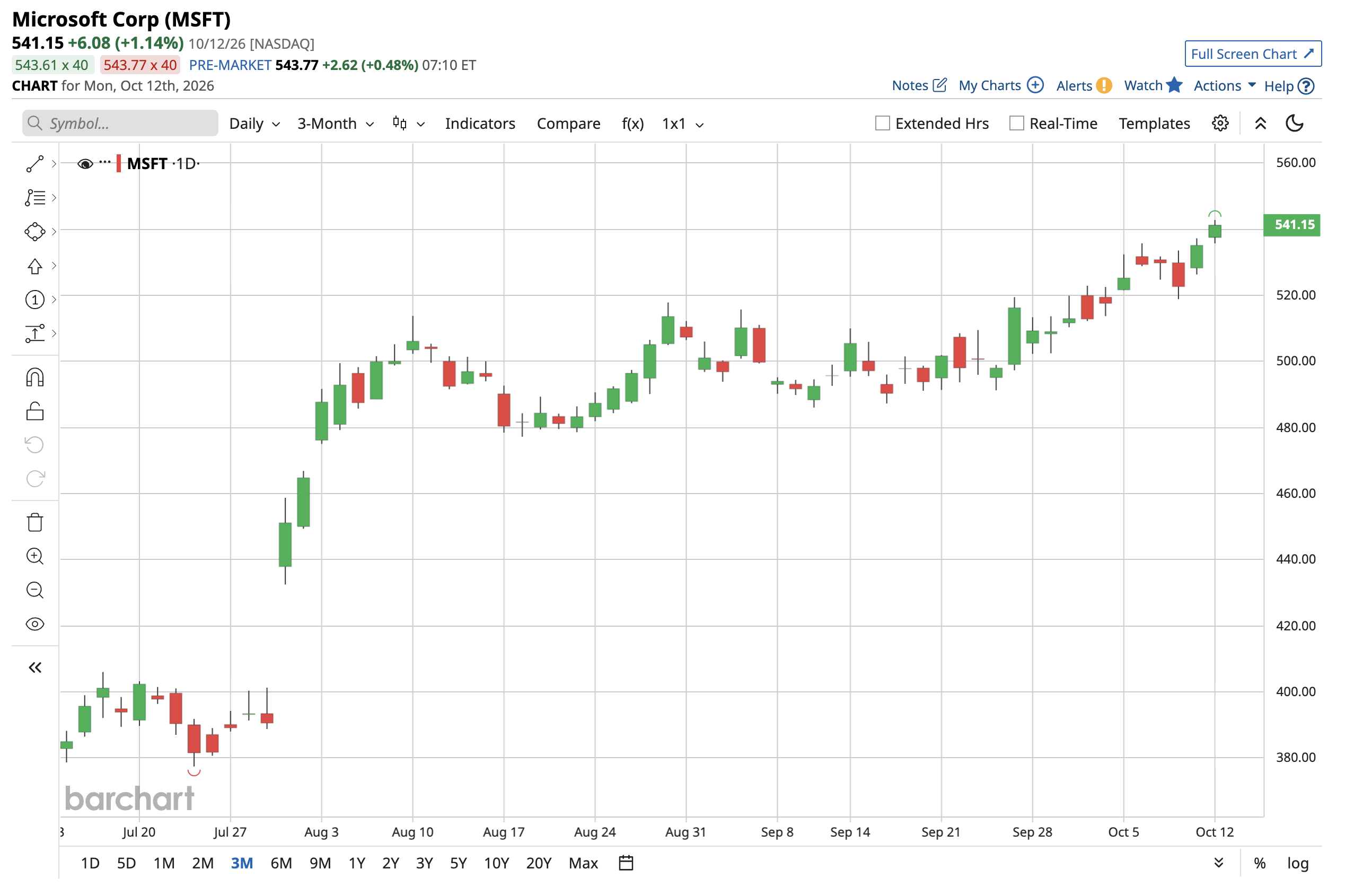
Microsoft trades slightly below its historical valuation, which stands out given where its growth is heading. The forward non-GAAP price-to-earnings (P/E) of 27.07x is about 11% under its 5-year average of 30.50x. That discount is unusual because analysts expect growth to speed up. EPS is forecast to rise about 14% this fiscal year, then roughly 20% to 22% over the following two. I think the discount mostly reflects worries about how much Microsoft is spending on AI. As I covered earlier, that includes massive projects like its Fairwater data center in Wisconsin. That’s where tools like Decision-1 come in. If cheaper AI models help those investments pay off sooner, Microsoft could return to its usual multiple and possibly earn a premium, given how fast its earnings are expected to grow.
Microsoft Guides for Strong Q1 Revenue
Microsoft Corp reported its fourth-quarter fiscal 2026 earnings on July 29. It reported revenue of $90.01 billion, up 18% year-over-year (YoY). The earnings per share came in at $4.74, comfortably beating the Wall Street consensus of $4.24. The company said fiscal 2026 was its strongest year yet. The company’s cloud business remained the main growth engine. Microsoft Cloud revenue exceeded $214 billion for the year, up 27%, while Azure passed $100 billion in annual revenue. Gross margin for the quarter was down 67% YoY because of a mix shift and AI infrastructure spending. However, the operating margin was 45%, slightly higher than a year earlier. The results indicated that Microsoft is still growing rapidly even at its large scale.
Looking forward, CFO Amy Hood guided Q1 fiscal 2027 total revenue to be between $89.85 billion and $90.95 billion. The company expects Azure growth to remain strong, with revenue in Intelligent Cloud projected at $40.95 billion to $41.25 billion for the quarter. For Productivity and Business Processes, the company guided revenue of $36.7 billion to $37 billion. Moreover, capital spending is likely to remain high, with first-quarter spending above $50 billion, including lease reclassification effects.
What Do Analysts Expect for MSFT Stock?
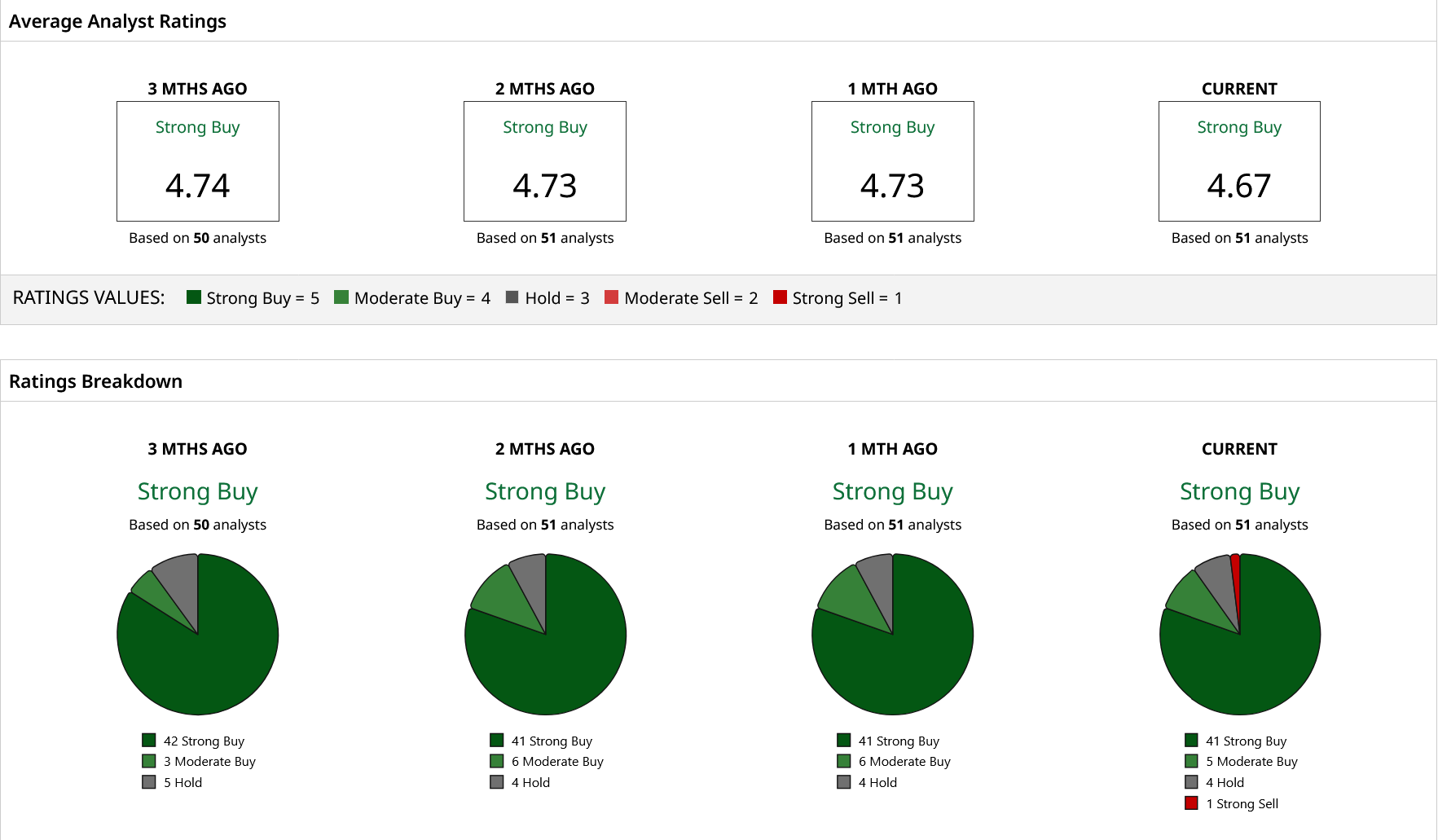
Barclays analyst Raimo Lenschow maintained a “Buy” rating on MSFT and set a price target of $600. Similarly, Deutsche Bank analyst Brad Zelnick reiterated a “Buy” rating while raising the firm’s price target from $550 to $600. In contrast to these two, Phillip Securities downgraded MSFT to a “Hold” rating with a price target of $515.
Based on 51 Wall Street analysts covering the stock, MSFT holds a consensus “Strong Buy” rating. However, its mean price target of $579.78 suggests just 6% upside from current levels, indicating limited near-term gains at the average estimate. The high price target of $725 implies 33% upside, showing that some analysts see considerably greater potential.
On the date of publication, Jabran Kundi did not have (either directly or indirectly) positions in any of the securities mentioned in this article. All information and data in this article is solely for informational purposes. For more information please view the Barchart Disclosure Policy here.