
BYD Stock Will Benefit From Exports and Its Focus on Innovation-Driven Growth
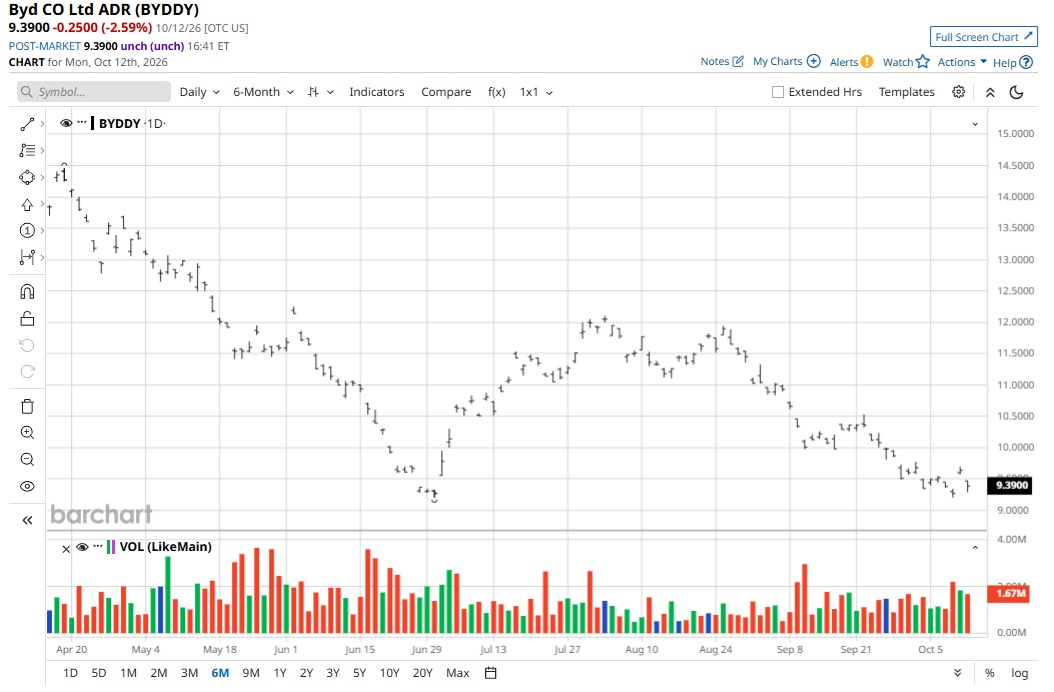
BYD Company (BYDDY), which is the world’s largest electric vehicle company by sales volume, has witnessed a subdued period in terms of stock price-action. In the past 52 weeks, BYDDY stock has declined by 31%.
The correction has been a combination of multiple factors that include global macroeconomic headwinds, supply-chain challenges, intense competition translating into a price war, and sluggish domestic (China) sales.
However, BYD, similar to Tesla (TSLA), is an innovation-driven company. Once temporary headwinds wane, it’s likely that BYD will make a strong comeback. Michael Burry, famed for predicting the 2008 housing-market crash, added shares of BYD to his portfolio.
Burry had earlier opined that BYD has a “cost advantage from controlling more of its supply chain.” This provides an edge in a competitive market. At the same time, Burry believes that the company is “exceptionally well-run and technologically advanced.”
This view of Burry is underscored by the fact that BYD already has a presence in 121 countries. While China sales have been sluggish, BYD’s international sales increased by 67.8% in the first half of 2026. The acceptability in global markets has significantly enhanced the company’s addressable market with Europe, Latin America, and Southeast Asia serving as sustained growth catalysts.
About BYD Stock
Headquartered in Shenzhen, China, BYD Company is involved in the development and production of new energy vehicles (NEV) and related electronics, as well as rechargeable batteries and photovoltaics. And, just like Tesla, robotics.
In the NEV business, BYD commands a leadership position globally with product innovation and competitive pricing being key growth factors. The company is also one of the leading rechargeable battery manufacturers in the world. The business covers areas such as consumer batteries, power batteries, and energy storage batteries. The company’s other business interests include electronics and urban rail transport business.
However, the electric vehicle segment remains the key business growth driver. For the first half of 2026, the automotive segment accounted for 79.85% of the total revenue. Further, the electronics segment contributed to 20.13% of the total revenue.
For the first half of 2026, BYD reported RMB 28.9 billion in R&D investment. Further, the company’s cumulative R&D investment has exceeded RMB 270 billion. As a technology-driven company, BYD seems well positioned for value creation.
However, with macroeconomic headwinds and intense competition impacting growth, BYDDY stock has declined by 34% in the past six months. This seems like a good opportunity to accumulate, considering a forward price-earnings ratio of 14.39 and a price-earnings-to-growth ratio of 0.8.
Exports to Remain Key Growth Driver
For the first half of 2026, BYD reported an export volume of 792,000 units, which was higher by 67.8% on a year-on-year (YoY) basis. Global sales have continued to increase for the fifth straight month in September. It’s also worth noting that BYD expects overseas shipments to exceed 2.5 million units in 2027. Therefore, the weakness in domestic sales is being offset by robust growth in exports.
Another point to note is that for the first half of 2026, the company’s gross profit declined marginally by 2.81% on a YoY basis. However, gross profit margin increased by 84 basis points to 18.85%. Margin expansion was on the back of growth in exports. With BYD having multiple premium models, it’s likely that margin will be supported even with intense competition.
What Do Analysts Say About BYDDY Stock?
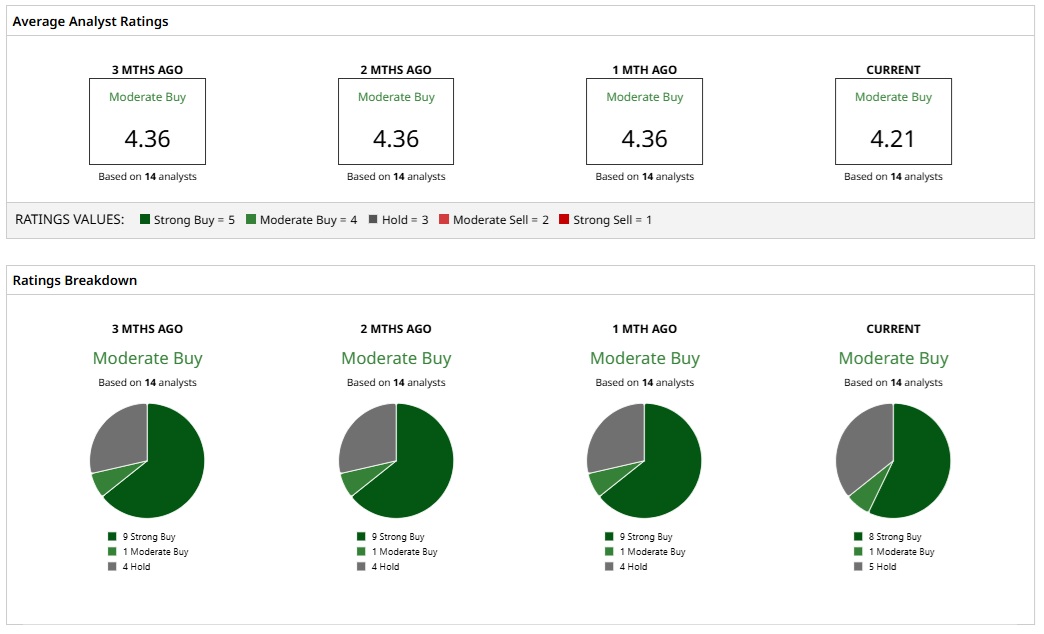
Considering the valuation, focus on innovation, and strong global presence, the outlook for BYD is positive. Based on 14 analysts with coverage, BYDDY stock has a consensus “Moderate Buy” rating. While eight analysts have a “Strong Buy” rating for the stock, one has a “Moderate Buy,” and five have a “Hold” rating.
The mean price target of $18 represents a potential upside of 92% from current levels. Further, the most bullish price target of $20 suggests that BYDDY stock could climb as much as 113% from here.
On the date of publication, Faisal Humayun Khan did not have (either directly or indirectly) positions in any of the securities mentioned in this article. All information and data in this article is solely for informational purposes. For more information please view the Barchart Disclosure Policy here.