
The Federal Reserve is sounding the alarm for interest rate hikes again! The heavy pressure of energy inflation and the AI infrastructure investment frenzy are still high, and the “anchor of global asset pricing” still hangs high
The Zhitong Finance App learned that Boston Federal Reserve Chairman Susan Collins (Susan Collins), one of the Federal Reserve's FOMC voting committee in 2028, said late on Tuesday that she is inclined to support the Fed's further interest rate hikes during the year to prevent the heavy pressure on energy costs under geopolitical turbulence, and the wave of tariff policies and AI investment solidifying the inflation trend. Her latest views and positions can be described as echoing the overall monetary policy positions of the Federal Reserve's “No. 3 person” Williams and Cleveland Federal Reserve Chairman Hammark, a member of the 2026 Federal Reserve FOMC voting committee, that is, it may be appropriate for the Federal Reserve to add one more time during the year.
Susan Collins said that to help curb inflation, interest rates may need to be raised further before the end of this year. “I also currently anticipate that it would be appropriate to raise interest rates moderately further before the end of the year to ensure a timely and consistent return to the Federal Reserve's FOMC Monetary Policy Committee target of 2%,” Collins said in a speech prepared for a banking conference hosted by the Boston Federal Reserve this week.
Collins warned that her judgment on whether interest rate adjustments need to be further accelerated and the exact timing will depend on a series of subsequent economic data including CPI and PCE inflation.
According to the minutes of the Federal Reserve's September monetary policy meeting, the Federal Open Market Committee (the Federal Open Market Committee (FOMC)) announced an interest rate hike of 25 basis points in September, which was supported by all 19 policy makers. Chairman Kevin Walsh described the move as removing a “dose of easing factor” from the economy.
Forecasts released after last month's meeting showed that the median forecast of 18 Federal Reserve officials indicated that interest rates might be raised again this year; Walsh once said he would not submit his predictions. Recently, a number of Federal Reserve officials said that the September rate hike will allow the central bank to calmly observe before tightening monetary policy again. Federal Reserve policy makers will meet again in Washington from October 27th to 28th local time.
Collins said she expects the economy to continue to grow and the labor market to remain close to full employment.
“Under this scenario, continued efficiency improvements will support the balance between supply and demand, and help cool down inflation so that inflation gradually returns to 2%,” she said in her speech.
However, she cautioned that the other two scenarios are almost as likely to occur as this one. Demand brought about by artificial intelligence may trigger an extraordinary investment boom, which in turn will further boost household spending, cause the labor market to overheat, and keep inflation above the Federal Reserve's target.
Furthermore, she said that price pressure brought about by tariffs and energy, especially as the war in Iran continues, may prolong the inflation problem.
“It is important to monitor whether high inflation is still mainly limited to categories related to energy and AI computing power infrastructure construction, while price increases in other sectors continue to slow down, or whether price pressure is showing signs of spreading,” Collins said.
The Boston Federal Reserve Chairman said that the current strong economy does not mean that the economy is overheating.
“On the contrary, I think the strength of actual economic activity reflects both strong demand and the increase in economic productivity brought about by increased efficiency,” she stressed.
Collins added that the US non-farm payroll labor market is still very stable, and productivity growth is increasing, enabling the economy to continue growing while maintaining a balance between supply and demand.
High oil prices have not abated, and hawkish expectations that the Federal Reserve will continue to raise interest rates during the year are difficult to overcome
On October 13, the latest pricing trends among interest rate futures traders showed that the probability that the interest rate futures market would raise interest rates in October and December was 19% and 88%, respectively. The futures prices of Brent crude oil and WTI crude oil closed at 105.69 and 94.14 US dollars/barrel respectively, which meant a sharp increase of 46% and 42%, respectively, from before the US-Iran war at the end of February. The 10-year and 30-year US Treasury yields were 5.21% and 5.56% respectively, surging 46 and 31 basis points at the end of August, and fell 3 or 4 basis points on the same day — highlighting that the 10-year US Treasury yield, which had previously risen sharply and had the title of the “anchor of global asset pricing,” is still high, and is still near the highest point in more than 20 years.
Furthermore, the latest diplomatic game at the global geopolitical level has yet to be translated into energy supply security. The US and Iran continue to grapple over plans to further open up the Strait of Hormuz. The exchange of fire between Saudi Arabia and the Houthis escalated, and on the evening of the 13th, it was reported that an outbreak broke out near the headquarters of Saudi Aramco, one of the world's largest oil and gas giants; although Zelensky proposed talks with the US envoy, his position on the “Russian-Ukrainian energy cease-fire” still presupposes Russia's compliance; Trump accuses the Houthis of trying to push up international oil prices, and said he might ask Turkey to join the fight against the Houthis.
The diesel cracking price gap is also still significantly high, highlighting that the global supply pressure on refined oil products is still very high. This is also the type of refined oil product with the worst global energy inflation: data disclosed by European financial giant ING showed that ICE diesel cracking price difference was about 73 US dollars/barrel on October 7. Although it is lower than the historical high of 90 US dollars or more in September, it is still the highest point in decades.
On the 13th, US diesel futures rose by about 5%, and the pressure transmitted from logistics costs to commodity prices has not been relieved, showing that new supply expectations are not enough to dispel market shortages; and the pressure has also spread to the terminal: Wood Mackens quoted AAA data on October 13 as saying that the retail price of US diesel was about 6.28 US dollars/gallon, up 71% year on year, clearly exceeding the increase of gasoline by about 41%.
The increase in crude oil supply did not immediately translate into sufficient diesel delivery capacity. The conflict between Russia, Ukraine and the Middle East has damaged refining and export links, and shipping costs have soared and hindered the distribution of raw materials across regions; US refineries are already operating at high loads, and space to further fill the global gap is limited. There is even a backlog of heavy crude oil in America, and refineries in Asia and Europe compete for misplaced suitable raw materials. Europe's release of strategic diesel stocks can ease recent tension, but it cannot replace the resumption of refinery production and the normalization of export channels. ING also pointed out that the long-term cracking price gap is still supported.
Although Federal Reserve officials disagree on the pace of interest rate hikes, financing cost indicators have already been tightened first
According to information, Collins's monetary policy stance is clearly biased towards the moderate hawks who rely on data — supporting the Federal Reserve's interest rate hike in September. This time, he continues to further tighten his proposition during the year, while acknowledging that higher productivity can support growth without necessarily causing overheating. She is not on the FOMC voting committee in 2026; the next rotating voting year for the Boston Federal Reserve is 2028.
At about the same time — the “top three” of the Federal Reserve — New York Federal Reserve Chairman Williams, still thought on the 13th that it might be appropriate to increase interest rates once more during the year, but he currently sees no need to continue raising interest rates in 2027. He is betting that underlying inflation will continue to cool down and be close to 2% next year: this provides a reference for the end point of interest rate hikes, and does not mean a shift to interest rate cuts.
Before and after Williams' speech, each Federal Reserve official spoke. Chicago Federal Reserve Chairman Goulsby also said on Tuesday that the AI boom has begun to push up prices, and inflation is still too high. “If inflation continues to be high, then I think it's very clear what the Federal Reserve needs to do.” Goulsby said; Richmond Federal Reserve Chairman Barkin said it was reasonable to take action to deal with continued inflation.
Federal Reserve Governor Waller, who has the right to vote on permanent monetary policy during his term of office, pointed out on the 13th that the rise in US bond yields of 10 years or more is suppressing sensitive interest rate demand for housing, automobiles, etc.; in combination with his position that “interest rates still need to be raised, but there is no need for continuous conference action” on the 8th, it can be seen that he himself is paying more attention to the austerity effects that the market has already achieved. In 2026, the Federal Reserve's FOMC voting committee Hamak advocated faster, smaller, and more frequent monetary policy adjustments to prevent the inflationary mentality from solidifying, but did not completely lock down the continuation of interest rate hikes in October.
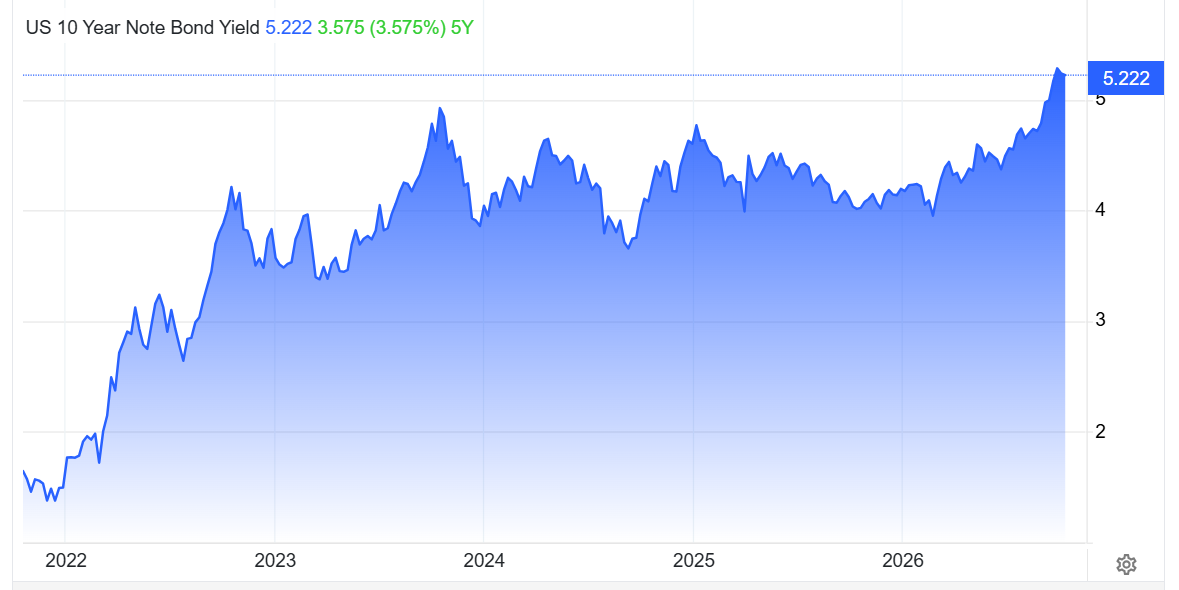
The 10-year US bond is known as the “anchor of global asset pricing” and a weather vane for global financing costs, stemming from its position as a benchmark in the dollar financing system and medium- to long-term cash flow valuation. The US Treasury bond market is large and active in trading, and the US dollar is widely used in international financing and reserves, so changes in yield have cross-market effects — US dollar corporate bonds usually refer to the yield of US bonds with similar maturity and compounded by credit spreads. Housing mortgage interest rates are affected by the pricing of treasury bonds and mortgage-backed securities, and stock and real estate valuations are highly sensitive to future cash flow discount rates. When this benchmark rises and profit and rent expectations do not improve at the same time, asset prices face downward pressure. The impact will also be transmitted overseas through US dollar financing costs, exchange rate hedging, and cross-border capital flows; different currencies, terms, and credit risks determine the extent to which specific assets are impacted.
From a theoretical perspective, the 10-year US Treasury yield is equivalent to the risk-free interest rate indicator r on the denominator side of the DCF valuation model, an important valuation model in the stock market. Other indicators (especially the molecular side's cash flow expectations) have not changed significantly — for example, during the earnings season, the molecular side is in a vacuum due to lack of active catalysts. At this time, if the denominator level is higher or continues to operate in historically extremely high regions above 5%, the valuations of risky assets such as technology stocks, high-yield corporate bonds, and cryptocurrencies that are closely related to AI are facing collapse.
According to some analysts, the energy inflationary pressure under the surge in prices of a series of refined oil products such as crude oil and diesel is the core driving force behind the surge in long-term US bond yields, but this sharp rise in US bond yields cannot be explained only by surging oil prices — since the end of August, the 10-year real yield has risen by 44 basis points, and even covered nominal increases at one point, indicating that long-term capital costs are undergoing a deeper revaluation — that is, AI construction first drives demand for financing, electricity and equipment, but at the same time, productivity dividends take time to be realized. More demanding Maturity risk compensation jointly raises long-term capital costs. This surge in US bond yields can be described as further spilling over to global equity bonds.
AI data center construction is rapidly driving demand for financing, electricity, and equipment, and productivity dividends sufficient to ease supply constraints will still take time to be realized; at the same time, large-scale financial financing and corporate capital expenditure compete for capital, and long-term bond investors are also demanding higher risk compensation, putting long-term interest rates under continuous pressure. As this “anchor of global asset pricing” moved upward, the impact spread from the US bond market to the global financing system: future profits of technology stocks will face higher discount rates, the opportunity cost of holding gold will increase, and data center projects that rely on long-term financing will also have to achieve higher and more stable cash returns to cover the rising cost of capital.